

Shoulder Length Hairstyles That Hide Thinning Temples

This is styling guidance. The medical sections link to the AAD and NHS, and anything new, spreading or painful belongs with a doctor rather than a stylist.
The temple is a small piece of scalp, roughly the width of two fingers, sitting between the outer corner of the eyebrow and the top of the ear. It is also the area where hair does the least work for you. Hair grows away from it in most directions, the skin there catches light easily and the surrounding skin is usually pale compared with the rest of the hairline. That combination is why a modest amount of thinning at the temples can look more obvious than a much larger loss further back.
The useful news is that this specific area responds well to structural choices. Coverage at the temples comes from three things: where the weight sits in your haircut, where your part begins and which direction your hair is dried. Length is the least important variable, which is why shoulder length works so well. It is long enough to carry weight and short enough to hold a direction.

First, work out what you are covering
Not all temple thinning behaves the same way, and the right haircut depends on which pattern you have.
Fine short hairs still growing. If the temple area is covered in soft, short, wispy hairs rather than bare skin, the density is reduced but the follicles are still producing. This responds best to weight and direction, because there is something to work with.
Smooth, shiny, bare skin. Where the skin looks polished and no short hairs are present, the follicles in that patch are no longer producing. Camouflage still works, but it has to come from hair grown elsewhere and moved across.
A band that runs from the temple around the front. If the recession forms a continuous strip along the front and sides of the hairline rather than sitting in two isolated patches, that is worth having looked at rather than styled around. The American Academy of Dermatology describes frontal fibrosing alopecia as a slowly developing band of hair loss along the front and sides of the hairline, often accompanied by thinning eyebrows, and notes that treatment tends to be more effective the earlier it starts.
Recession that follows a hairstyle. If the sparse area sits exactly where a ponytail, braid, weave or clip pulls, tension is the likely factor. The AAD lists broken hairs near the forehead, a receding hairline and pain or stinging from tight styles as early signs of traction alopecia, which can become permanent if the pulling continues.

Photograph the area in the same light every few weeks. That single habit tells you far more than a mirror check does, and it gives a doctor something concrete to look at.
What actually hides a temple
Most advice about thinning hair defaults to adding layers and texture. At the temples, that instruction is often backwards. Sparse areas are concealed by continuity, not by movement.
Three principles do the work.
Weight travelling across the zone. Hair that crosses the temple horizontally covers it. Hair that lifts away from it, springs upward or is cut short enough to sit above it does not. A front section that reaches at least the cheekbone gives you something to lay across the area.
A part that starts behind the thin patch. Wherever a part begins, scalp shows. If your part opens directly above a sparse temple, you have widened the gap. Moving the origin of the part back by even two centimetres often does more than a haircut.
Overlap rather than density. Two thin sections lying over each other read as one thicker section. This is why a soft swept front piece conceals better than a heavily thinned one, and why blunt edges tend to look denser than feathered ones.
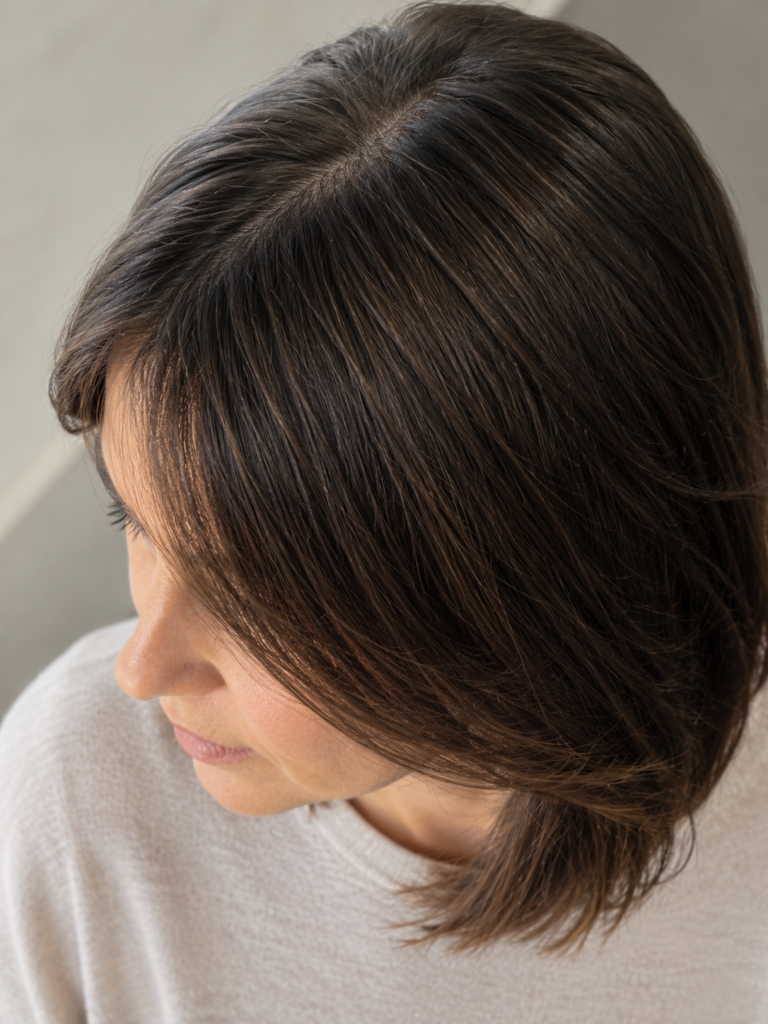
Shoulder length shapes that work
A collarbone cut with a solid perimeter
The most reliable shape is also the plainest: hair cut to just above or just at the collarbone, with the outline kept close to one length and layering restricted to a small number of long front sections. A defined perimeter gives the eye an edge to read as thickness, and the length is heavy enough to stay where you place it.
Ask for the shortest front piece to land at the cheekbone or lower. Anything shorter tends to sit above the temple instead of across it.
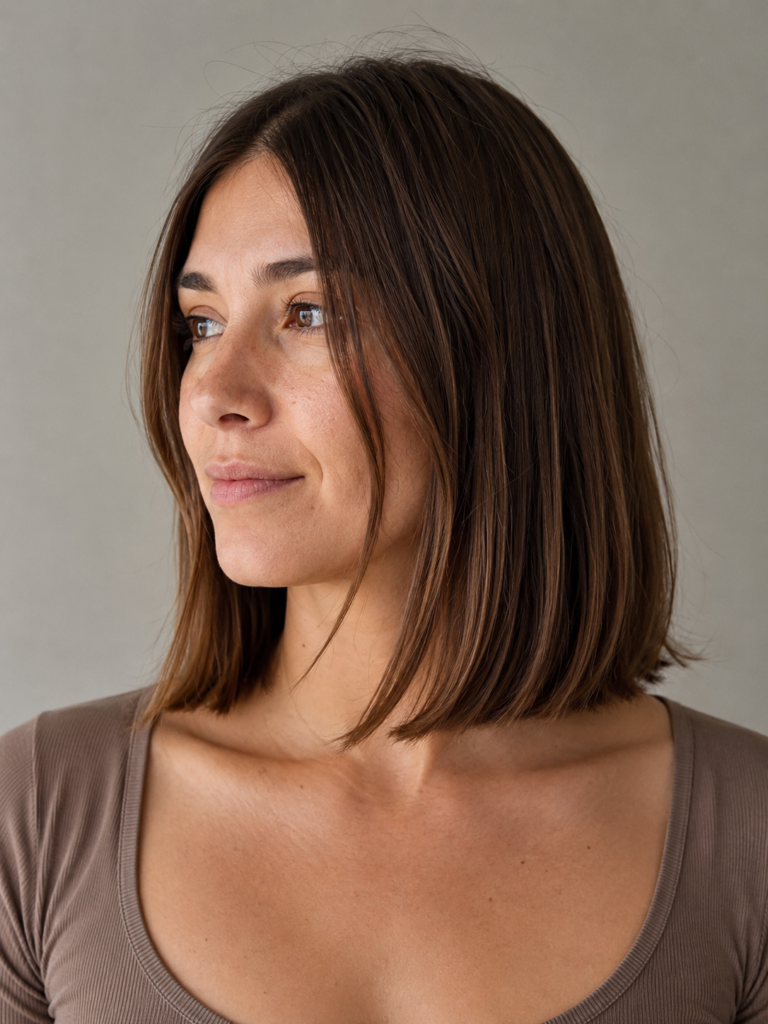
A soft curtain fringe that begins behind the recession
A curtain fringe is the most direct answer to a sparse temple, provided it is cut in the right place. The section should be taken from behind the thin area, not from the middle of it, so that the fringe covers the recession rather than exposing it.
Cut long, reaching the cheekbone at the outer edges, it drapes over both temples without looking like a deliberate cover up. It is also forgiving as it grows, which matters if you are not sure you want a fringe permanently. The same principles about where a front section should begin apply to other shoulder length shapes with face framing layers, though the starting point shifts backward when the goal is coverage rather than shape.

A deep side part with a swept front section
Moving the part off center pushes a wider band of hair across the opposite side of the forehead and temple. The trick is to open the part behind the thinnest point and to dry the hair in the opposite direction before setting it, so that the roots lift instead of lying flat against the scalp.
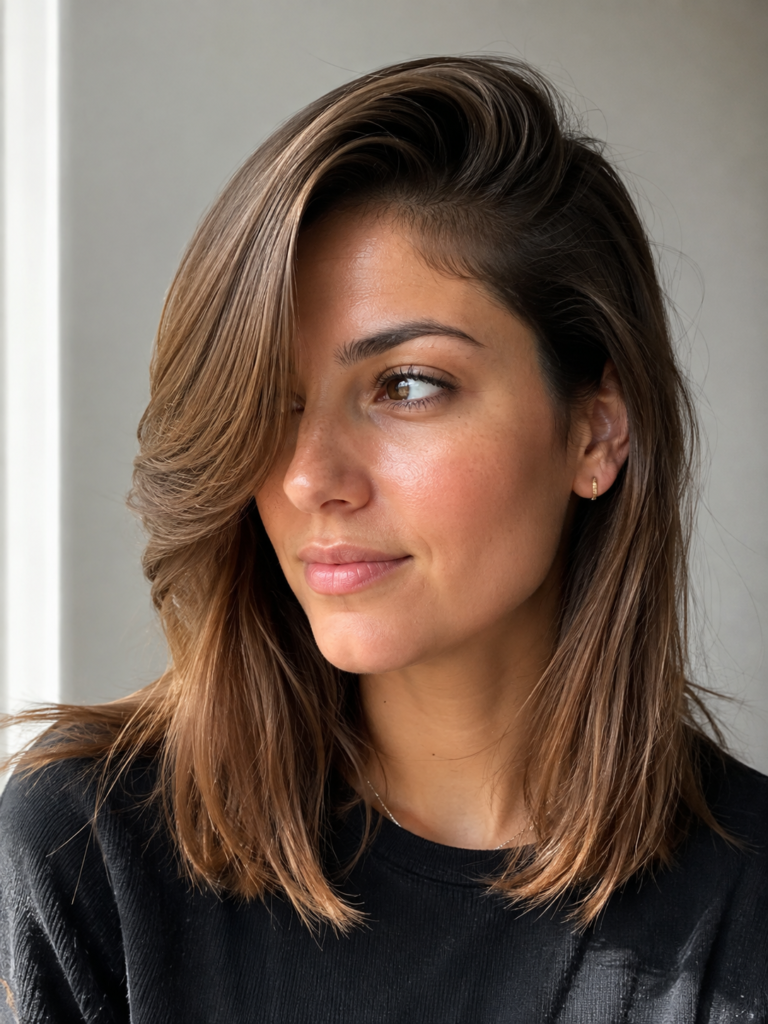
One caution: alternate which side you part on every few weeks. A permanently fixed part concentrates the same tension and the same sun exposure in the same place.
A blunt shoulder bob for low density hair
If your overall density is low as well as your temples, a shoulder skimming blunt bob usually outperforms anything layered. Concentrating the same amount of hair into a single strong line makes the whole head read as fuller, and the thicker front sections have enough substance to cover the hairline. The same logic sits behind the advice in our guide to cutting fine hair without hollowing out the perimeter, applied here at a longer length.

Shapes to approach carefully
Heavily textured shags, razored ends and short choppy face framing all create separation. Separation is exactly what you do not want next to a sparse patch, because gaps between pieces mirror the gap in the hairline. A slicked back style, a tight high ponytail and a hard center part all put the temple on display.

What to say at the salon
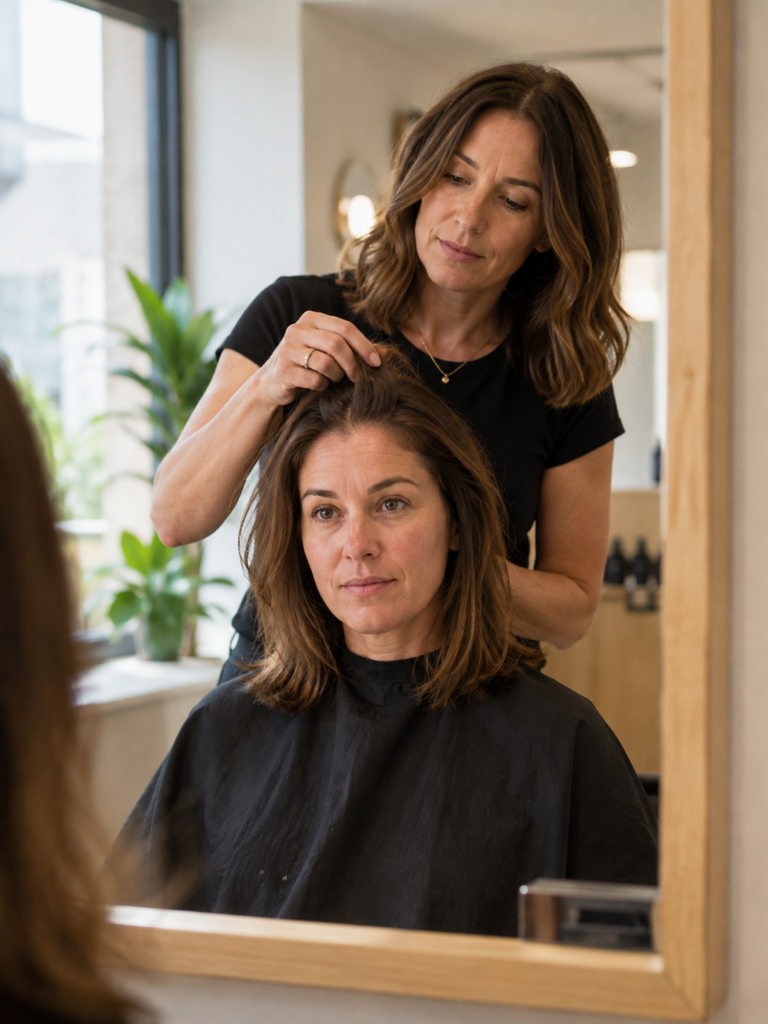
Stylists cannot see what you are worried about unless you show them. Say it in the first two minutes, dry, before anything is washed.
Point at the area with a finger and use plain language. Useful sentences:
- “My temples are thin here. I want the cut to cover this rather than draw attention to it.”
- “Please take my fringe section from behind this patch, not through it.”
- “Keep the perimeter fairly solid. No thinning shears near the ends or around the front.”
- “The shortest front piece should reach my cheekbone.”
- “Can you check where my part naturally falls and cut it so I can wear it slightly off center?”
Ask to see the shape dry before the final cut. Wet hair sits flatter and further back, which makes a temple look better covered in the chair than it will at home.
Styling that holds through the day
Dry the front against its growth direction first. Roots set in the first minute or two of drying while the hair is wettest. Lift the front section away from the scalp with your fingers, dry it backwards or across, then let it fall into place once cool. Hair that has been dried flat in the direction it will be worn has nothing holding it off the skin.
Keep conditioner, oil and cream away from the hairline. Weight is helpful in the length and harmful at the front. Anything that makes fine temple hair lie flat against the scalp makes the skin underneath more visible.
Use dry texture at the roots, not shine. A light dry texture spray or a matte root product applied to the front sections adds friction so the hair stays where it is placed. Shine products do the opposite, because a reflective surface highlights the contrast between hair and scalp.

Reduce the contrast, not just the gap. A sparse temple looks worse when dark hair sits next to pale skin. Tinted root powders and scalp concealers work by narrowing that contrast, and they are cosmetic rather than medical. Applied lightly with a small brush and pressed rather than swept, they are one of the few genuinely quick fixes.
Rethink the fastenings. Metal toothed clips, tight elastics and heavy clip in extensions all concentrate their pull at the front and sides. Fabric covered elastics worn low and loose, and switching your ponytail height and part from day to day, reduce repeated tension on the same follicles.
When color helps and when it does not
Color can improve how a temple reads, but the details matter. Foils placed right at the hairline lighten the very hairs that are already fine, which makes them harder to see against the scalp. Asking a colorist to keep lightening slightly back from the front hairline and to shadow the root area keeps the boundary between hair and skin softer.
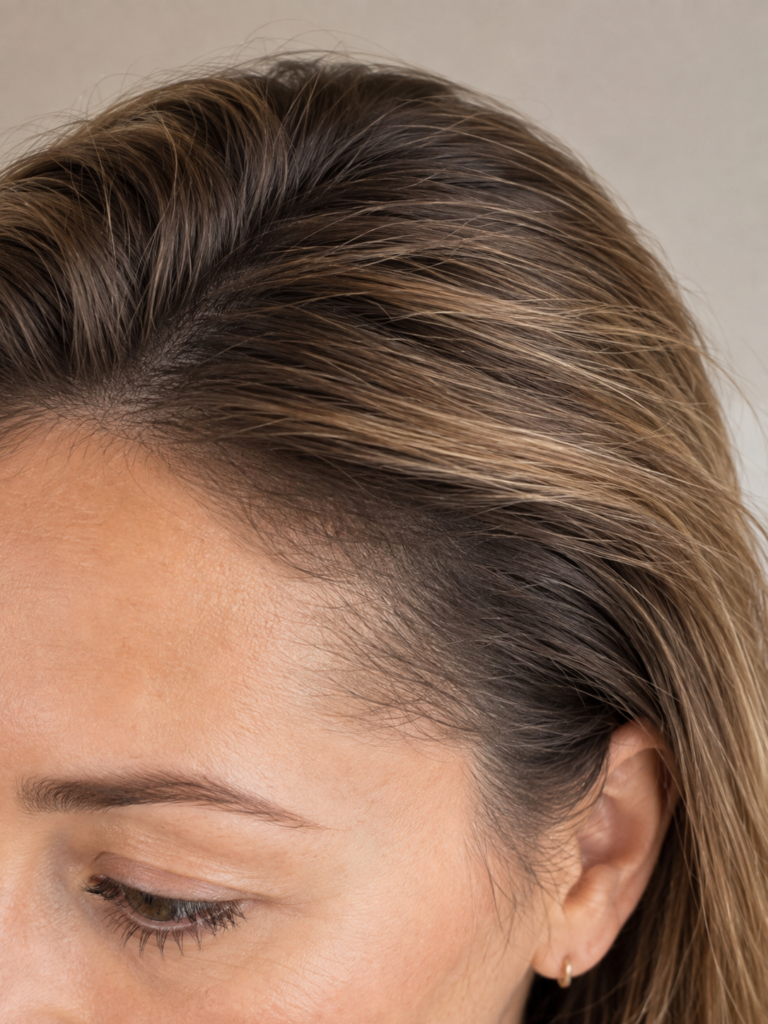
Going one or two shades lighter overall also reduces the contrast with the scalp. This is a genuinely small effect, but it is a real one, and it costs nothing extra at an appointment you were having anyway.
Bleaching directly at a fragile hairline, particularly on hair that is already breaking, is the version worth avoiding.
When styling is not the right answer
A haircut changes how density reads. It does not change density. That distinction is worth holding onto, because time matters with several causes of temple thinning.
Book an appointment with a doctor rather than a salon if the loss is sudden, if it is spreading, if the scalp there is itchy, sore, scaly or shiny, if you are losing eyebrow hair at the same time or if your hairstyle regularly causes pain. The NHS advises seeing a GP to establish what is causing hair loss before approaching a commercial hair clinic, and notes that shedding fifty to a hundred hairs a day is normal, that many causes are temporary and that no treatment works for everyone. A GP can check for reversible contributors such as iron levels or thyroid function and refer you onward if a specialist opinion is needed.

Two honest limitations are worth stating. Cosmetic camouflage does nothing for the underlying cause, and where follicles have already scarred over, no cut or product will bring hair back to that patch. Knowing which situation you are in changes what you should spend money on.
What a haircut can and cannot do
A well placed part, a front section cut to the right length and two minutes of directional drying will make most temple thinning considerably less noticeable in ordinary light. That is a real result, and for many people it is enough.
What it will not do is survive wind, a hair tie or a swim. If you want coverage that holds in all conditions, that usually means accepting a fringe as a permanent feature of the cut rather than an occasional style. Deciding which of those two you actually want, before you sit in the chair, is the single most useful thing you can do.
Frequently Asked Questions
Will bangs make my temples worse over time?
A fringe itself does not damage the hairline. Problems come from how it is created and worn. Taking the fringe section from within an already sparse patch removes coverage from where you need it, and clipping the rest of the hair back tightly every day adds tension at the same points. A fringe cut from behind the thin area and worn loose is not a risk factor.
Is shoulder length better than long hair for thinning temples?
Usually yes, though not because of the length itself. Longer hair carries more weight, which pulls front sections downward and away from the temple and encourages tight tying back on busy days. Shoulder length keeps enough weight to hold a direction while staying light enough to sit where you place it.
Can I still wear a ponytail?
Occasionally, worn low and loosely, with a soft fabric elastic. The problem is frequency and tightness rather than the style. Dermatologists treat pain, stinging or a pulled tight sensation as a signal that a style is too tight, and rotating between different styles gives the same follicles a break.
Do root concealers and hair fibres actually work?
For visual coverage, yes. They reduce the contrast between the scalp and the hair, which is what makes a sparse temple more noticeable. These are cosmetic products that wash out easily and do nothing to address the underlying cause of thinning. Results are also better when fine, short hairs are still present, as the fibres or powder need something to cling to.
How do I know whether to see a doctor or just change my haircut?
Change your haircut for gradual, stable, symmetrical thinning that has been the same for a long time. See a doctor for anything that is new, spreading, patchy, sore, itchy or accompanied by eyebrow loss, and for any thinning that follows the exact line of a hairstyle you wear often.