Bixie Haircut for Fine Hair: What to Ask For and How to Style It

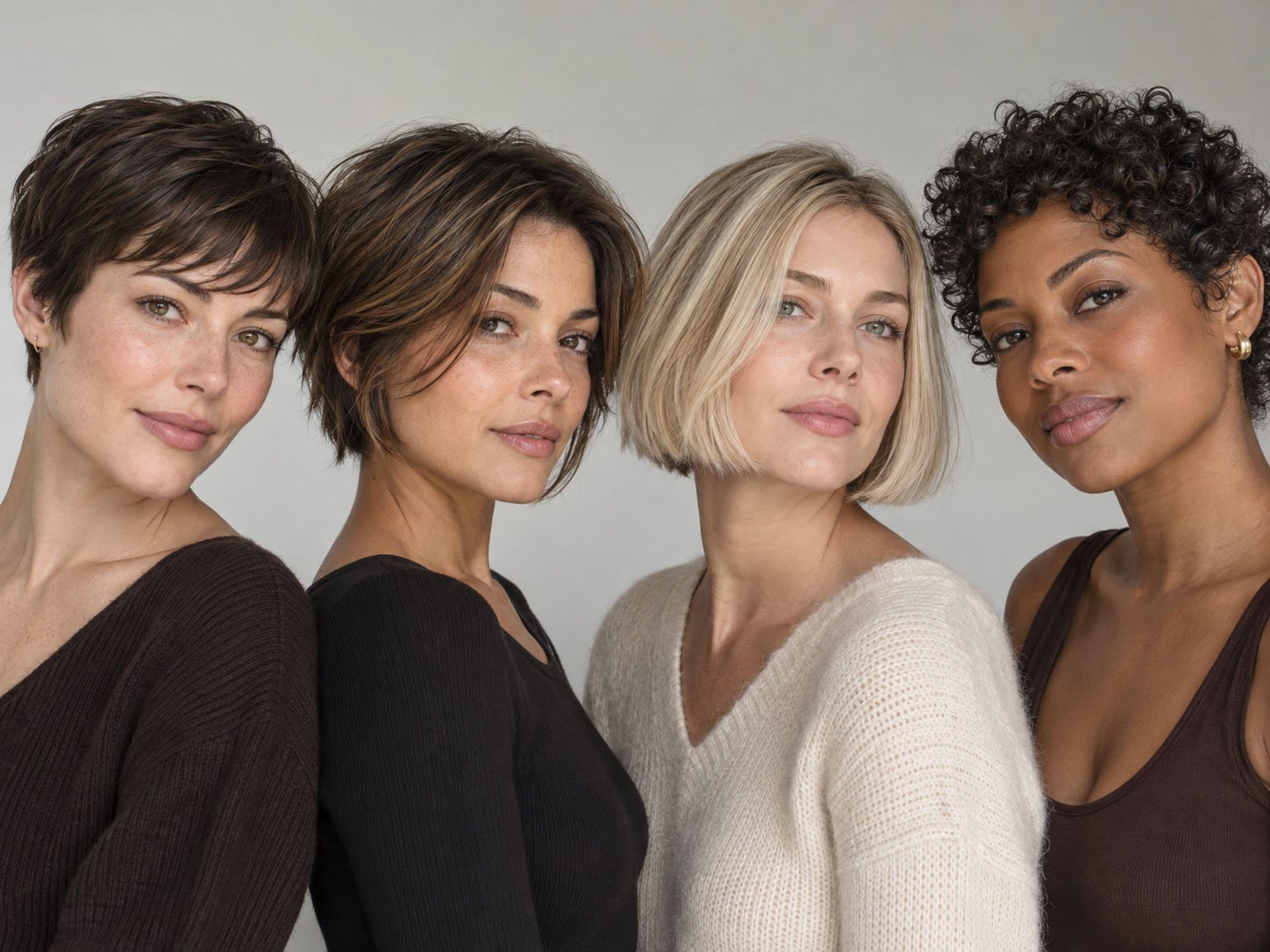
A bixie sits between a pixie and a bob cropped through the back and crown, longer through the front, layered rather than blunt. On fine hair, two people can ask for that same cut and walk out with completely different results. One gets a shape with real lift at the crown and a clean edge that reads thicker than her hair actually is. The other gets something soft and airy that goes flat by lunchtime.
The difference is almost never the length. It is where the weight was taken out.
What a bixie actually is
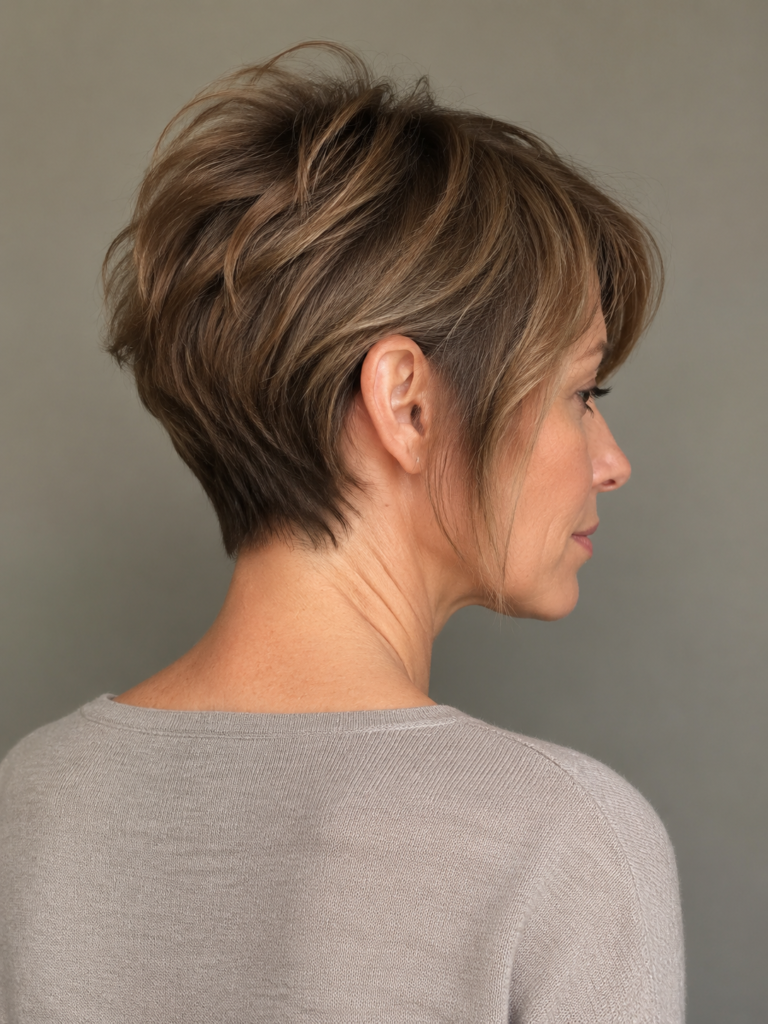
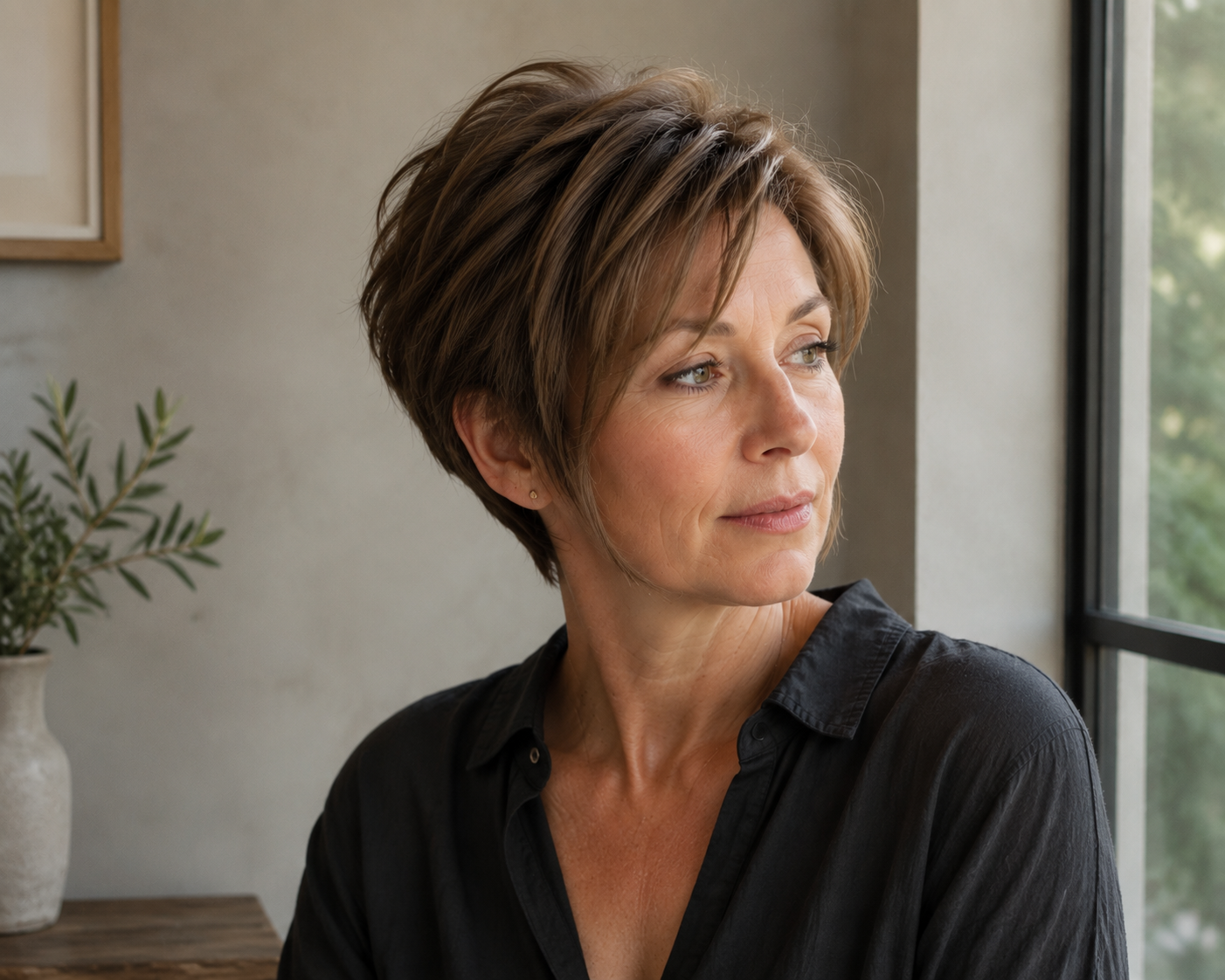
The name is a blend of bob and pixie, and the cut behaves like both. Length usually falls somewhere between the top of the ear and the jaw. The back and crown are cut short with internal layering, the sides sit closer to the head than a bob but longer than a classic pixie, and the front pieces are left long enough to frame the face.
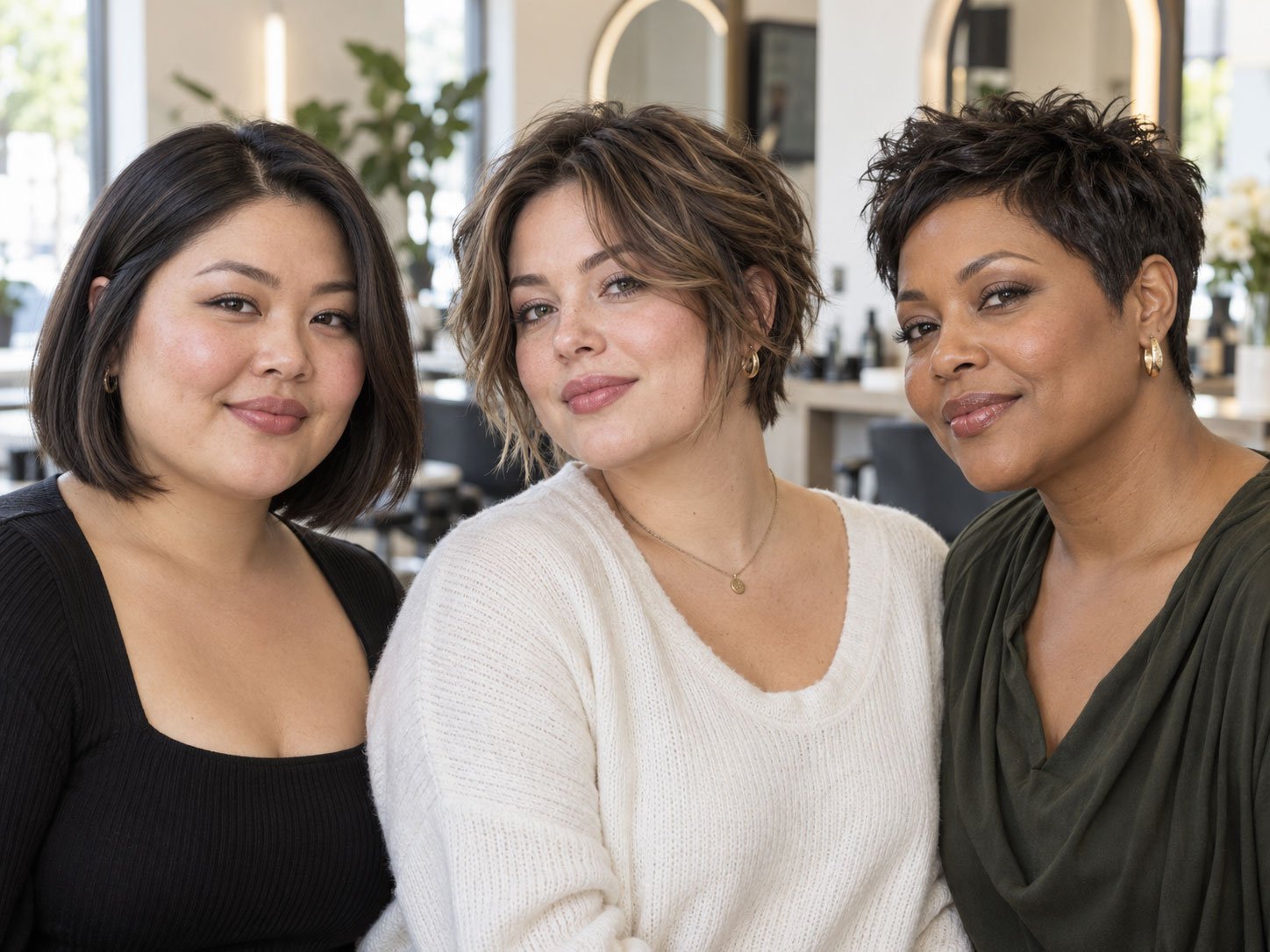
What matters for anyone with fine hair is that a bixie is not a fixed formula. It is a range of shapes sharing a family resemblance. Two stylists can both call their work a bixie while making opposite decisions about the perimeter, the crown, and how much internal weight to remove. That flexibility is why the cut suits so many people and why the outcome depends so heavily on what you ask for.
Why fine hair changes the brief
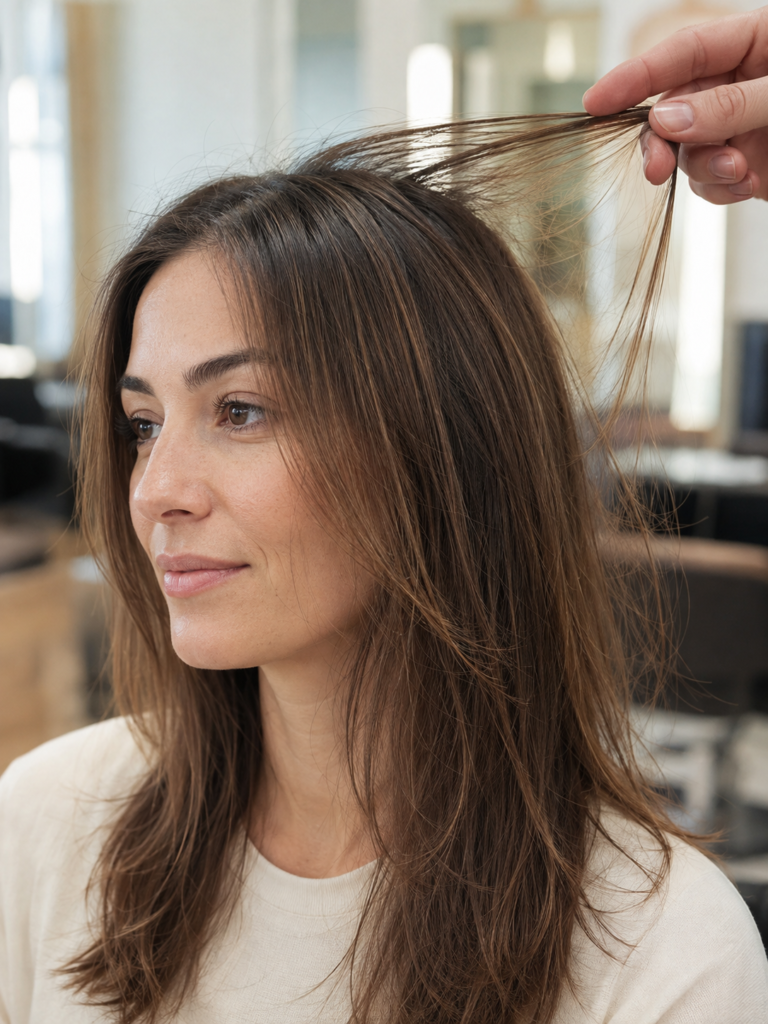
“Fine” and “thin” get used interchangeably in salons and they describe different things. Fine refers to the diameter of each individual strand. Thin more precisely, low density refers to how many strands are growing per square centimetre of scalp. You can have fine hair and a great deal of it. You can have coarse hair and very little.
The distinction is structural, not just descriptive. A hair shaft is built in layers: an outer cuticle, a cortex that makes up most of the fibre, and an innermost core called the medulla which, according to histology references, appears only in thicker hairs. Fine strands simply have less material inside them. They hold a shape less firmly, they collapse under the weight of length and product more readily, and they are quicker to look sparse when the ends are broken up.
It is worth ignoring the specific micron numbers you will see quoted for “fine” hair, because published cut-off points vary depending on the source and the measurement method. What is useful is the behavior: if your hair goes flat within hours, if elastics slip, if a full head of hair still looks small in a ponytail, you are working with fine strands regardless of how many of them you have.
Work out which version of the problem you have
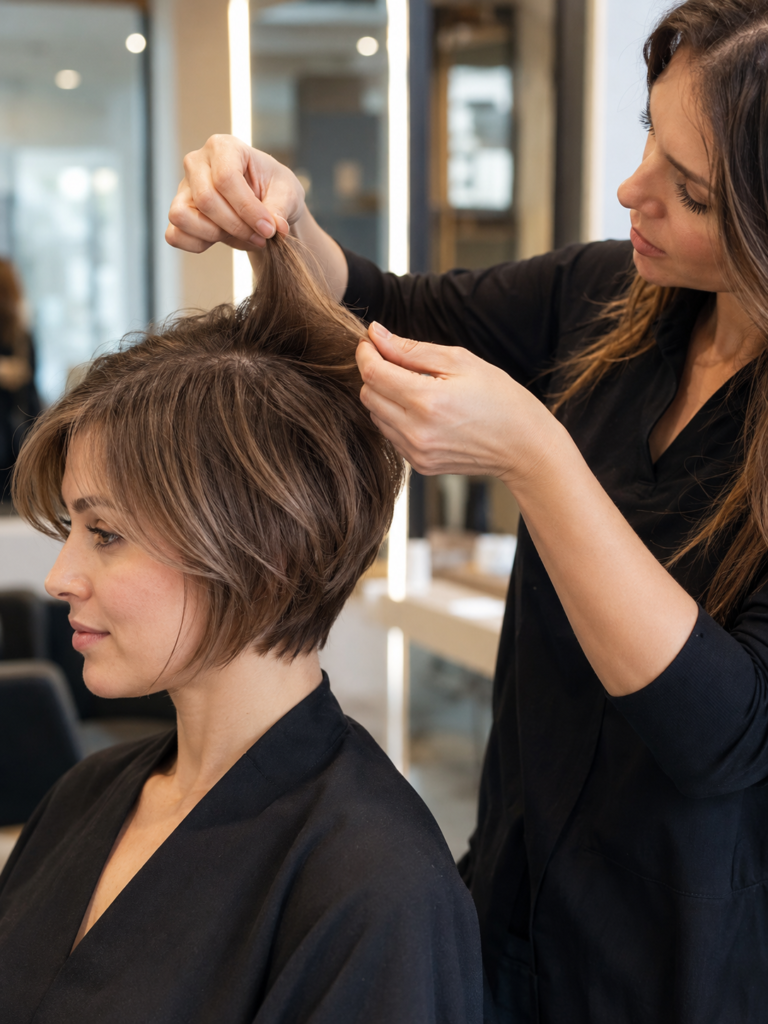
This is the step most people skip, and it determines everything that follows.
Fine strands, good density. Your hair looks reasonably full at the roots and your scalp is not visible under normal indoor light, but the hair itself is soft and refuses to hold volume. A bixie is an excellent fit. Your risk is bulk, not sparseness without internal weight removal, a short layered cut on dense fine hair puffs outward through the middle and takes on a triangular shape.
Fine strands, lower density. Your part looks wider than it used to, or you can see scalp at the crown in overhead light. A bixie can still work, but it needs to be cut conservatively: weight kept in the perimeter, texturizing limited and placed internally, nothing that thins the ends. Aggressive layering on hair that is both fine and sparse is the single most common way this cut goes wrong.
Rough at-home checks ponytail circumference, whether your scalp shows in bright overhead light, how quickly a blow-dry drops will get you close enough to have a useful conversation with a stylist. They are not diagnostic. If your density has changed noticeably, or if you are shedding more than usual, that is worth sorting out before you change your hair. Dermatologists recommend having thinning hair evaluated rather than managed cosmetically, because many causes respond better the earlier they are addressed. A haircut changes how density reads. It does not change density.
How the cut should be built
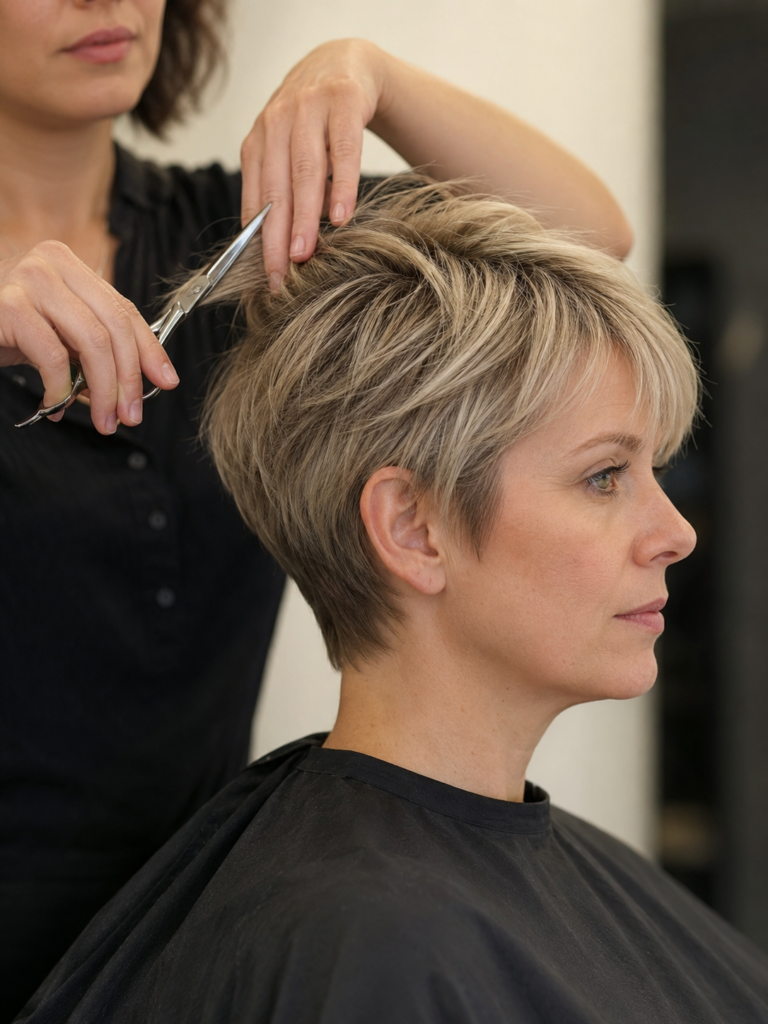
Volume on fine hair is an illusion produced by two things: weight concentrated where you want fullness, and roots directed away from the scalp. Layers help with the second and work against the first. The whole craft of cutting a bixie on fine hair is balancing those two forces.
The crown carries the shape. This is where short, stacked layers earn their place. Lift at the crown is what stops a short cut from reading as a helmet, and on fine hair it is also what creates the impression of density through the top of the head.
The perimeter should stay relatively solid. A soft, feathered, wispy edge at the nape and around the ears is the fastest way to make fine hair look like there is less of it. A defined line even a soft one gives the eye something to read as thickness. This is the same principle that makes blunt bobs so reliable on fine hair, applied to a shorter shape.
Texture belongs inside, not at the ends. Point cutting and internal notching through the crown remove bulk without hollowing out the outline. Heavy thinning shears used near the ends, or extensive razor work, tend to fray fine cuticles and leave the perimeter looking see-through. If your hair is fine and your density is average or below, it is reasonable to ask a stylist to skip thinning shears entirely.
Shorter at the back is usually better. Length at the nape adds weight that pulls the crown flat, which defeats the point of the cut. The workable rule is the shortest back you are comfortable with that still lets the crown stack above it.
What to say in the consultation
Vague requests produce vague cuts. Specific, technical language gets much better results, and no stylist minds a client who knows what she wants.
Useful things to say:
- “My strands are fine but I have a reasonable amount of hair” or the opposite, whichever applies. Say it early.
- “I’d like the weight removed internally through the crown, and the perimeter left fairly solid.”
- “Please don’t thin the ends.”
- “Can you check the length dry before you finish?” Fine hair looks longer and heavier wet, and shrinks less than curly hair, so wet-cut length is easy to misjudge.
- “I’ll spend about three minutes on this in the morning” or ten, if that is true. The right amount of layering depends on how much drying you will actually do.
Bring two photos: one you like and one you do not. The second is more informative than the first, because it shows where your tolerance ends.
It is also worth discussing where the length sits relative to your jaw. Short cuts change facial proportion as much as they change hair, and the same principles that govern short shapes for rounder faces and softer jawlines apply to a bixie front pieces that fall at or just past the chin lengthen, while a perimeter that stops at the widest point of the cheek can widen.
Styling it so it holds
Sequence matters more than product on fine hair.
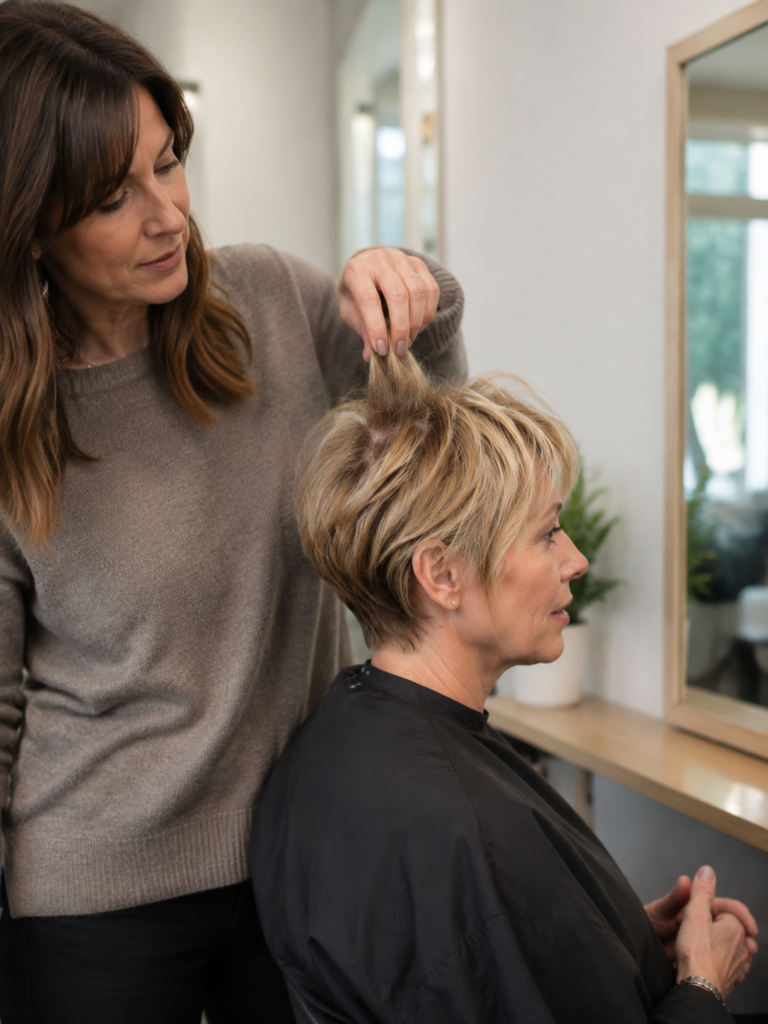
Work at the roots while the hair is still damp, not dry. A light mousse or root spray applied to the crown and lifted through with fingers does more than any amount of product added later. Keep it off the lengths anything heavy near the ends drags the whole shape down.
Dry the crown first, while that section is wettest, and dry it against the direction it naturally falls. The set happens in those first ninety seconds; everything after is refinement. Once the crown is dry and lifted, the rest of the cut can be smoothed in whatever direction you want it to sit.
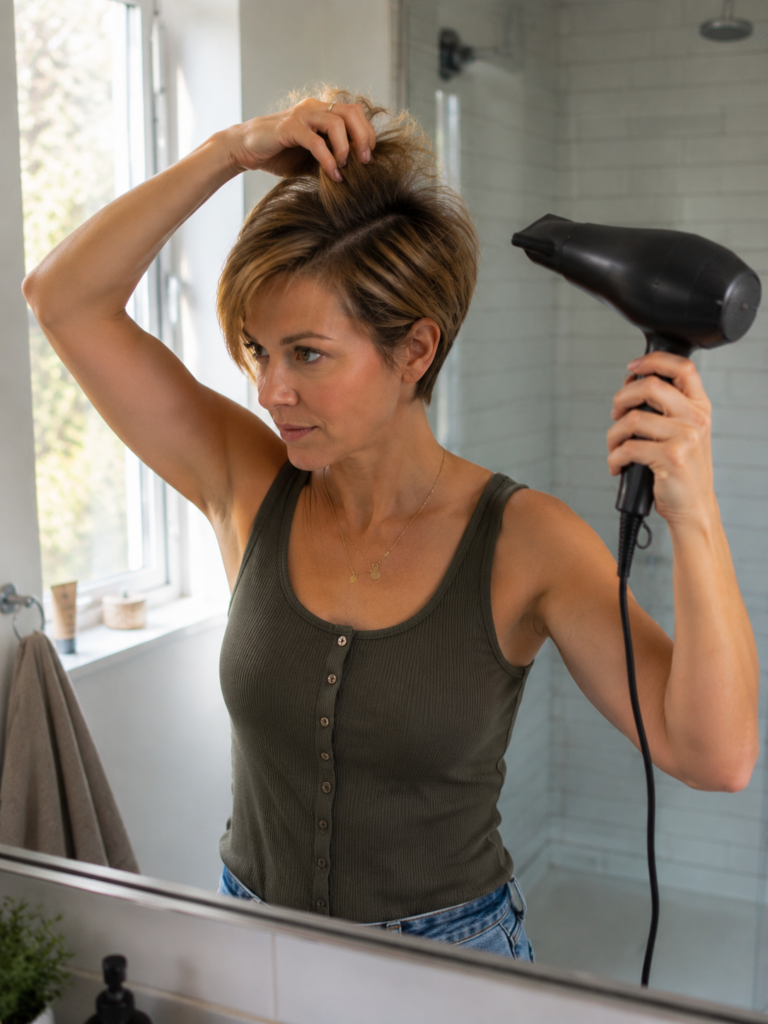
On heat: hold the dryer roughly fifteen centimetres away and keep it moving. A laboratory study published in Annals of Dermatology compared hair tresses dried under several conditions and found that the closer and hotter the dryer, the more cuticle damage occurred but also that drying at about fifteen centimetres with continuous movement compared favourably with letting hair dry on its own. That was a controlled test on hair samples rather than a study of real morning routines, and it is not a licence for daily high heat. The American Academy of Dermatology still advises limiting heat styling, using low or medium settings, and applying a heat protectant. Distance and motion are what make blow-drying survivable, not the dryer itself.
Two more things that matter disproportionately on fine hair. First, conditioner belongs on the ends only the AAD guidance above makes this distinction explicitly for fine and straight hair, and it is the difference between a bixie that lifts and one that lies down. Second, choose dry texture over creams and oils. A light dry texture spray at the roots on day two, applied before the hair actually looks flat rather than after, will extend a good blow-dry considerably.
What happens as it grows out
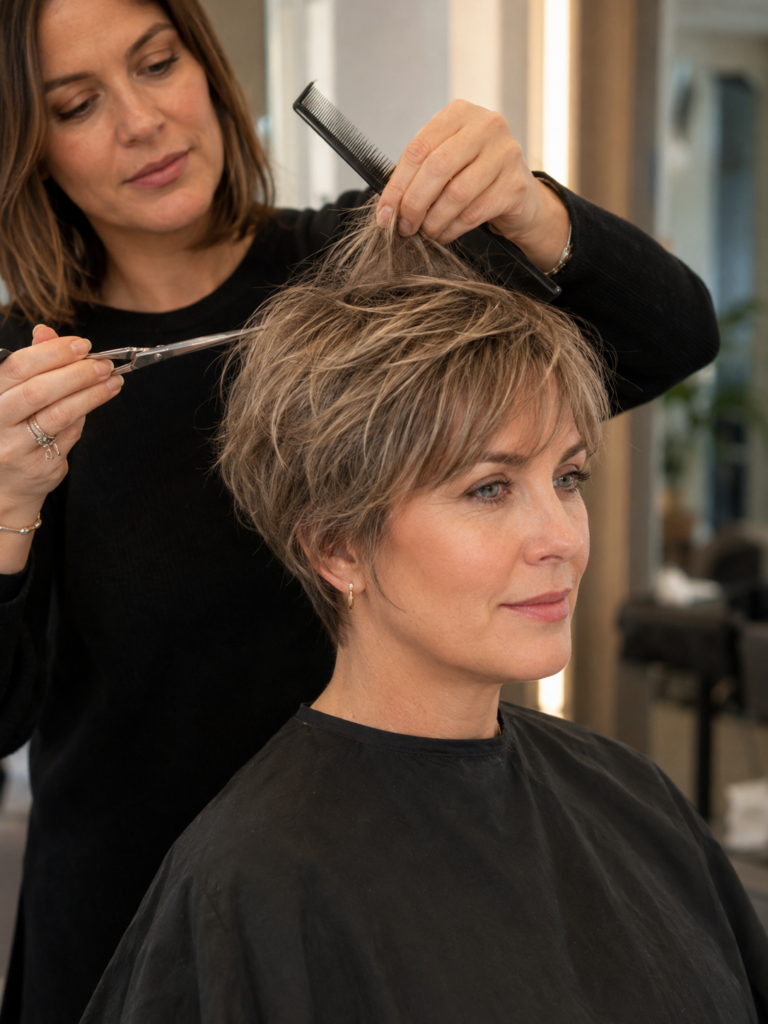
Fine hair grows out of a bixie in a predictable and slightly annoying way. The crown loses its lift first, because the layers there are shortest and any added length immediately weighs them down. Meanwhile the sides gain weight and start to sit outward. The combination flattens the top and widens the middle, which is how a good bixie turns into a mushroom shape somewhere around week seven.
The practical response is to trim the interior on schedule even when you are trying to grow the length out. Refreshing the crown layers while letting the perimeter run keeps the shape wearable through the transition. Most people find they need attention somewhere in the five-to-eight week range, sitting at the shorter end if the crown is doing most of the work.
When to choose something else
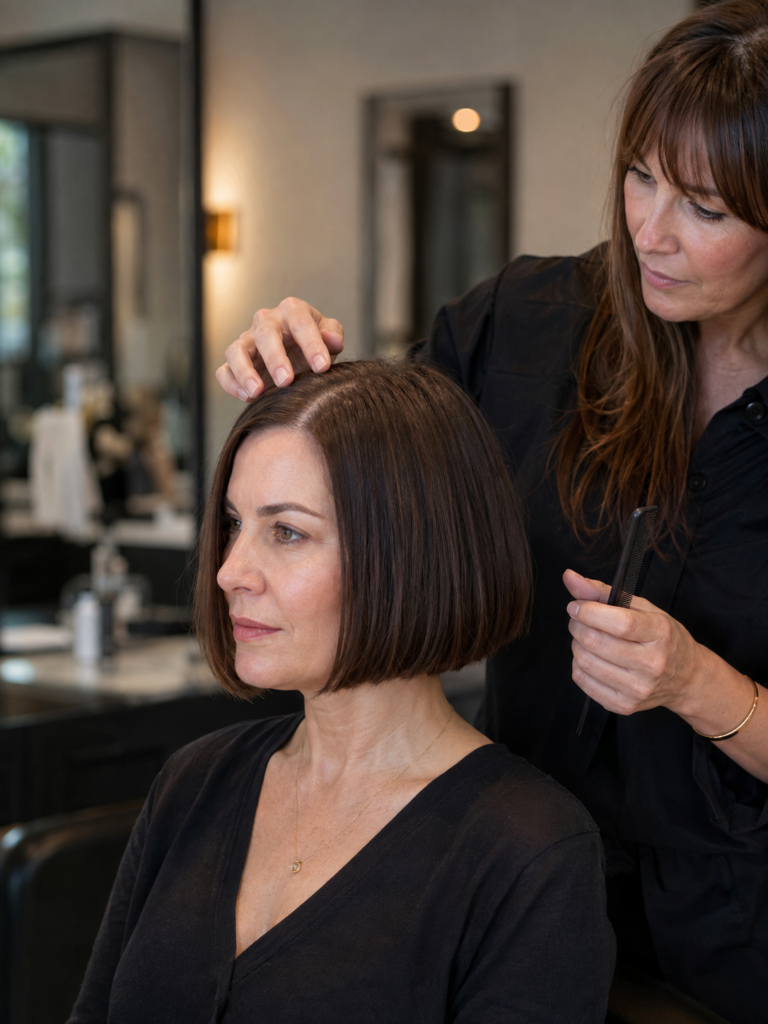
A bixie is not automatically the right answer for fine hair, and it is worth being honest about the cases where it is not.
If your scalp is clearly visible along your part or at the crown under normal indoor light, a cropped, layered crown can draw attention to exactly that area. A one-length short bob concentrates every remaining strand into a single edge, and that concentration is usually what makes fine, low-density hair read as fuller. Several of the shapes in this roundup of short cuts that stylists are being asked for most do that job better than a bixie will.
If you are in the middle of noticeable shedding, postpone. Cutting during a period of active change means committing to a shape based on density that may look different in three months.
And if the answer to “how long will you spend on this?” is genuinely zero, choose something blunter. A bixie’s crown lift is not optional it is the cut. Without those few minutes of root drying, the shape does not appear.
What to realistically expect
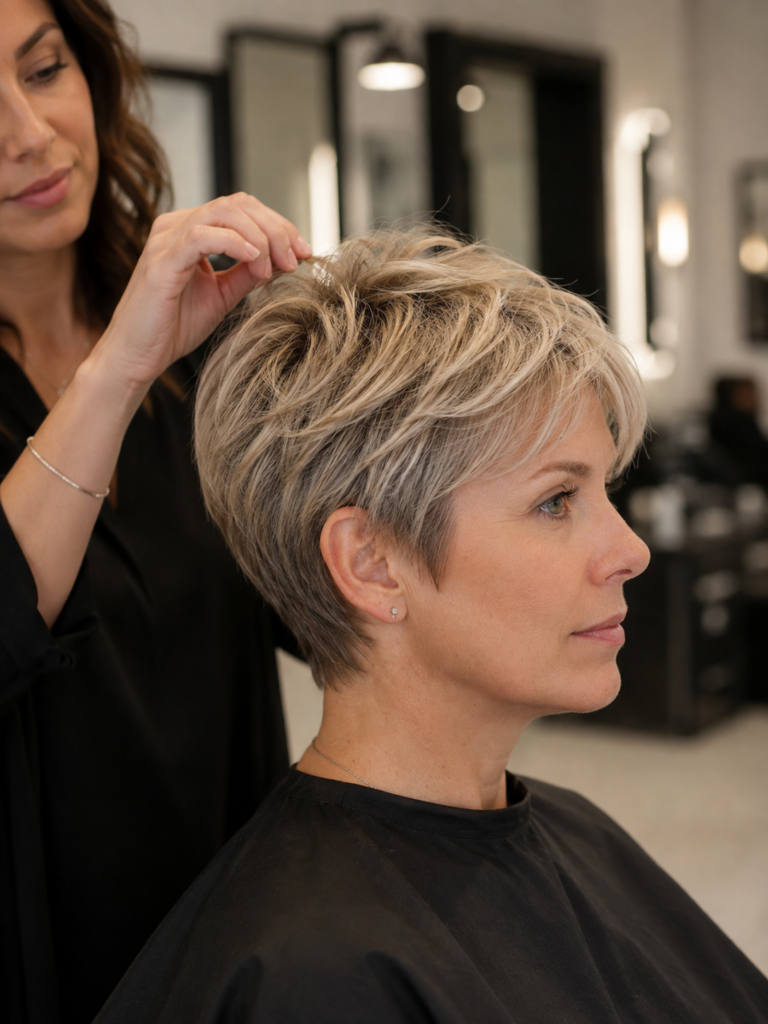
A well-cut bixie can make fine hair look meaningfully fuller. It does this by concentrating weight into a shorter perimeter, lifting the crown away from the scalp, and giving the eye a defined outline instead of tapering ends. What it cannot do is add hair, and no cut can.
The gap between a bixie that transforms fine hair and one that disappoints almost always traces back to a single decision made in the chair: where the weight came out. Go in able to describe that, and the odds shift considerably in your favour.
Frequently Asked Questions
Does a bixie actually make fine hair look thicker, or is that just marketing?
It genuinely can, but through appearance rather than substance. Removing length concentrates the same amount of hair into a smaller area, and lifting the crown creates space between the hair and the scalp that reads as density. The effect is real and visible. It is also entirely dependent on the perimeter staying reasonably solid a heavily texturized bixie on fine hair usually looks thinner than the length it replaced.
Should I refuse thinning shears completely if my hair is fine?
Not necessarily. If your hair is fine but dense, some internal thinning through the crown prevents the cut from puffing outward. The thing worth refusing is thinning near the ends and around the outline, which is what hollows out the perimeter. Saying “internal weight removal is fine, please keep the ends solid” is more useful than a blanket no.
How is a bixie different from a layered pixie for someone with fine hair?
Mostly in how much perimeter weight survives. A layered pixie is shorter throughout and relies almost entirely on crown height and texture. A bixie keeps enough length at the front and sides to retain a defined edge, which is generally the more forgiving option on fine hair there is simply more material left to read as thickness, and it grows out into a bob rather than into an awkward in-between length.
Can I get a bixie if my scalp shows a little at the crown?
Possibly, but ask your stylist to look at the crown specifically before deciding, and expect a more conservative version less elevation at the top, more weight retained through the sides. If the visibility is recent or increasing, it is worth having it assessed by a board-certified dermatologist before committing to a short cut, since options are broader when a cause is identified early.