Outdoor rug on grass, concrete or decking: what actually works

An outdoor rug is one of the cheapest ways to make a backyard seating area look finished. It’s also the piece most likely to leave a mark on whatever it sits on.
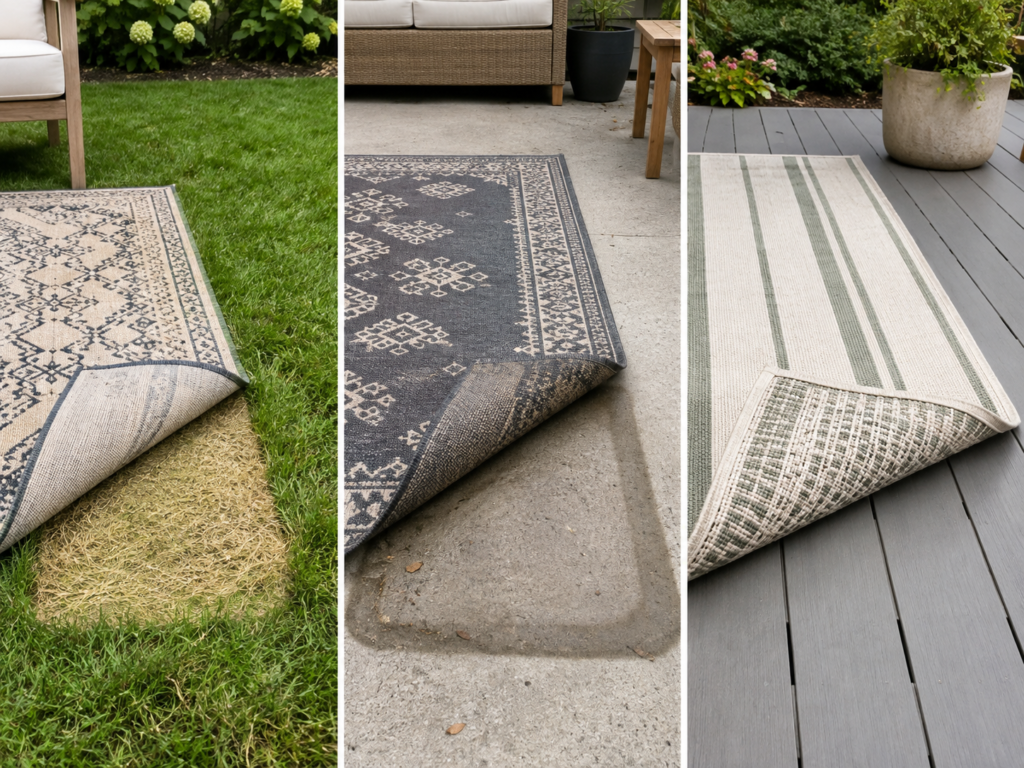
Here’s the short version. An outdoor rug on grass will kill the grass, usually within a few weeks of warm growing weather. On concrete, the rug itself is fine, but water trapped underneath leaves a damp outline and some dyes stain a porous slab. On wood or composite decking, the backing matters more than the rug, and the wrong one can lighten the boards in a way that doesn’t come out.
So the question worth asking isn’t which outdoor rug is best. It’s what’s underneath it, and how often you’re willing to pick it up.
Two questions to ask before you buy
Most rug advice only answers one: will this rug survive outside? That’s the easy half. Synthetic fibers, a flat weave and a bit of shade will get almost any rug through a season.
The half that costs money is the other direction. A rug blocks light, holds water and presses whatever it touches against the ground for weeks at a time. Grass, concrete, wood and composite each react differently to that, and the reaction is what people end up regretting.
Answer both questions for your surface and the rest of the choice gets simple.
Outdoor rug on grass: the lawn always loses
Grass needs light and air. Cover it with something solid and it stops photosynthesizing, which is exactly why covering turf is a standard way to remove a lawn on purpose. The University of Maryland Extension’s guide to lawn removal recommends smothering sunny areas with a reusable tarp or woven weed barrier and leaving the cover in place for two to three months until the turf dies.
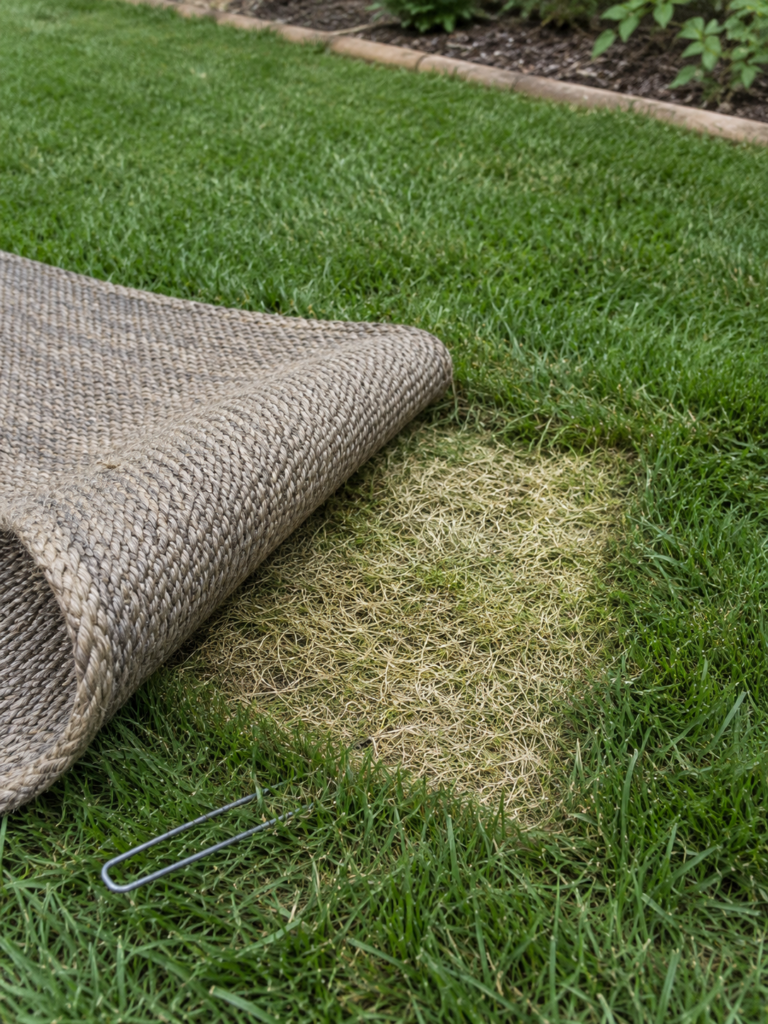
A rug does the same thing, just less deliberately. In warm growing weather you’ll see pale yellow green grass after roughly a week. Two or three weeks in, it thins. Leave it all summer and you get bare soil, compacted from foot traffic, often with a damp mat of dead thatch that takes real work to fix.
That doesn’t make a rug on grass a bad idea. It makes it a temporary one.
- For a party, a weekend or a few evenings, put it down and don’t think about it.
- If you want the lawn back, lift the rug every three or four days, let the grass dry out and water the patch afterward.
- If the rug is staying put for the season, give it a base first: paver squares, interlocking deck tiles or a compacted gravel pad. Then you have a patio, not a rug on a lawn.
- Mesh backed rugs sold for grass help with airflow and drainage. They still block light, so they slow the damage rather than prevent it.
One practical note that gets left out: a rug on grass moves. Ground is uneven, the weave catches, and the whole thing shifts every time someone stands up. Landscape staples through the corners solve it, and they pull out cleanly.
Outdoor rug on a concrete patio
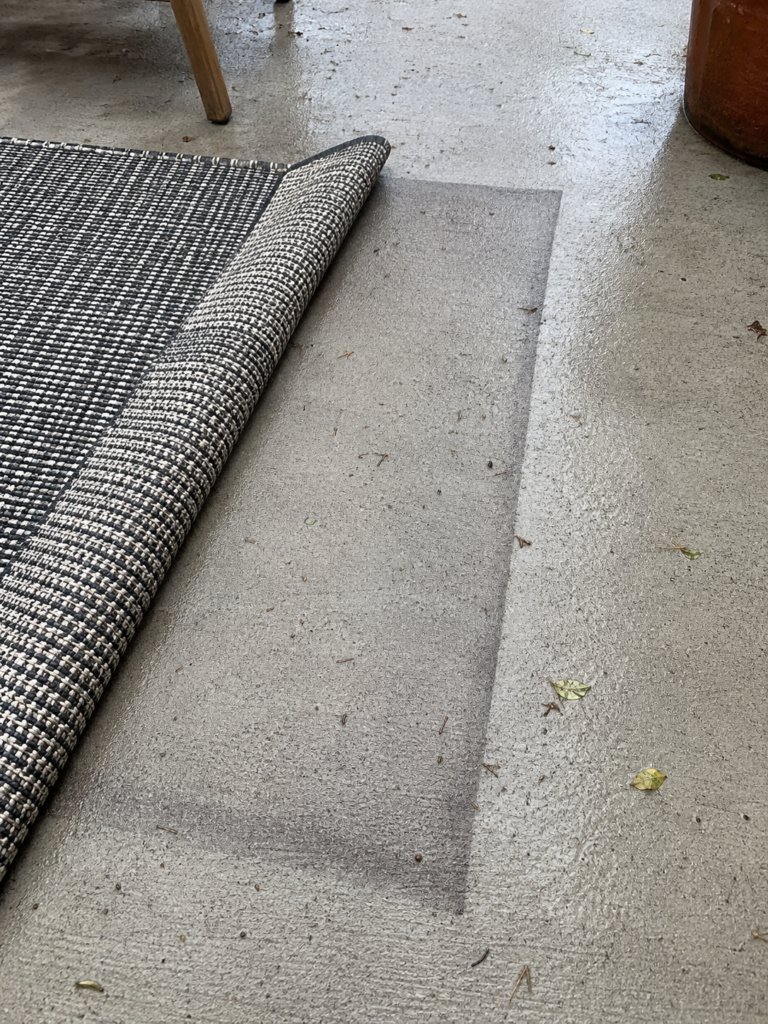
Concrete is porous, and that’s where the trouble starts. Three things tend to go wrong.
Water gets trapped. Rain soaks the rug, the rug holds it against the slab, and the underside stays damp long after the top looks dry. The EPA’s guidance on mold and moisture is to dry wet items within 24 to 48 hours to prevent mold growth. Outside you can’t run a dehumidifier, so the only control you have is lifting the rug and letting air at both sides.
Dye moves. Rugs not built for outdoor use, and cheap printed rugs of any kind, can bleed color when they stay saturated. On sealed concrete that usually washes off. On bare, porous concrete it can soak in and stay.
Grit grinds. Sand and leaf litter work under the rug and act like fine sandpaper every time someone walks across it. That’s what wears a flat weave out, more than sun does.
What helps: pick a spot on the slab that drains rather than the low corner where puddles sit. Keep the rug edge out from under the roof drip line and away from downspout splash. Sweep underneath it once a month. After heavy rain, drape it over a railing or two chair backs until the underside is dry to the touch. If a dark rug has been sitting on light concrete all season, check the outline when you lift it, because a fresh mark cleans up far more easily than one that’s been there since spring.
Outdoor rug on a wood or composite deck
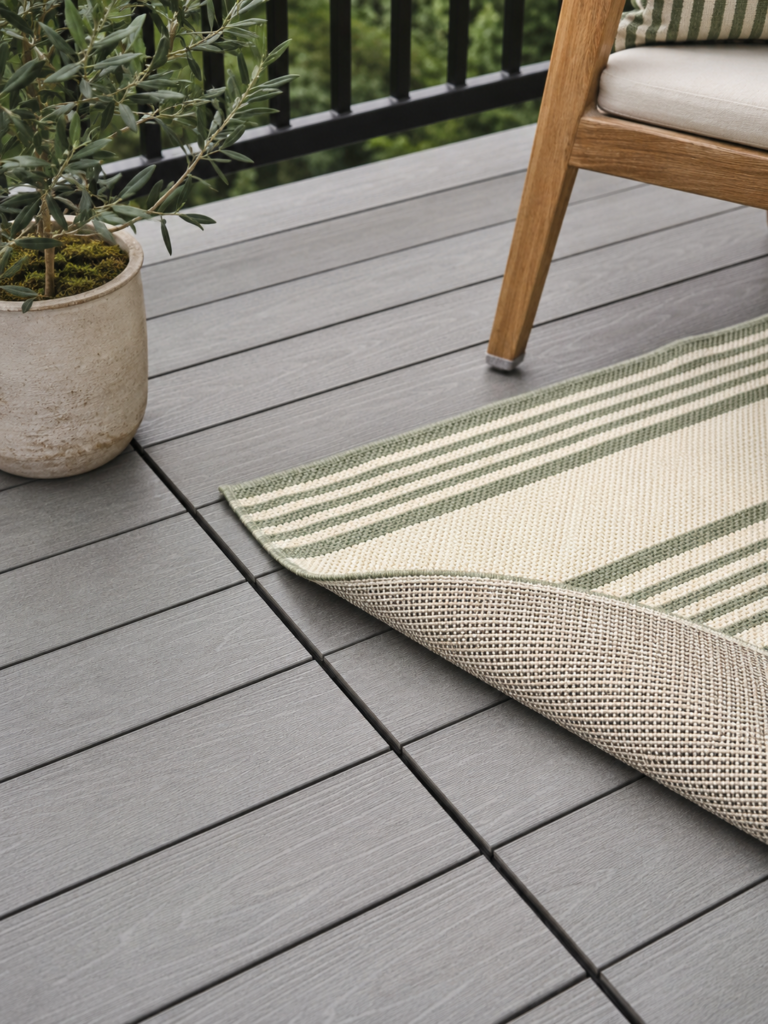
On decking, the backing does more damage than the rug ever will.
Composite boards carry colorant in the surface, and additives in rubber and vinyl can react with it. Trex’s care and cleaning guidance tells owners to use caution with rubber backed mats because substances in them can discolor or lighten the composite surface. That’s the manufacturer’s own instruction, and it flips the usual buying advice: a rubber backed mat that would be perfectly fine on concrete is the wrong choice here. Look for a woven or open mesh back instead.
Wood has a different problem. Trapped moisture keeps the boards damp, which encourages mildew on the surface film of pollen and dirt, and can lift a stain or sealer over time. Debris packed into the gaps between boards stops water draining, and that’s usually where the black staining starts.
Both materials also weather in UV. Leave a rug in one position for a full season and you’ll find a lighter or darker rectangle when you move it. That evens out eventually, but it takes months.
Simple habits fix nearly all of it: lift the rug monthly and sweep the gaps, rotate it a quarter turn each season so the boards weather more evenly, and leave a new deck uncovered for its first few months while the color settles.
Gravel, pavers and everything else
Gravel is the least rug friendly surface there is. Stones push up through a flat weave, the rug never sits flat, and the underside abrades fast. If you want a rug over gravel, put down a rigid base first: outdoor deck tiles, a slab of exterior plywood cut to size or a few flat pavers.
Pavers behave like concrete with extras. The joints hold water and jointing sand, so the rug stays damp longer than it would on a poured slab, and weeds keep growing underneath in the dark. Lift and sweep more often than you would on concrete.
Sealed or painted surfaces deserve a test. Some backings mark sealer, and the mark shows up as a dull patch. Leave a folded corner of the rug in an out of the way spot for a couple of weeks before you commit the whole thing.
If your outdoor space is a balcony rather than a yard, drainage and weight limits change the picture, and it’s usually easier to build the look from plants and light. These balcony and terrace ideas using plants and warm light work in that direction.
Choosing the material once you know the surface
| Surface | Works well | Avoid | Reason |
|---|---|---|---|
| Lawn, short term | Flat woven polypropylene, mesh backed grass mats | Jute, sisal, seagrass, wool | Natural fibers hold moisture against wet ground and rot quickly |
| Concrete or pavers | Polypropylene or recycled PET, flat weave, no backing | Solid rubber or PVC backing, thick pile, printed budget rugs | Solid backing traps water and some dyes soak into porous concrete |
| Wood or composite deck | Woven or open mesh back | Rubber backed mats, latex backing, dense pile | Backing additives can lighten or discolor boards |
| Covered porch | Most synthetics, natural fiber if it stays dry | Anything that stays wet after rain blows in | Shelter widens the options but doesn’t make a fiber waterproof |
Two details do more work than the fiber name.
The first is how the color got there. Solution dyed fibers have pigment through the strand, so fading is slow and even. Printed rugs carry color on the surface, and in full sun they go patchy in a season or two. If a listing doesn’t say, assume printed.
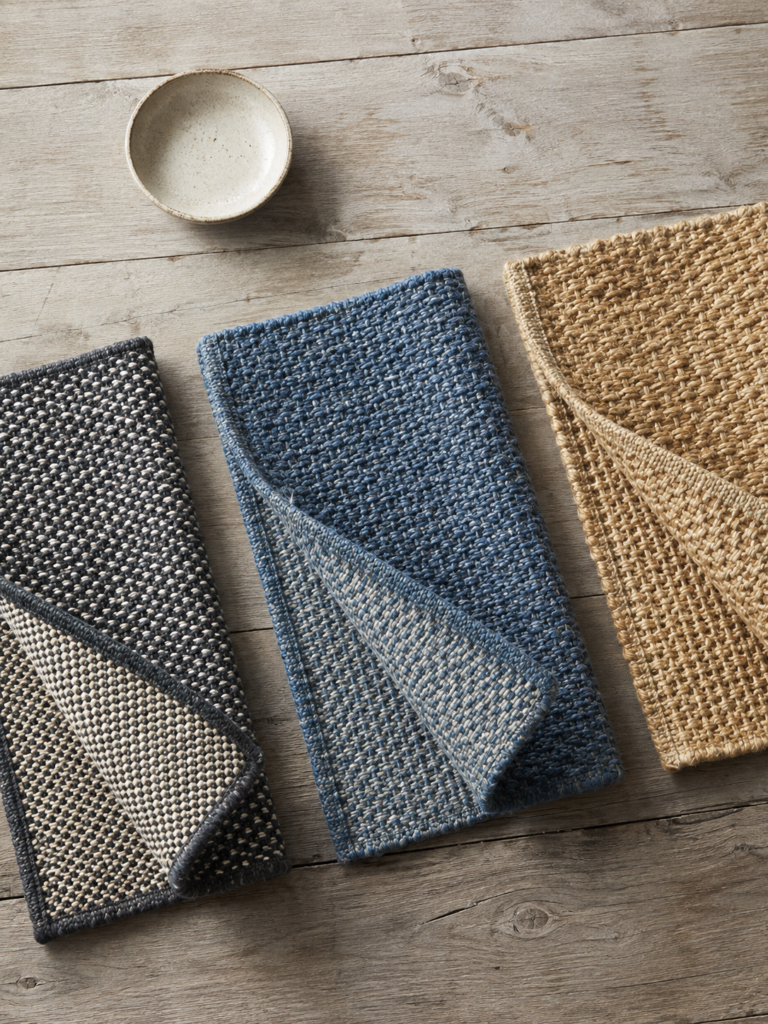
The second is the weave. A flat, open weave drains and dries in hours. A dense or looped pile holds water in the base for days, which is the real reason some outdoor rugs smell after a wet spell. Feel the back: if you can see light through it, it will dry.
Size and placement that prevent most problems
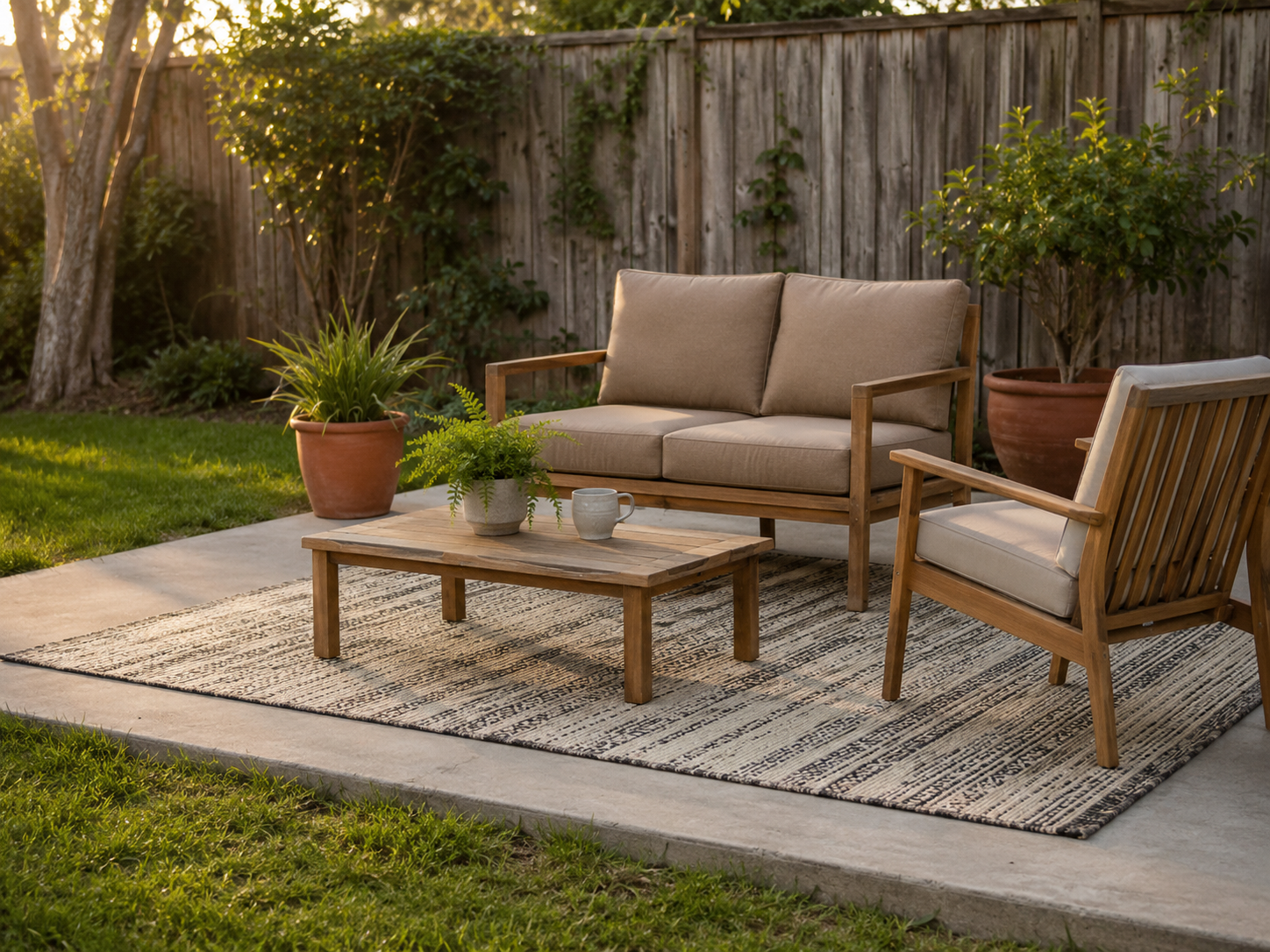
A rug that’s too small is the most common sizing error, and it makes a seating area look unfinished no matter how good the rug is. At minimum, the front legs of every seat should sit on it. Better, all four legs sit on it, which also stops chairs catching the edge and dragging it out of position.
Around a coffee table, leave roughly 18 to 24 inches of rug beyond the table on the sides people walk. That’s enough to stand up and step back without a foot landing half on and half off.
A few placement habits worth keeping:
Keep the rug edge clear of the roof drip line, downspout splash and sprinkler throw. Constant soaking in one strip is what makes an edge rot or curl while the rest of the rug still looks new.
Don’t cover an entire slab or deck. The perimeter needs to dry, and on decking the uncovered boards keep weathering at the same rate as the covered ones.
Leave a gap around planters. Saucers overflow, water runs sideways under the rug, and you get a dark ring that never fully dries.
Once the rug is sized and placed, it becomes the anchor for everything else, which is where these cozy patio inspiration ideas pick up.
Care that decides whether it lasts one season or four
Shake it or sweep it weekly. Grit is the main thing wearing the fibers.
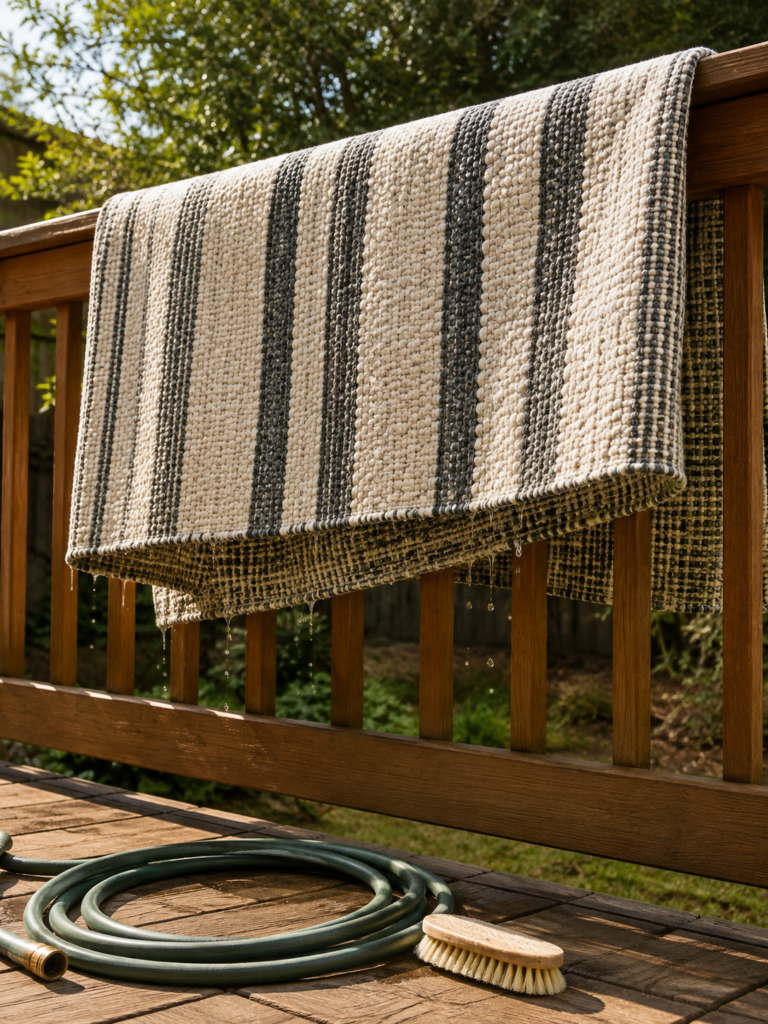
Lift it after heavy rain. Drape it over a railing, a fence panel or two chair backs so air reaches both faces. This single habit prevents most of the smell, staining and marking problems described above.
Wash it with a hose, mild dish soap and a soft brush. Rinse thoroughly, because dried soap film attracts dirt faster than the dirt would have arrived on its own. Skip bleach on colored fibers.
Store it rolled, never folded. Folds set permanent creases in synthetic weaves, and creases are where curling corners start. Make sure it’s completely dry before it goes into storage, since a rug rolled up damp in October is a mildew problem in April.
Mistakes that cost people a rug or a lawn
- Using an indoor rug outside because it looked right. Indoor backing breaks down within a season and the fibers hold water.
- Leaving a rug flat on grass all summer and expecting the lawn to recover on its own.
- Putting a rubber backed mat on composite decking.
- Buying a size that stops halfway under the seating, so chairs sit half on and half off.
- Rolling it up damp at the end of the season.
- Hosing it clean and putting it straight back down while the underside is still wet.
Safety notes worth two minutes
A rug that slides or curls is a trip hazard, and that risk is higher outdoors where the surface may also be wet. The CDC’s home fall prevention checklist advises removing rugs or using a non-slip backing so they won’t slip, which is worth applying to a patio that older relatives or small children use regularly. Flat weave synthetics on smooth sealed concrete are the slipperiest combination when wet.
Keep rugs well clear of fire pits, chimineas and grills. Synthetic fibers melt, and a wind-carried ember lands on a rug the same way it lands on anything else.
Check the temperature before bare feet or a dog gets on it. Dark synthetic rugs in full afternoon sun get considerably hotter than the surrounding paving, and a hand held flat for five seconds tells you what you need to know.
Frequently asked questions
Do I need a rug pad outside?
Usually not, and the wrong one makes things worse. Indoor pads with a solid rubber or PVC film hold water against the surface, which is the problem you’re trying to avoid. If you want cushioning or grip, use an open mesh pad sold for outdoor use, cut it slightly smaller than the rug so the edges can breathe, and lift both together when you clean.
Can I put an outdoor rug over artificial turf?
Yes, and nothing will die, but drainage still matters. Water and organic debris sit down in the turf pile and can’t evaporate through a rug, which is where the musty smell comes from. Lift it monthly, rinse the turf underneath and let both dry before it goes back. Expect the turf fibers to stay flattened for a while after the rug moves, since they recover slowly.
Why do the corners keep curling, and how do I fix it?
Curling usually traces back to storage creases or to one edge staying wetter than the rest. Reverse roll the affected corner and leave it rolled the wrong way for a day or two, then weight it with a planter or a table leg. An hour in direct sun softens synthetic fibers enough to help them relax. Outdoor rug tape holds poorly on damp concrete, so weight is more reliable than adhesive.
Is there a real difference between an indoor outdoor rug and an outdoor rug?
Neither label is a regulated standard, so read the construction instead of the name. Look for solution dyed fibers rather than printed color, and an open flat weave rather than a dense pile. A rug marketed as indoor outdoor is often built to survive moisture and cleaning but not months of direct UV, so it’s a better fit for a covered porch than an exposed slab.
Can I leave the rug out over winter?
You can, but it shortens the rug’s life and gives anything trapped underneath months to stain. Snow keeps a rug saturated for weeks, and repeated freezing stiffens the fibers and the backing. Clean it, dry it fully, roll it and store it somewhere dry. If it truly has to stay outside, at least stand it rolled on end where water can drain out rather than leaving it flat.
Where to start
Stand in the spot where the rug will go and answer one question honestly: how often am I actually willing to pick this up? If the answer is monthly, almost any surface works. If the answer is never, put the rug on concrete or a deck and skip the lawn entirely.
Take a photo of the surface before the rug goes down. It’s the fastest way to see what’s changed underneath when you lift it in a few weeks, and it turns a vague suspicion into something you can fix early. If the rest of the seating area still needs work, these backyard decor ideas for turning a bare patio into a usable space cover what goes on top of it.