Balcony privacy from neighbors above: what actually blocks the view

You put up a railing screen, felt good about it for a week, then looked up and realized the person on the floor above still sees your chair, your book and your coffee. That gap is where most balcony privacy advice ends. Nearly every screen sold for balconies is designed for the view from the street or from the balcony next door, not for a window eight feet above your head.
Blocking a downward view works on different rules. It comes down to angles, to where you actually sit and to what your building will let you hang. Getting balcony privacy from neighbors above usually costs less than people expect, and the first move is often free.
Balcony privacy from neighbors above depends on what sits between their eyes and your seat, not on how tall your railing screen is. Railing screens block street level views only. Blocking a downward view takes overhead cover, a tall panel or plant placed right beside your chair, or simply moving that chair back under the floor above.
Balcony privacy from neighbors above starts with a sight line, not a screen
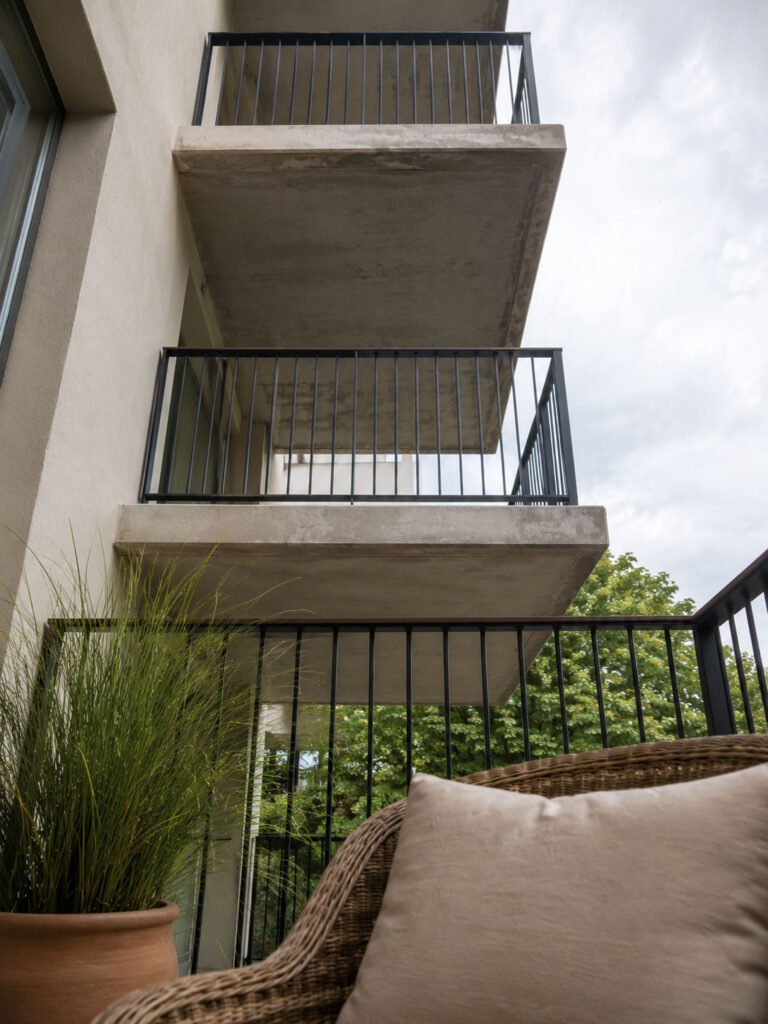
A sight line is the straight path between another person’s eyes and the spot where you sit. Before buying anything, find out which sight lines actually reach you, because most people discover only two or three matter and the rest of the balcony was never exposed.
The test takes five minutes and needs nothing but your phone.
The sit down test
- Sit in the chair you actually use, at the time of day you actually use it. Morning light and evening light expose different windows.
- Look up slowly, then to each side. Note every window, balcony edge and rooftop you can see from that seated position. If you can see them, they can see you.
- Hold your phone at your seated eye level and photograph each of those spots. The photo shows the angle far more honestly than memory does.
- Stand up and repeat. Standing usually exposes you to more windows, and it may change which solution you need.
- Mark the two or three positions that actually bother you. Those are the only sight lines you have to block.
People often skip this step and buy a screen for the whole railing. The test usually shows the problem is one balcony diagonally above, which is a much smaller job.
What railing screens actually block
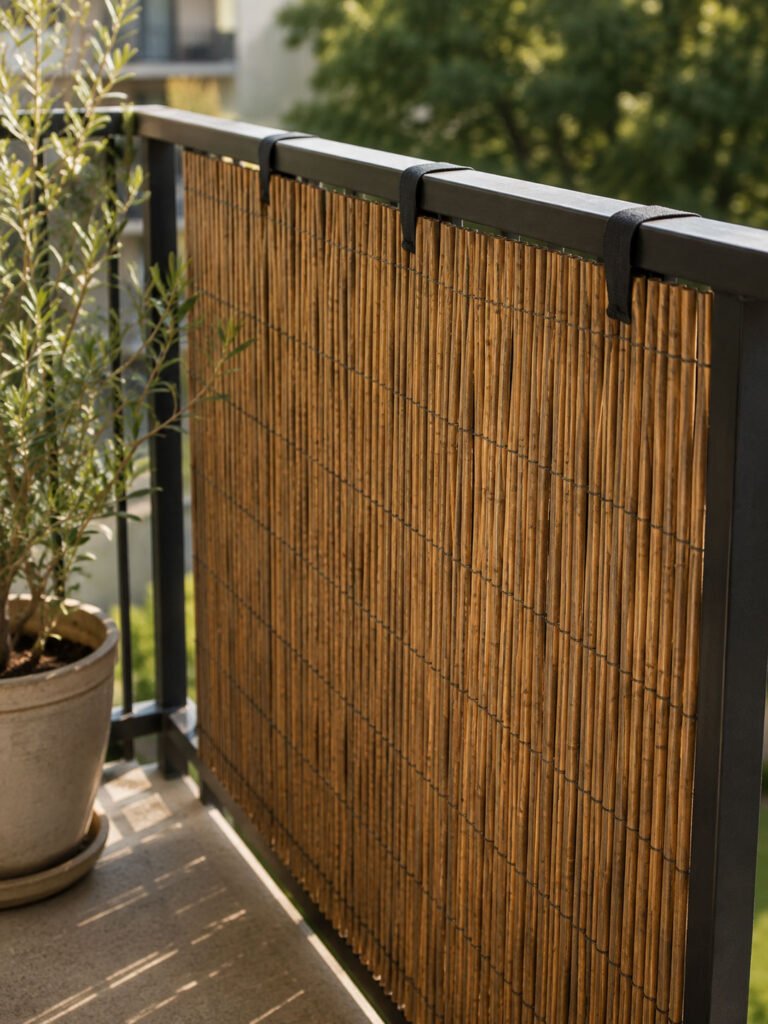
A railing screen blocks the view from the street and from balconies at your own level. Against a neighbor looking down from a higher floor it does almost nothing, because their eyes sit above the top edge of the screen no matter how opaque the material is.
The height math explains it. Apartment and condo railings are usually built to 42 inches under the International Building Code, while single family decks commonly follow a 36 inch minimum, and local codes vary. A screen tied to that railing therefore tops out around chest height on a standing adult. Someone one floor up is looking down over the whole thing.
Railing screens still earn their place. They hide stored items and bare railing bars, they cut the view from a balcony beside yours and they soften a hard edge visually. Treat one as a starting layer rather than the answer. The common mistake is buying the same screen again in a taller size, which raises the price and the wind load without changing the angle that matters.
Overhead cover for a straight down view
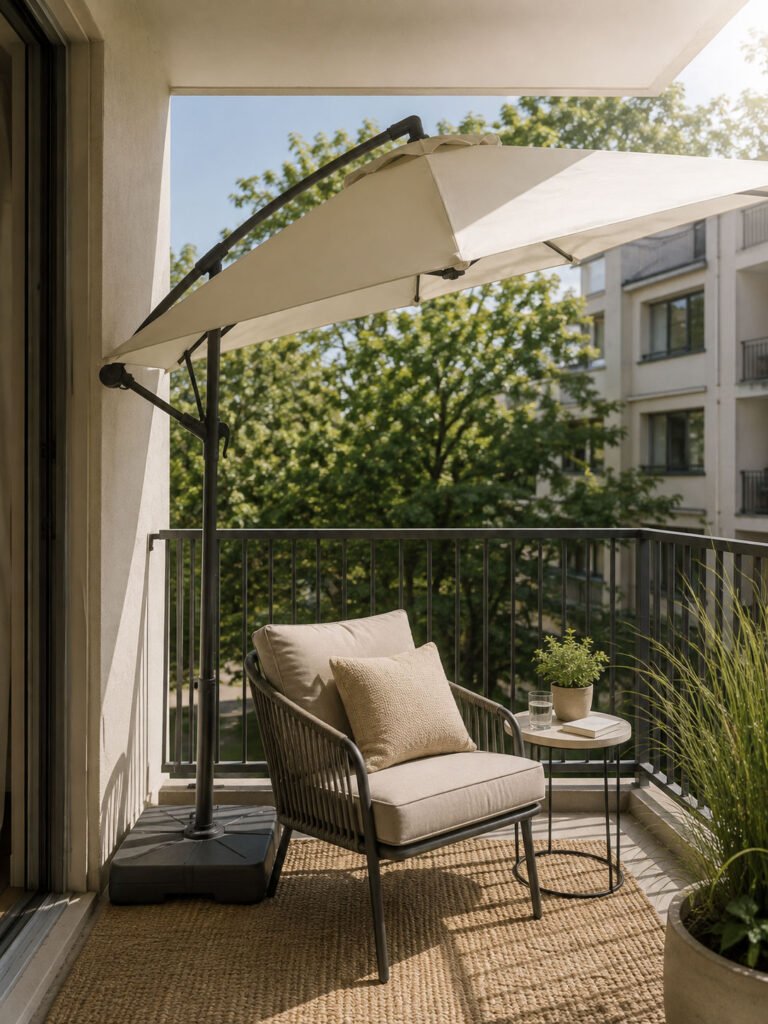
When a neighbor is directly above you, only something over your head blocks the view. On most apartment balconies that something already exists, because the floor above yours is a solid slab and the back half of your balcony is already covered.
Start by moving the seating back. Pull the chair toward the interior wall until the slab above sits between you and the balcony overhead. This costs nothing, changes nothing about the building and solves the problem for a surprising number of recessed balconies. You lose some sky and some rain exposure, which is usually a fair trade.
If your balcony is open to the sky, you need to bring cover with you. An offset or cantilever umbrella puts a canopy over the seat with the pole out to one side, so nothing blocks the seating area, and it needs a heavy base sized for the canopy. A shade sail or square canopy works when there are anchor points at several corners and you can tilt it so rain runs off one low corner instead of pooling in the middle.
Cover overhead does a second job. Nearly half of ultraviolet radiation arrives between 10 a.m. and 4 p.m. according to the EPA’s guidance on ultraviolet radiation and sun exposure, so the same canopy that blocks the view from above makes the balcony usable through the hottest part of the day.
One caution: never hang anything from a sprinkler head, sprinkler pipe or light fixture on a balcony ceiling. Those are fire safety and electrical components, and hanging loads from them can be both dangerous and a lease violation.
Why a panel beside your chair beats a taller screen at the railing
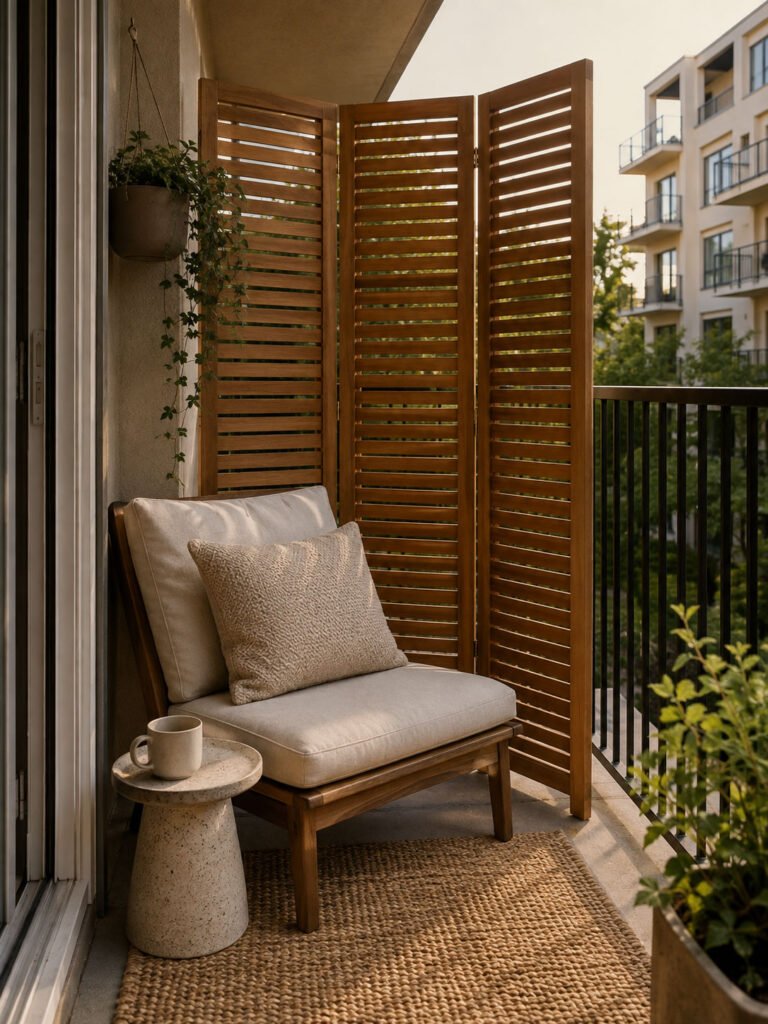
Distance does more work than height. A panel placed close to your seat blocks a much steeper angle than the same panel standing out at the railing, which is why a modest folding screen next to a chair outperforms an expensive tall screen along the edge.
Here is the math with round numbers. Seated eye level for many adults sits around 4 feet above the floor. Put a 6 foot panel 2 feet from your shoulder and its top edge is 2 feet above your eyes at 2 feet of distance, so it blocks everything arriving at less than roughly a 45 degree angle on that side. Move the same panel out to the railing, about 6 feet away, and it only blocks angles below roughly 18 degrees, which is barely more than the building across the street. The neighbor two floors up still has a clear line.
The practical version: put the tall thing next to the chair, not at the edge. A single panel or plant beside one shoulder also keeps the balcony feeling open, because you are not walling in the whole perimeter to solve a problem that comes from one direction.
Test before you buy. Stand a broom, a folded drying rack or a cardboard sheet where the panel would go, sit down and take the photo again. If the offending window disappears behind it, the plan works.
Using plants to block the view from above
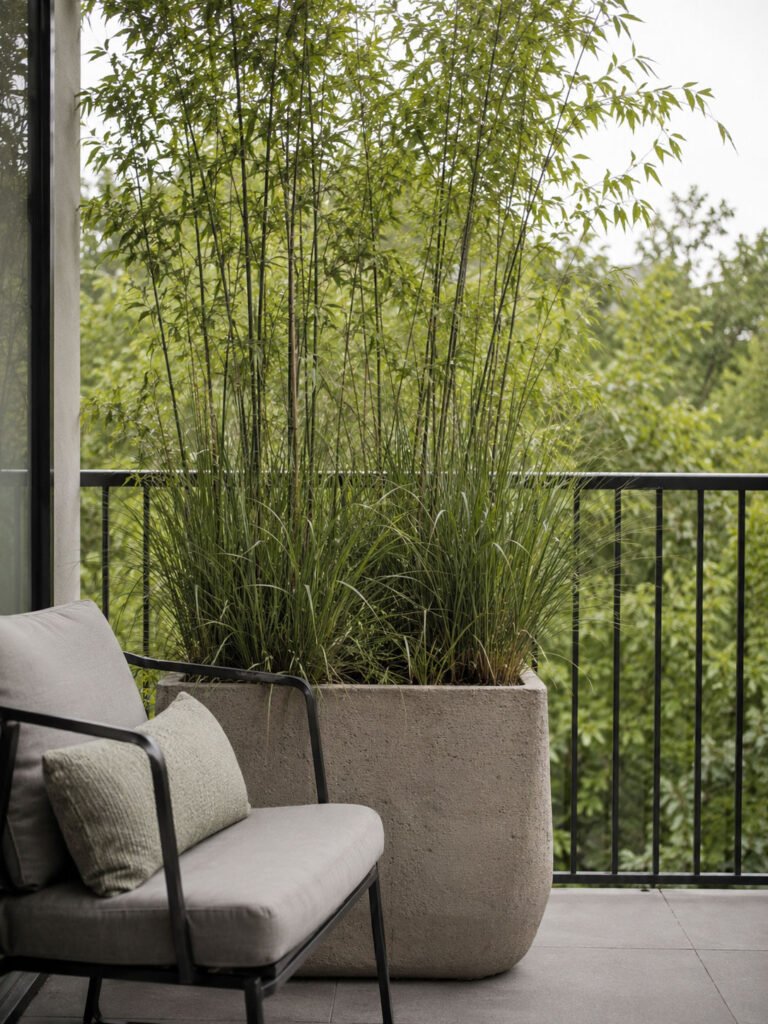
Plants screen a downward view when three things are true: they clear seated eye level, they sit close to the chair and they grow in a container heavy and wide enough to stay upright. A row of short pots along the railing looks lovely and blocks nothing from above.
Choose for height and staying power rather than flowers. Clumping bamboo, tall ornamental grasses, a narrow evergreen or a trellis carrying a vine all reach useful height in a container. On an exposed upper floor, look for narrow or flexible leaves, since broad soft foliage shreds in steady wind and a plant that gives up in August stops being a screen.
Container choice decides whether this works. Colorado State University Extension’s container gardening guide notes that tall plants need a heavier container to avoid tipping, and that containers can need watering once or twice a day as the plants fill out. A wide base, a heavy material and a saucer that catches runoff will do more for the screen’s survival than the plant label will. If you want a fuller planting plan for the space, our guide to balcony and terrace ideas using plants and warm light covers choosing greenery by the light your balcony actually gets.
Keep tall plants inside the railing line. Planters hooked to the outside of a rail are the most common cause of falling object incidents on upper floors, and many buildings prohibit them outright.
Putting privacy up without drilling
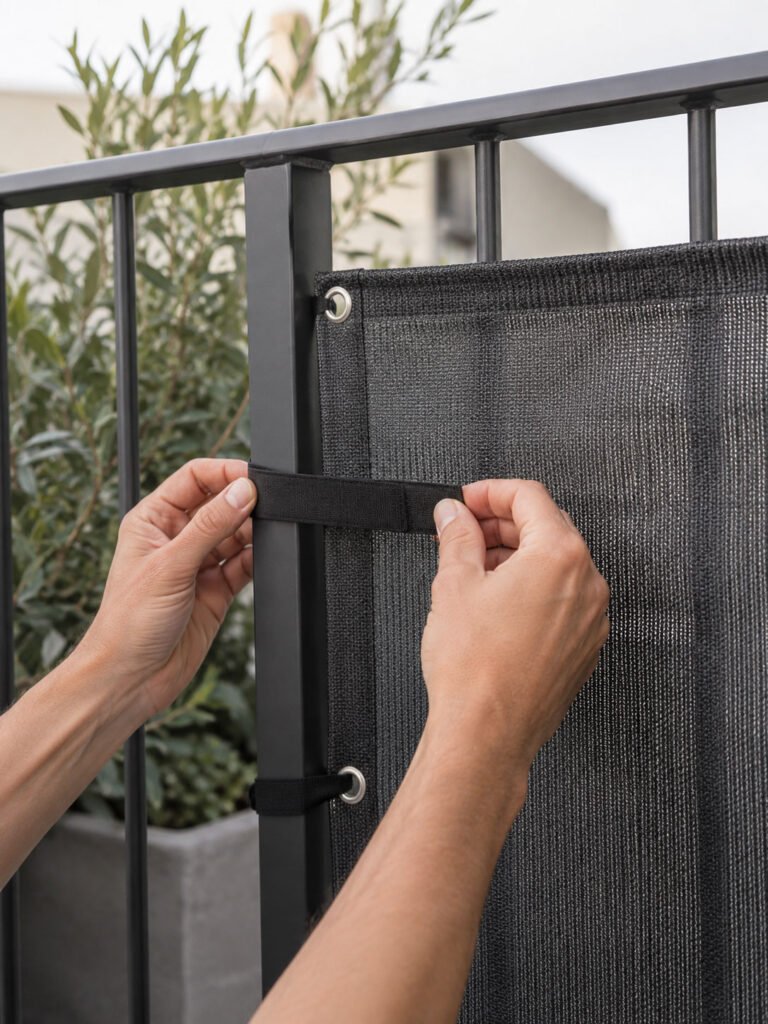
Renters have five realistic attachment methods, and only some of them are honestly no drill. Tension rods work between two solid side walls, not between a railing and a ceiling. Clamp brackets grip the top rail and hold light panels or umbrella poles. Straps and cable ties fasten mesh or reed to railing bars. Freestanding panels need weight in the base. Planters double as the base for a trellis when the container is heavy enough.
Be honest about what removable means. A tension rod is temporary. A clamp bracket is temporary. A cable anchored into a wall or beam is removable, but it is not no drill, and a landlord who finds anchors after you move out will treat it that way.
Two materials fail outdoors more often than sellers admit. Adhesive hooks lose grip in summer heat and after repeated rain, and suction cups on glass release once the sun heats the panel. Neither is a good choice for anything with surface area.
Use one removal test before you install: could you take this down in ten minutes and leave no mark? If the answer is no, ask the building first and get the answer in writing.
What wind does to balcony privacy screens
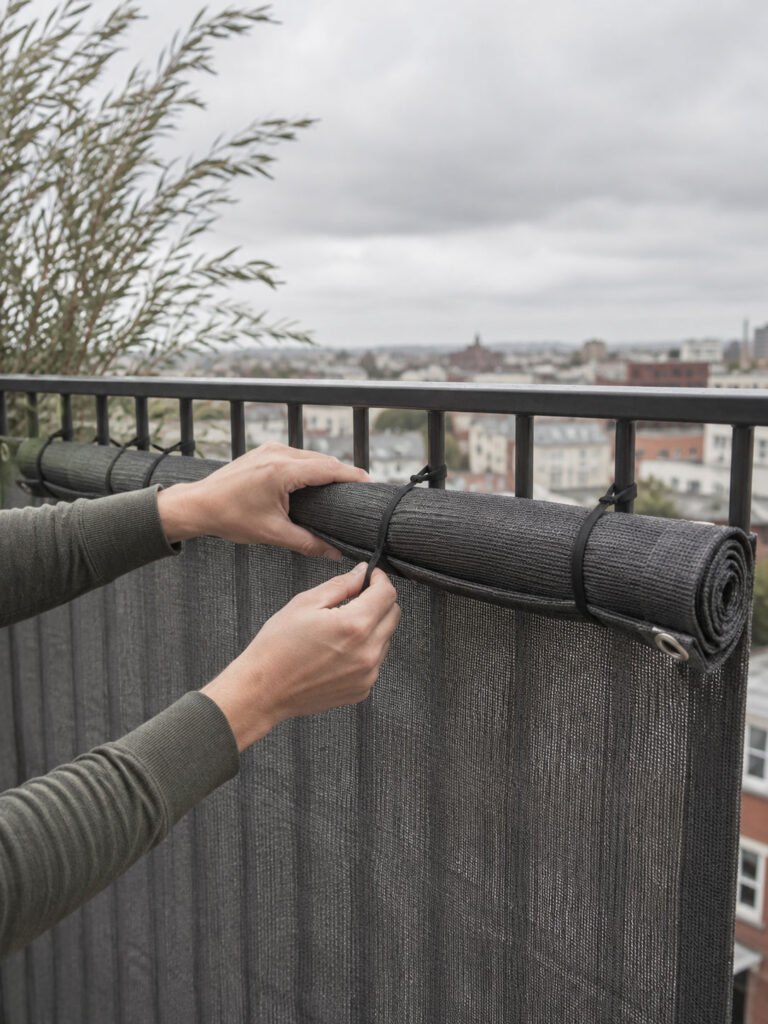
A solid panel on an upper balcony behaves like a sail. Mesh that lets air pass through flexes, holds its shape and stays attached far longer, which is why privacy mesh is sold by how much of the view it blocks rather than by how solid it feels.
Choose materials with that in mind. Woven mesh, slatted wood with gaps and reed fencing all pass some air. Solid boards, plastic sheeting and tightly woven canvas do not, and on a high floor they pull hard on whatever is holding them. Straps hold a light panel. They do not hold a large solid one in a gust.
Have a takedown point rather than a hope. A wind advisory generally means sustained winds of 31 to 39 mph for an hour or more, or gusts of 46 to 57 mph, though the National Weather Service wind advisory thresholds vary by forecast office. Anything you cannot remove in a few minutes will eventually be out in weather you would not have chosen.
The stakes are higher than a damaged screen. An object that leaves an upper balcony can seriously injure someone below, and you may be held responsible for it. If a setup only stays put in calm weather, it is not finished.
At night, privacy is a lighting problem
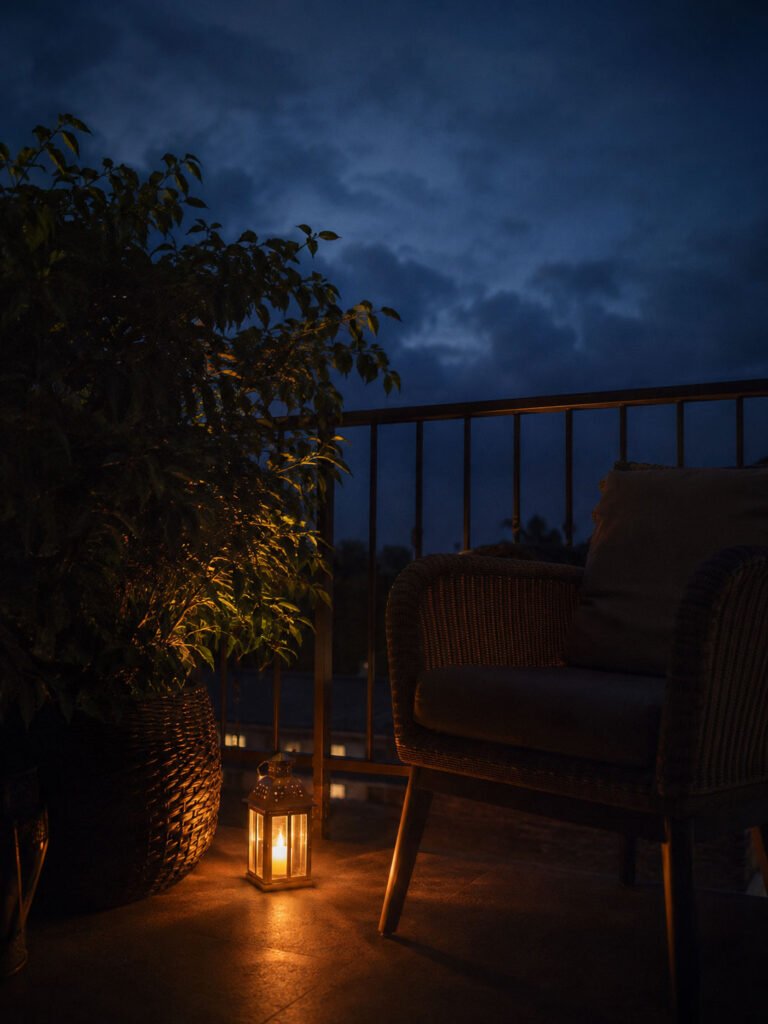
After dark, neighbors see you because your side is lit and theirs is not. No screen fixes that. A bright fixture behind or above you turns the balcony into a lit stage while every dark window around you keeps a clear view in.
Drop the light and warm it up. A lantern at floor level or a small lamp on a side table keeps the glow on the surfaces near you instead of on you, and shielded fixtures that throw light downward do the same job with less spill. Our guide to patio lighting without an outlet covers solar and rechargeable options that suit a balcony with no outdoor power.
Look inside too. Light spilling through the sliding door often lights the balcony more than anything you have out there. A curtain or blind on the inside of that door does more for evening privacy than another panel outside it.
Choosing by balcony type
The right setup depends less on your taste than on what your balcony already has. Find yours below.
Recessed balcony with a floor above
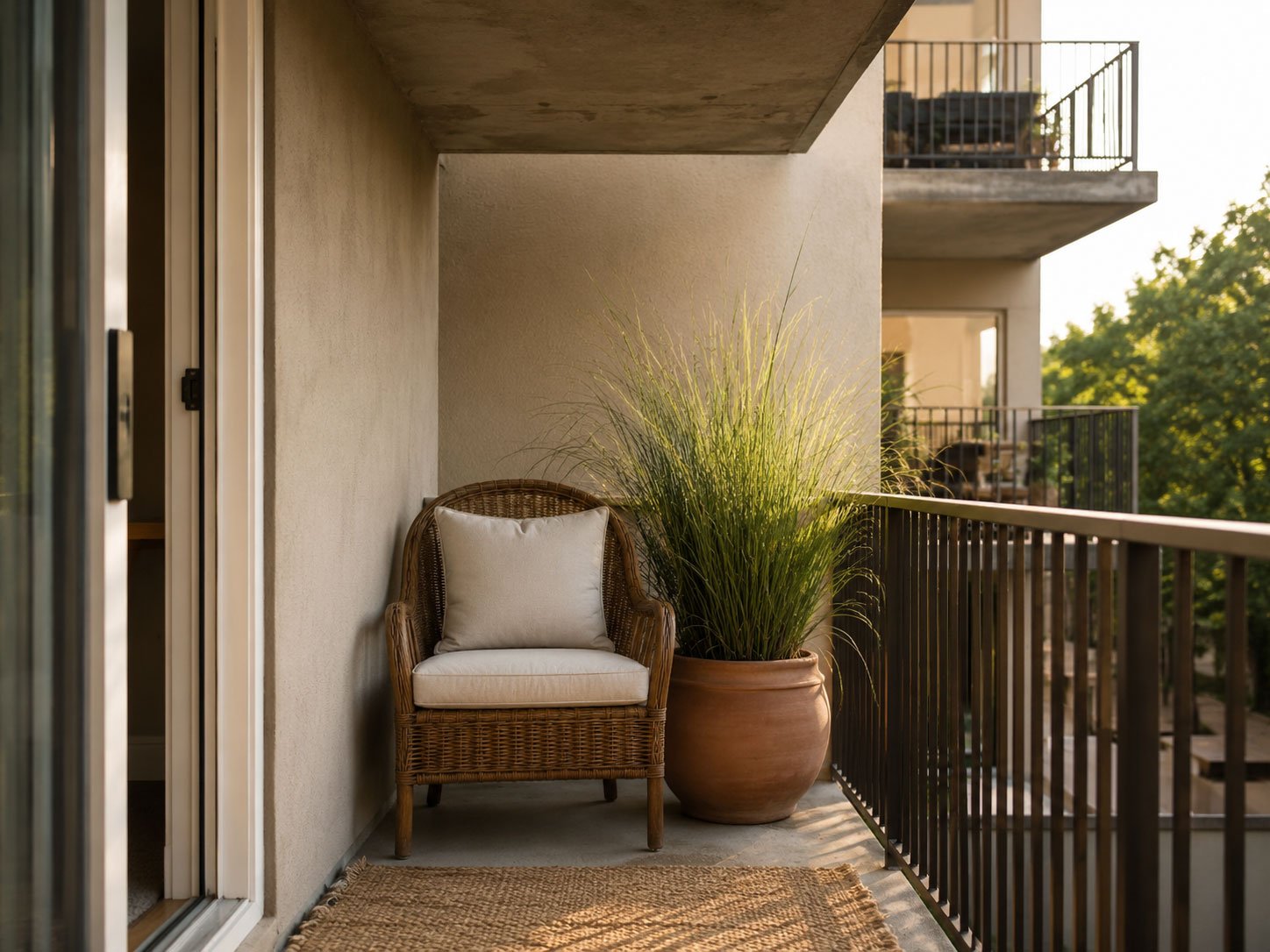
You already own the best privacy tool in the building. Move seating toward the interior wall so the slab above covers you, then add one tall element on whichever side stays exposed. This is usually a chair and a planter, nothing more.
Top floor or open sky above
Nothing above you means bringing your own cover. An offset umbrella with a heavy base handles this with the least commitment, and it comes down for storms in about a minute. Shade sails work when there are solid anchor points at several corners and permission to use them.
Glass railing
Glass shows your whole body from the side and from below, and it is the one railing type where a low screen genuinely helps. Options are a mesh or reed panel fastened to the inside face, a row of planters along the base or privacy film applied to the glass. Ask first about film, because many buildings treat glass as part of the facade and prohibit changes to it.
Balconies side by side with a shared divider
Extend the divider rather than the railing. A freestanding panel placed just past the end of your chair, in line with the existing divider, closes the gap where your neighbor’s seat faces yours. A full length screen along the whole shared edge costs more and blocks light you probably want.
Rules and safety checks before you install anything
Read the lease or association rules first, then ask in writing about anything you plan to attach. Buildings commonly prohibit items fixed to the outside of a railing, anything that changes the look of the facade and any screening that has to be removed for balcony inspections or window washing.
Fire rules matter here more than in a backyard. Some buildings restrict combustible screening and stored materials on balconies because a fire on one balcony can spread upward quickly, and fabric plus any open flame is a poor combination in a small space. The U.S. Fire Administration’s outdoor fire safety guidance advises against storing or using a grill on a porch or balcony at all, which is worth knowing before you build a cozy enclosed corner around one.
Four more checks before you commit:
- Keep the path to the door clear. A balcony is part of your exit route in some buildings, and it is your only outdoor space in an emergency.
- Do not block the balcony drain or scupper. A panel or planter sitting over it leaves standing water behind and sends runoff onto the balcony below.
- Keep planters, storage boxes and low furniture away from the railing if children use the space. Anything solid at the base of a rail becomes a step.
- Take screens down before scheduled maintenance rather than after a notice arrives.
Frequently asked questions
How can I get privacy on my balcony if I am not allowed to attach anything to the railing?
Work from the floor up instead. A freestanding folding screen weighted at the base, a tall plant in a heavy container or a rearranged seating position all sit inside your own space and touch nothing. Weight matters more than looks: pavers or a sandbag inside the base frame, kept within the screen’s own footprint, will hold a light panel through ordinary breezes.
What is the cheapest way to block the view from an upstairs neighbor?
Moving your chair costs nothing and often works, especially on a recessed balcony where the floor above already provides cover. After that, a single secondhand folding screen placed beside the seat is usually the next cheapest step, followed by one tall plant in a wide container. Buying a full length railing screen first is the most common way to spend money without changing the angle that bothers you.
Is it legal for my neighbor to look down onto my balcony?
Generally there is no rule against a neighbor being able to see a balcony that is visible from their own home, and privacy expectations outdoors are limited in shared buildings. Photographing or recording you is a different matter, and rules on that vary by state and city. If someone is deliberately watching or filming, raise it with building management and check your local rules rather than handling it alone.
Will frosted film on a glass balcony railing come off when I move out?
Static cling film peels away cleanly and can often be reused, which makes it the safer choice in a rental. Adhesive film usually needs heat and patience to remove and can leave residue on old glass. Ask the building before applying either, since glass railings are often treated as part of the exterior and some associations require every panel to match.
Can I hang a curtain from the balcony ceiling above me?
Only if you have permission to fix something into that slab, or an existing track or hooks are already there. Ceiling anchors mean drilling into structure, which most leases treat as a permanent alteration. Tension rods are a better renter option, but they need two solid facing walls to press against, and a railing will not substitute for one. Keep any rod clear of sprinkler heads.
How tall does a screen need to be to hide me when I am standing?
Standing eye level for many adults sits between 5 and 5 and a half feet, so a screen has to clear that height to hide a standing person from the side. Height alone still will not stop a view from above. For that, the screen also has to sit close to where you stand, or you need cover overhead instead.
Where to start this week
Do the sit down test before you buy anything. It takes five minutes, it costs nothing and it usually shrinks the job from screening a whole balcony to blocking one or two angles. Then work in order: move the chair, add one tall element beside it, and only buy a railing screen if a side or street view is part of the problem.
Balcony privacy from neighbors above rewards small, well placed changes far more than big purchases. Start with the free move this week, sit with it for a few evenings and add the next layer only if you still feel watched. For more ideas in this category, browse the balcony and terrace ideas collection at Femorias.