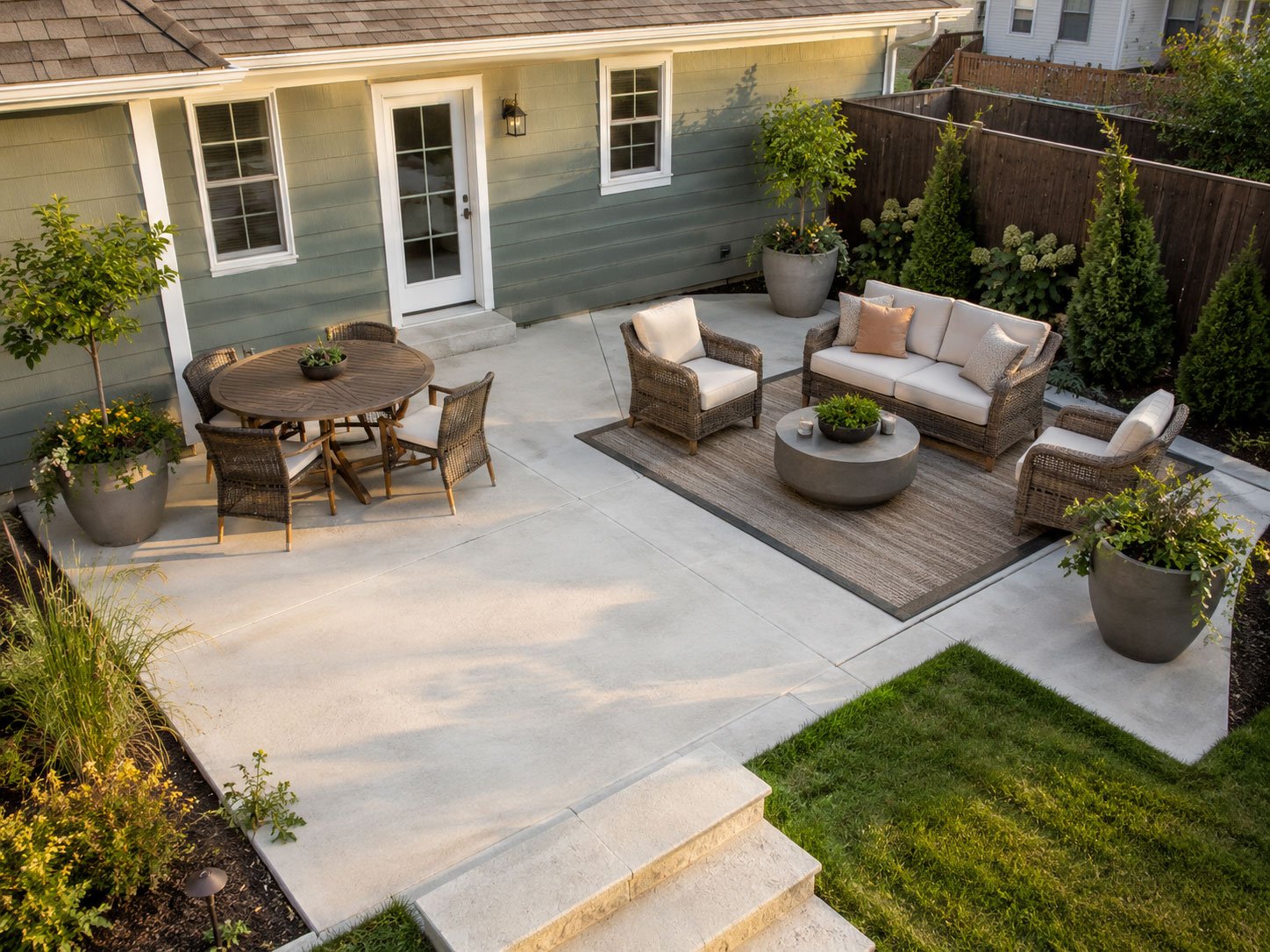
Patio lighting without an outlet: what actually works

A patio with no outdoor outlet is less a lighting problem than a planning problem. The lights exist and most of them are cheap. What usually gets skipped is deciding where the light needs to fall before anything goes in the cart, which is how a patio ends up with one glaring solar spotlight in the corner and a dinner table nobody can see.
Patio lighting without an outlet means lighting an outdoor seating area with no weatherproof exterior receptacle within reach, so every source has to run on stored power or on a temporary cord. That covers a lot of homes: older houses built before exterior receptacles were standard, townhome slabs, rental patios and apartment balconies.
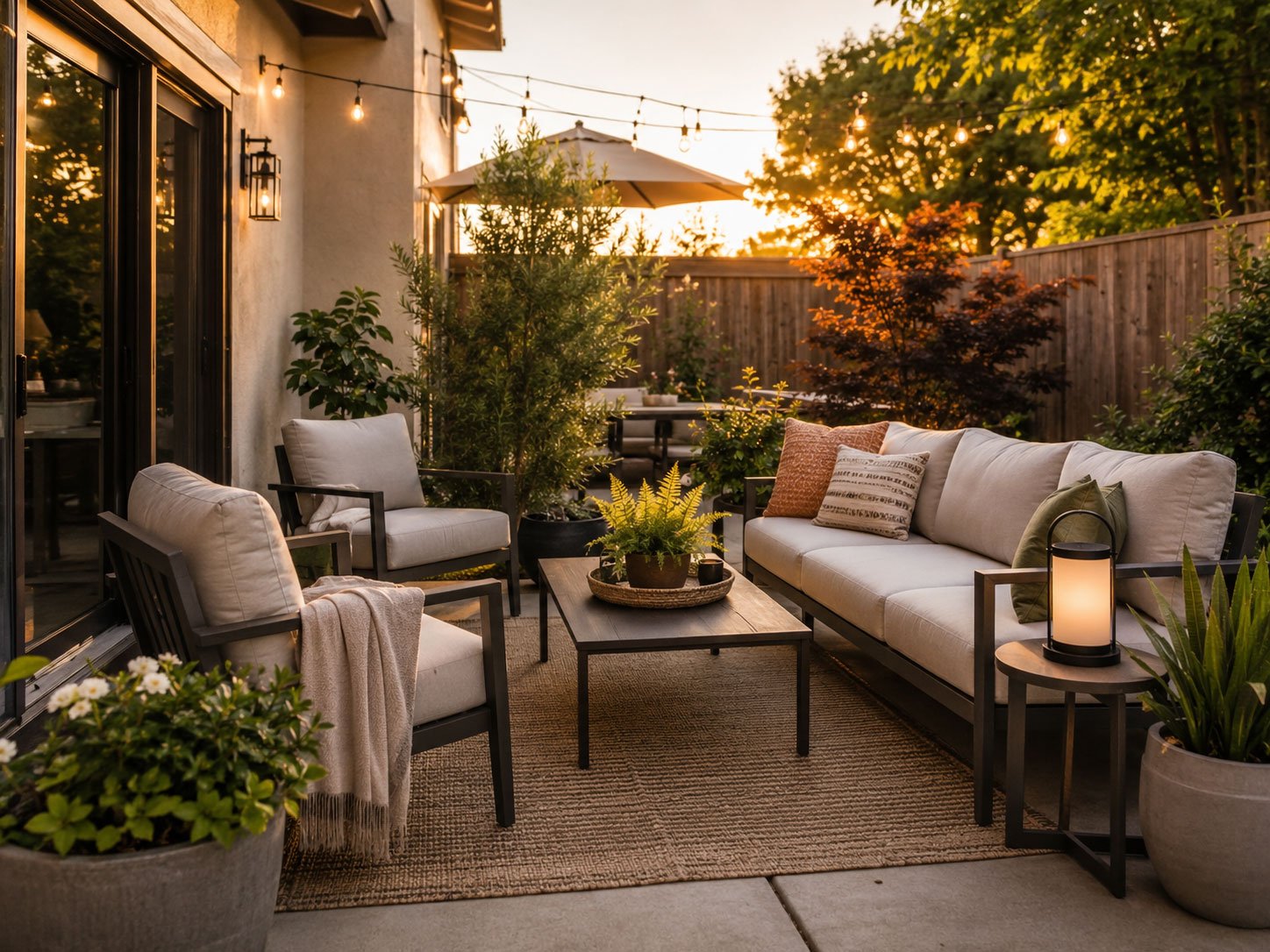
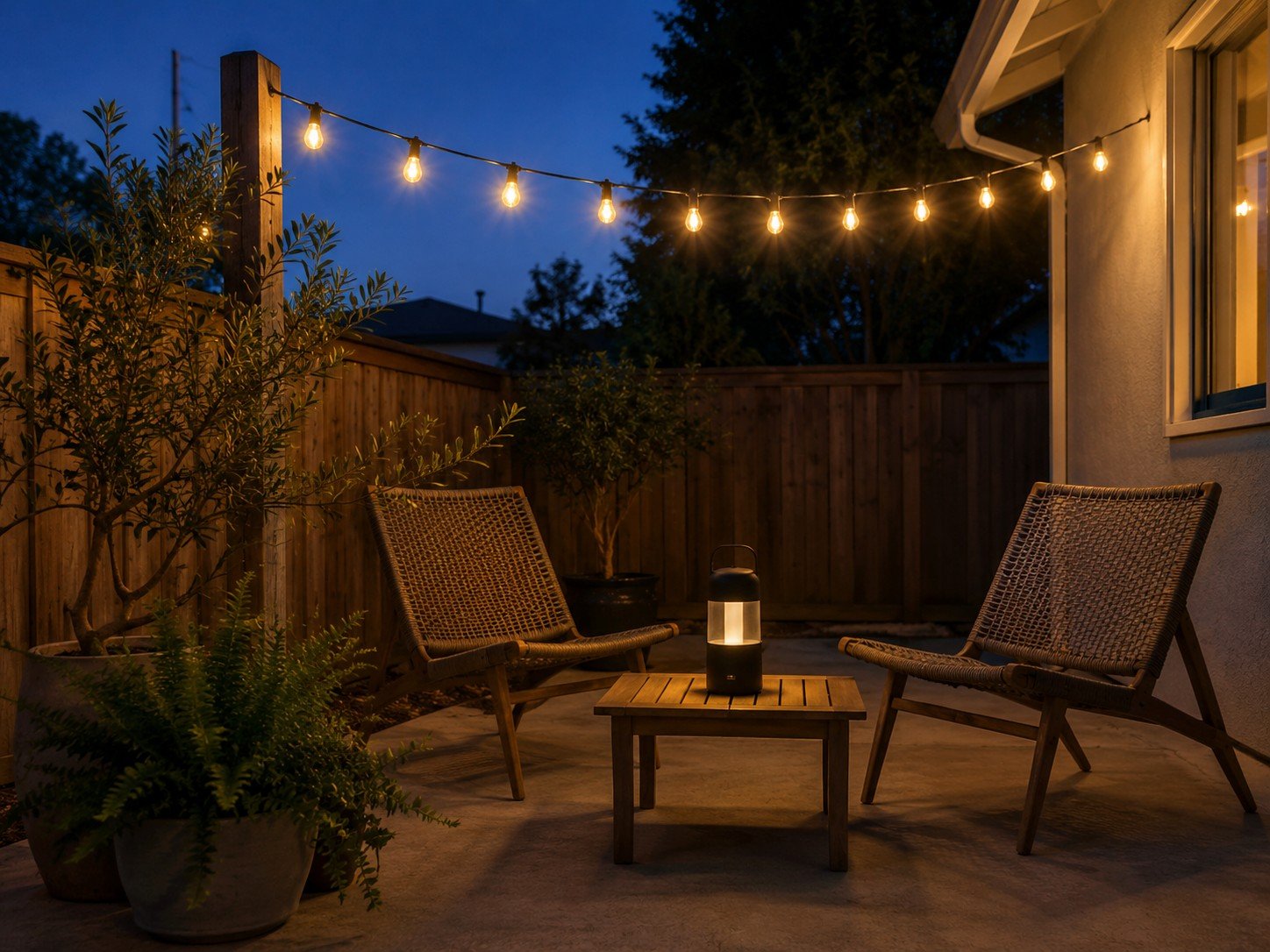
Patio lighting without an outlet works best in three layers: solar string lights overhead, rechargeable LED lanterns at table height and low solar path lights at the edges. Solar carries the ambient glow, rechargeable lanterns give brightness you can count on, and an outdoor rated extension cord stays a temporary fix, not a permanent setup.
How many light sources does a patio actually need?
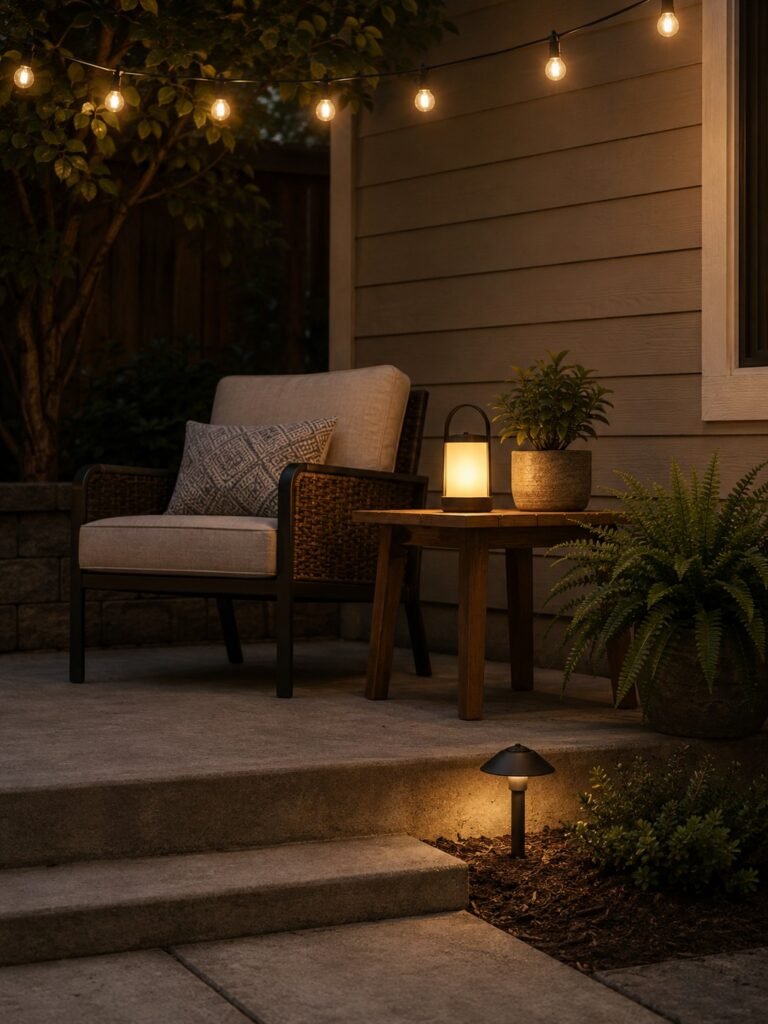
A patio usually needs at least three separate light sources rather than one bright fixture. The Department of Energy splits lighting into ambient, task and accent roles, and an outdoor seating area uses all three: general glow so the space reads as a room, brighter light where people eat or read and small accents that mark steps and edges.
The amount of light needed is smaller than most people assume. According to the Department of Energy’s rundown of lighting principles and terms, for simply finding your way around at night, 5 to 20 footcandles may be sufficient. That’s the reason a single bright solar floodlight fails so reliably. It delivers far more light than the task needs, concentrates it in one spot and leaves everything outside its beam looking darker by contrast.
Three layers on a patio look like this. Overhead comes from a strand of string lights or a hanging lantern, and it does the ambient work. Mid height comes from a table lantern or a wall mounted light near the seating, and it does the task work so you can actually see a plate or a book. Low light comes from a few small fixtures at the step, the doorway or the planted edge, and it does the accent work that keeps people from tripping.
The same layering logic applies indoors, which is why the approach in the Femorias guide to lighting a dining room with no ceiling light transfers so directly to a patio. In both cases the missing infrastructure forces you to spread light out instead of hanging one thing in the middle.
Do solar patio lights actually work?
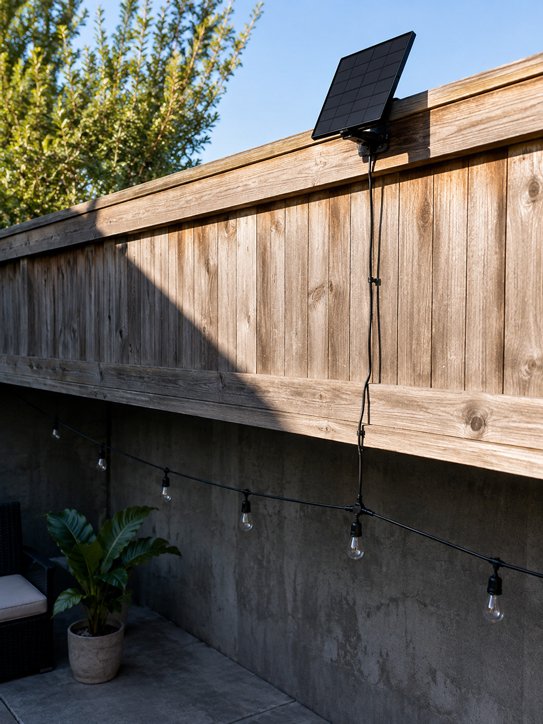
Solar patio lights work well for ambient glow and poorly as your only light source. The limits are not marketing spin, they’re physical, and the Department of Energy’s guide to outdoor solar lighting sets them out plainly.
Three points from that guidance change how you shop. First, the nightly run time printed on the box is based on specific sunlight conditions, so lights placed where the cells get less sun than they need will run for fewer hours than advertised. Second, operating times in winter months may vary as much as 30 to 50 percent unless the system was sized for winter operation. Third, shading from trees or buildings reduces charging and performance, and insufficient charging can shorten the life of the battery itself.
That last point is the one that quietly ruins most patios. The patio is usually the shaded, sheltered part of the yard. The panel needs the opposite. So the practical fix is to buy solar sets where the panel sits on a separate lead rather than on top of the fixture, then mount the panel on a sunny fence top, roof edge or post while the lights stay where you sit.
Before buying, stand on the patio around 1pm and note where full sun actually lands. If nothing on or near the patio gets a few hours of direct sun, treat solar as decorative and let rechargeable lights carry the real work. Keep the panel clean too, since dust, pollen and bird droppings all cut charging.
Rechargeable lanterns are the most reliable light without an outlet
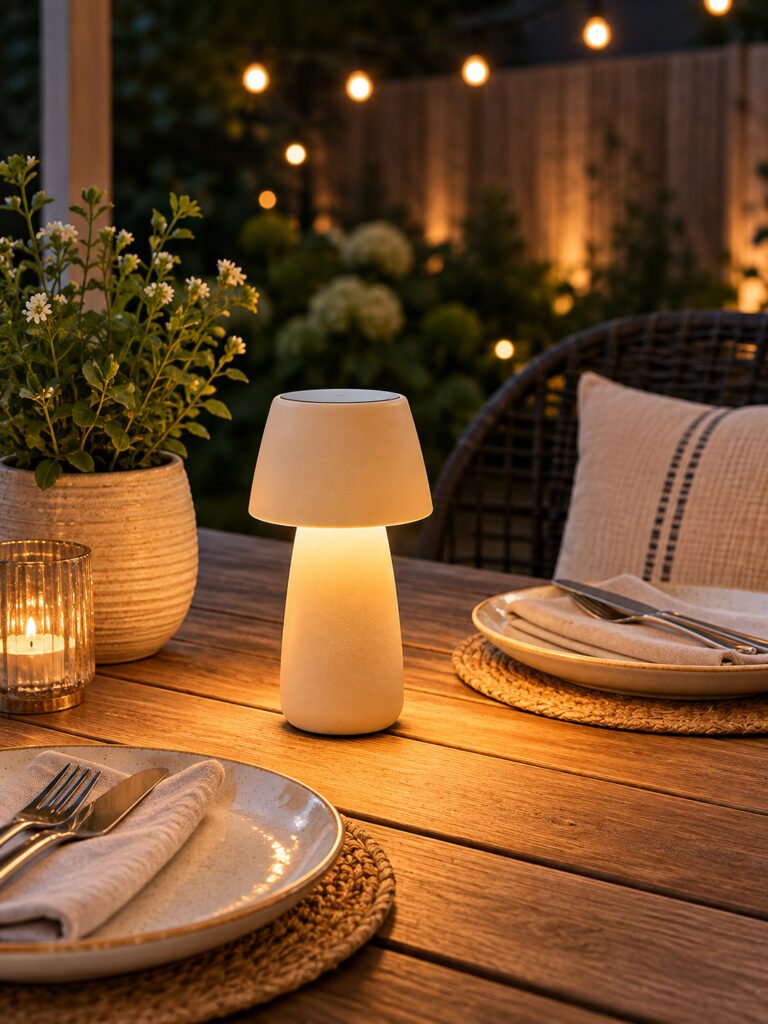
Rechargeable LED lanterns and cordless table lamps are the most dependable way to get usable light on a patio with no outlet, because you charge them indoors on your schedule instead of hoping the sky cooperates. They also dim smoothly, which most solar fixtures do not.
When comparing models, look for the runtime listed at full brightness rather than the headline number, which is usually measured at the lowest setting. Look for a warm output, a dimmer or at least a low mode, USB charging so one cable serves everything and a stated outdoor rating. A lamp with a weighted base is worth more than a pretty one on a breezy patio.
The habit matters more than the product. Buy two lanterns instead of one, keep one charging indoors while the other is in use and swap them on a fixed day. Bring them inside when the patio isn’t in use through the coldest and wettest weeks, since sitting flat and cold in a damp corner is what kills these batteries early. Charge them indoors on a hard surface with the cable that came with them.
Disposable battery lights still have a place, just a narrow one. They’re fine for small fairy light accents, a lantern you use twice a season or lighting inside a covered nook. They’re a poor choice for anything you want on every evening, because the cost and the replacing add up fast.
Is it safe to run an extension cord out to the patio?
![Gray weatherproof outdoor receptacle cover mounted on a house wall above a concrete patio with a chair leg visible at the edge]](https://femorias.com/wp-content/uploads/2026/08/Weatherproof-exterior-outlet-cover-on-a-house-wall-beside-a-patio-768x1024.jpg)
An extension cord can power patio lights for an evening, but it is not a substitute for an outdoor outlet. The Electrical Safety Foundation International’s extension cord safety tips put it directly: an extension cord is a temporary solution and is not meant to be used as a long term extension of your household’s electrical system, and it should not be run through walls, doorways, ceilings or floors.
That single line rules out the workaround most people try first, which is cracking a window or door and running the cord through the gap. A pinched cord degrades where you can’t see it, and covering a cord traps the heat it needs to shed.
If you use a cord as a genuine short term setup for an evening, a few things aren’t optional. Use a cord marked for outdoor use and listed by an independent testing lab such as UL, ETL or CSA. Plug it into a GFCI protected receptacle. Match the cord’s rating to what you’re plugging in and never chain two cords together. Keep it clear of standing water and puddles. Unplug it when you go inside, and stop using any cord that feels warm or shows damage.
One more thing worth flagging: never tuck a cord under an outdoor rug to hide it. It’s the most tempting fix and one of the worst, because the rug traps heat and the cord takes abuse from foot traffic you can’t inspect. If the rug is what’s driving the decision, the Femorias guide to choosing an outdoor rug for grass, concrete or decking covers placement that keeps the seating area clear.
If you want mains powered lighting on the patio permanently, the answer is an exterior receptacle installed by a licensed electrician. It’s a small job, it’s the safe version of what the cord is pretending to be, and it makes every future lighting choice easier.
How to hang patio string lights without drilling
You can hang patio string lights without drilling by borrowing anchor points that already exist or by adding weight instead of hardware. Most patios have more usable anchors than they look like they do.
Start with what’s already there. Fence posts and top rails take clips or cable ties easily. Deck railings work the same way. A patio umbrella pole makes a good center point, letting a strand radiate out to the corners. Gutter hooks slip over an existing gutter lip with no fasteners. Existing porch posts, pergola beams and window trim edges can all carry a light strand’s weight, which is small.
When there’s nothing to grab, add mass. Set a tall pole into a large planter filled with concrete, sand or gravel, then plant something on top to hide the fill. Shepherd’s hooks pushed into soil along a bed edge work for lower strands. Freestanding poles and heavy planter bases both need enough weight to hold in wind, so err heavier than looks necessary, especially on an exposed or upper level patio. Outdoor rated adhesive hooks work on clean, dry, smooth siding, though they’re the least reliable option in heat and humidity, so use them for light strands only and check them each season.
Height is the part people get wrong. Keep the lowest point of the strand above head height wherever anyone walks, which lands around 8 feet. Directly over a table you can drop to roughly 7 feet, since nobody stands there and the lower run puts warm light closer to faces. Leave a soft sag in the strand rather than pulling it drum tight, because tension travels straight into whatever you anchored to and into the sockets themselves.
What brightness and color to look for
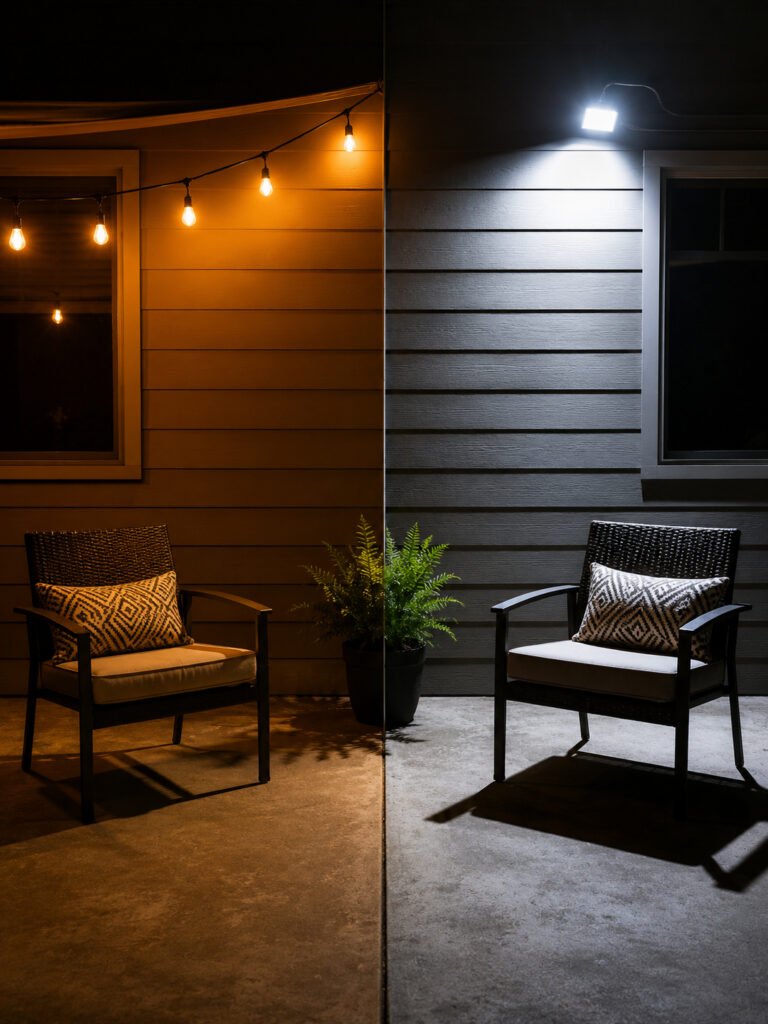
Warm and dim beats bright and white on a patio. The Department of Energy describes 2700K to 3000K as warm light and notes that warm light is preferred for living spaces because it’s more flattering to skin tones and clothing, and a patio is a living space that happens to be outdoors.
Direction matters as much as color. DarkSky’s Five Principles for Responsible Outdoor Lighting, published jointly with the Illuminating Engineering Society, come down to five words: useful, targeted, low level, controlled and warm colored. In practice, aim light downward. Shield anything that would shine into eyes or a neighbor’s window. Use the lowest level that does the job. Put lights on a timer.
For brightness, the useful check is lumens rather than watts. A lumen measures light emitted by a lamp. A 100 watt incandescent bulb emits about 1600 lumens for reference. Once you know that, product claims get easier to read. A set of string lights totaling a few hundred lumens across twenty bulbs is doing exactly what it should. A single 1500 lumen solar spotlight aimed at a seating area is doing far too much.
The rule that follows from all of this is simple. More small warm sources at low output, fewer bright ones. If a light makes you squint from your own chair, it’s pointed the wrong way or it’s too strong for the space.
Common mistakes when lighting a patio with no outlet
The most common mistake is buying one bright solar floodlight and expecting it to light the whole patio. It creates a hot spot, deep shadows and glare in exactly the spot where you want to relax, and it costs about the same as two better choices.
Here’s the rest of the list, with the fix for each.
- Putting the solar panel where the patio is instead of where the sun is. Buy sets with a remote panel on a lead and mount the panel in the sunniest spot within cable reach.
- Choosing cool white because it looks brighter in the store. Cool white flattens an outdoor space and reads as security lighting. Stay in the warm range.
- Running an extension cord under an outdoor rug. The rug traps heat and hides damage. If a cord has to cross a walking path, the setup needs rethinking.
- Expecting decorative fairy lights to serve as usable light. Thin wire fairy lights are accent lighting. Pair them with something that actually lights the table.
- Having no charging routine. Rechargeable lights that live outside and never get charged become clutter within a month. Pick a day and stick to it.
- Leaving everything outdoors through winter. Solar batteries charge poorly in short, low sun days, and repeated deep discharge shortens their life. Bring the portable pieces in.
- Skipping a timer. Most solar and many rechargeable sets have dusk sensors or timers. Using them saves battery and keeps light off when nobody’s outside.
A simple starting plan by patio size
Match the number of light sources to the patio’s square footage rather than to its shape. Below are three starting points you can adjust once you see how the space behaves at night. The Femorias approach to any outdoor space is the same as indoors: work out where people sit before you work out what to buy.
Under about 60 square feet, which covers most balconies and small slabs. One strand of solar string lights along the rail or clipped to the wall, one rechargeable lantern on the table and one small accent light near the door. Three sources is enough at this size, and anything more feels busy. If your space is a balcony specifically, the plant and light pairings in the Femorias guide to balcony and terrace ideas using plants and warm light work alongside this setup.
Around 10 by 12 feet, the standard townhome or backyard patio. Two strands crossing above the seating area rather than one strand around the perimeter, since crossing strands put light over the middle where people sit. Add two rechargeable lanterns, one on the table and one on a side surface, plus two low accent lights marking the step or the edge of the concrete.
Larger patios with a separate dining area and lounge area. Treat each zone as its own small patio. One overhead strand per zone, one cordless lamp per zone and a run of low lights along the route between them. Zoned light is what makes a big patio feel like rooms rather than a parking lot.
Frequently asked questions
Do solar lights work on a covered patio or under a roof?
Solar lights themselves work fine under cover, but their panels don’t. Any solar fixture with the panel built into its top will underperform badly on a covered patio because the panel never sees direct sun. The workaround uses a panel on a separate cable. Mount it on the roof edge, a sunny fence top, or a post beyond the cover. Run the cable neatly back to the lights.
Is it safe to leave solar patio lights outside all winter?
Most wet rated solar lights survive winter physically, but they perform poorly and the batteries suffer. Short days, low sun angles, and snow all reduce charging. The cells rarely reach a full charge. Repeated undercharging shortens battery life. If you’re not using the patio, bring portable pieces inside. Store them somewhere cool and dry. Top up the batteries once mid-season if the manufacturer recommends it.
What is the difference between damp rated and wet rated outdoor lights?
Damp rated fixtures handle moisture in the air and occasional condensation but are not built for direct water contact, so they belong under a solid roof or a covered porch. Wet rated fixtures are sealed to take direct rain and splashing, which is what an uncovered patio needs. The rating appears on the packaging or the fixture label. When you’re unsure, a wet rated fixture can go anywhere a damp rated one can, but not the reverse.
How long should a rechargeable patio lantern last on one charge?
Runtime varies widely by model and by brightness setting, which is why the number on the front of the box is usually measured at the lowest, dimmest mode. Look for the runtime listed at full or high output and treat that as the real figure. A useful habit is to plan for shorter runtime than claimed, keep a second lantern charged and swap them, rather than buying one lantern and hoping it lasts an evening.
Should I choose solar or rechargeable lights for a patio that only gets morning sun?
Rechargeable should carry the main light on a patio like that, with solar used only for accents. Morning sun is real charging time. A remote panel aimed east can keep low output bulbs running for part of the evening. It won’t reliably run brighter fixtures through a full night, especially in winter. Put your budget into two rechargeable lanterns first and treat any solar output as a bonus.
Can I use indoor string lights outside if I bring them in when it rains?
It’s not a good idea. Indoor rated strands aren’t sealed against moisture, and outdoor patios get dew, humidity and sudden rain well before you notice. Sockets are usually the failure point. A wet socket on a live strand is a shock and fire risk. That is more than a broken decoration. Wet rated outdoor strands cost a little more. They are built for the job, so buy the right rating from the start.
Where to start this week
Pick one evening, sit on the patio after dark with whatever light you already have and note the two places where you actually want to see: usually the table and the step. Those two spots decide almost everything else. Buy a rechargeable lantern for the first and a small accent light for the second, then add the overhead strand once you know where you’ll be sitting.
If you’d like more ideas for the space around those lights, browse the rest of the patio and outdoor decor guides on Femorias.