Dining room lighting without a ceiling light

If your dining table sits under a blank ceiling, this is not really a decorating problem. The room’s original wiring served a different purpose, and no amount of styling can fix a dining table that leaves you struggling to see across it at dinner.
The short answer: there are five workable ways to handle dining room lighting without a ceiling light, and which ones are available to you comes down to three things. Check where your nearest outlet is, identify your ceiling material and confirm what changes your rental allows. Once you answer those three questions, you can usually narrow the choices down to just one or two practical options.
Three things decide which option you can use
Work through these before you look at a single fixture. They eliminate more choices than taste does.
Where the nearest outlet is.
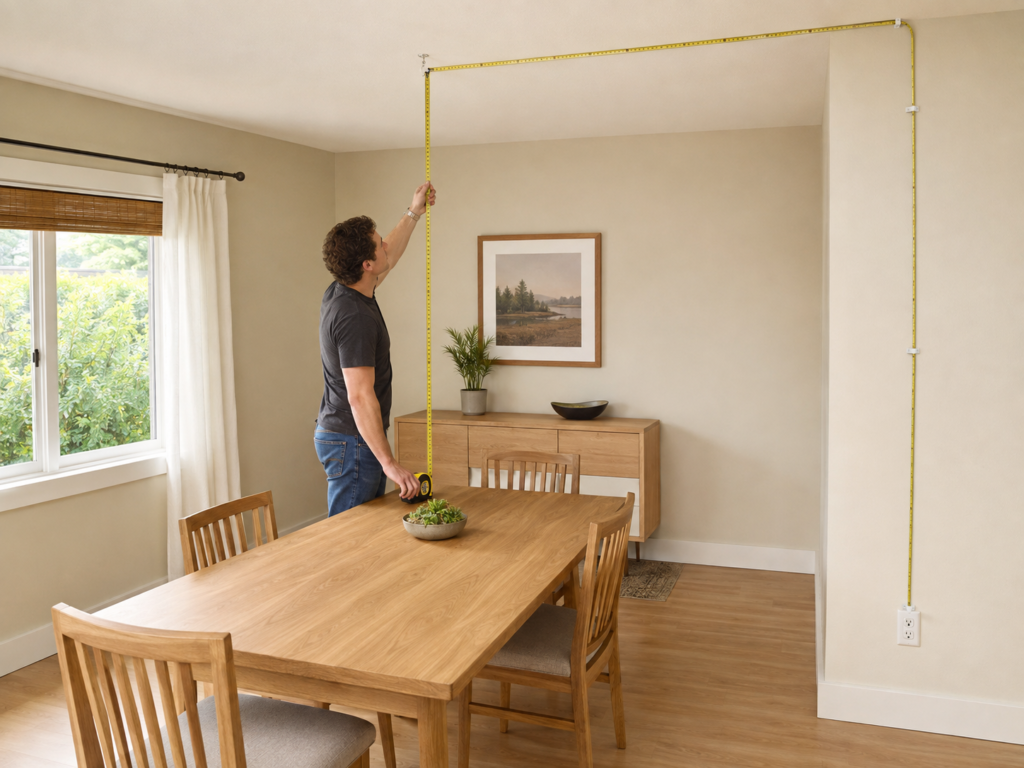
Stand at the table, find the closest working outlet and measure the path a cord would actually travel: up to the ceiling, across to the wall, then down. Not the straight line distance. That number decides whether a hanging fixture is realistic at all, because cord kits list a fixed cord length on the packaging and running short is the most common reason a plan collapses at the last minute.
What the ceiling is made of.
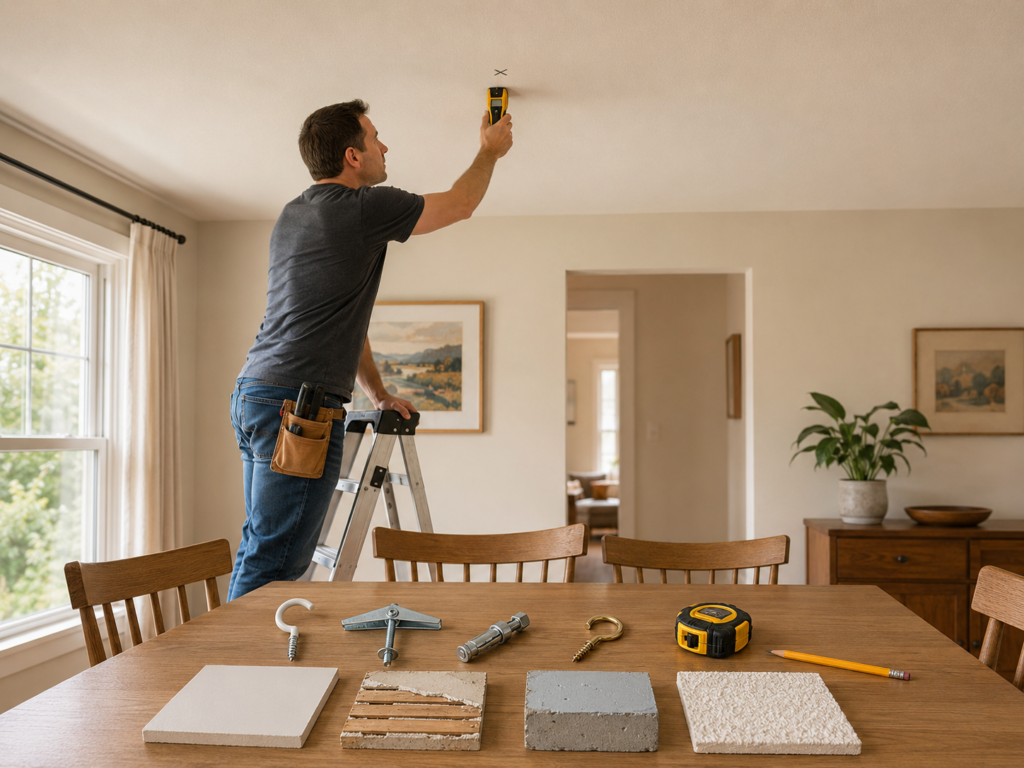
Drywall, plaster over lath, concrete and textured ceilings all take different hardware, and a hook that only grips drywall will not safely hold a hanging fixture. You need a ceiling joist or an anchor rated for more than the fixture weighs. If you cannot find a joist and cannot identify the ceiling material, treat overhead options as closed and move down the list.
What you are allowed to change.
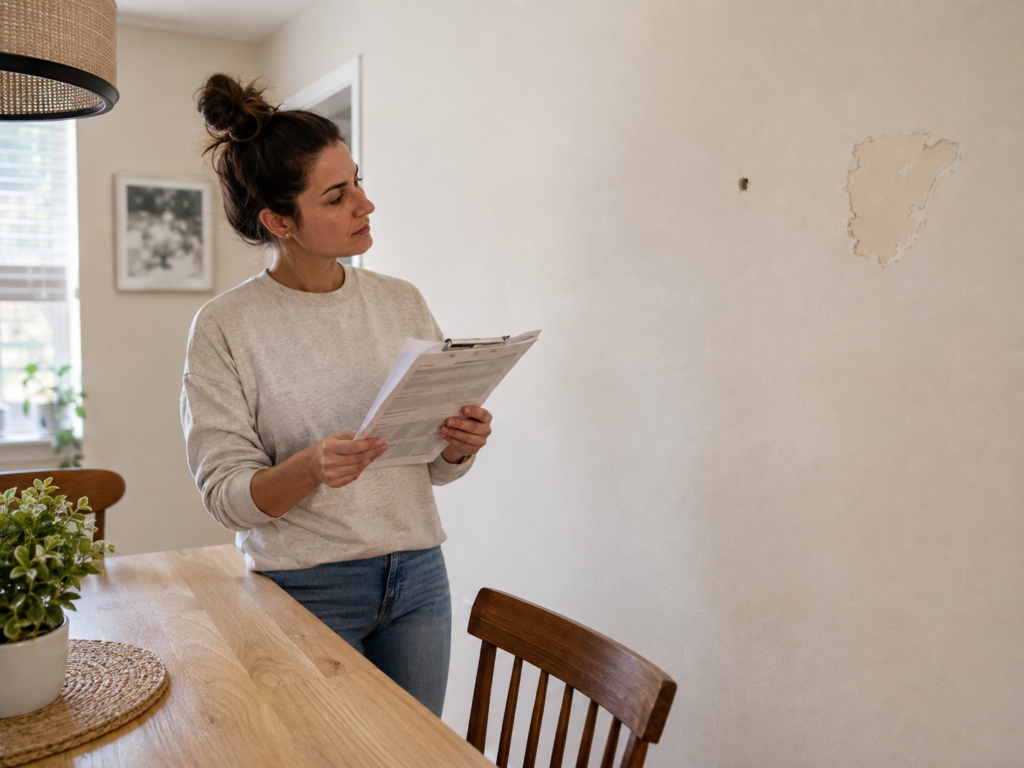
Renting narrows this, but not as much as people assume. A small hook hole is usually easier to make good than a row of adhesive strips that pulls paint off. Read the lease, and if you are unsure, ask before you drill rather than after.
| Option | Ceiling work | Best when | Main drawback |
|---|---|---|---|
| Swag pendant on a ceiling hook | One or two hooks with real anchors | You want light directly over the table and can put a hook up | The cord has to travel somewhere visible |
| Pendant hung from a beam, high shelf or bracket | None | There is already something solid near the table to hang from | Rarely lands over the table center |
| Plug in wall sconce or swing arm | None, wall fixings only | The table sits against or near a wall | Lights one side of the table more than the other |
| Lamps on a sideboard, console or shelf | None | You already have furniture beside the table | The tabletop itself stays fairly dim |
| Arc floor lamp reaching over the table | None | You cannot drill anything at all | The base eats floor space near the chairs |
Swag a pendant from a ceiling hook
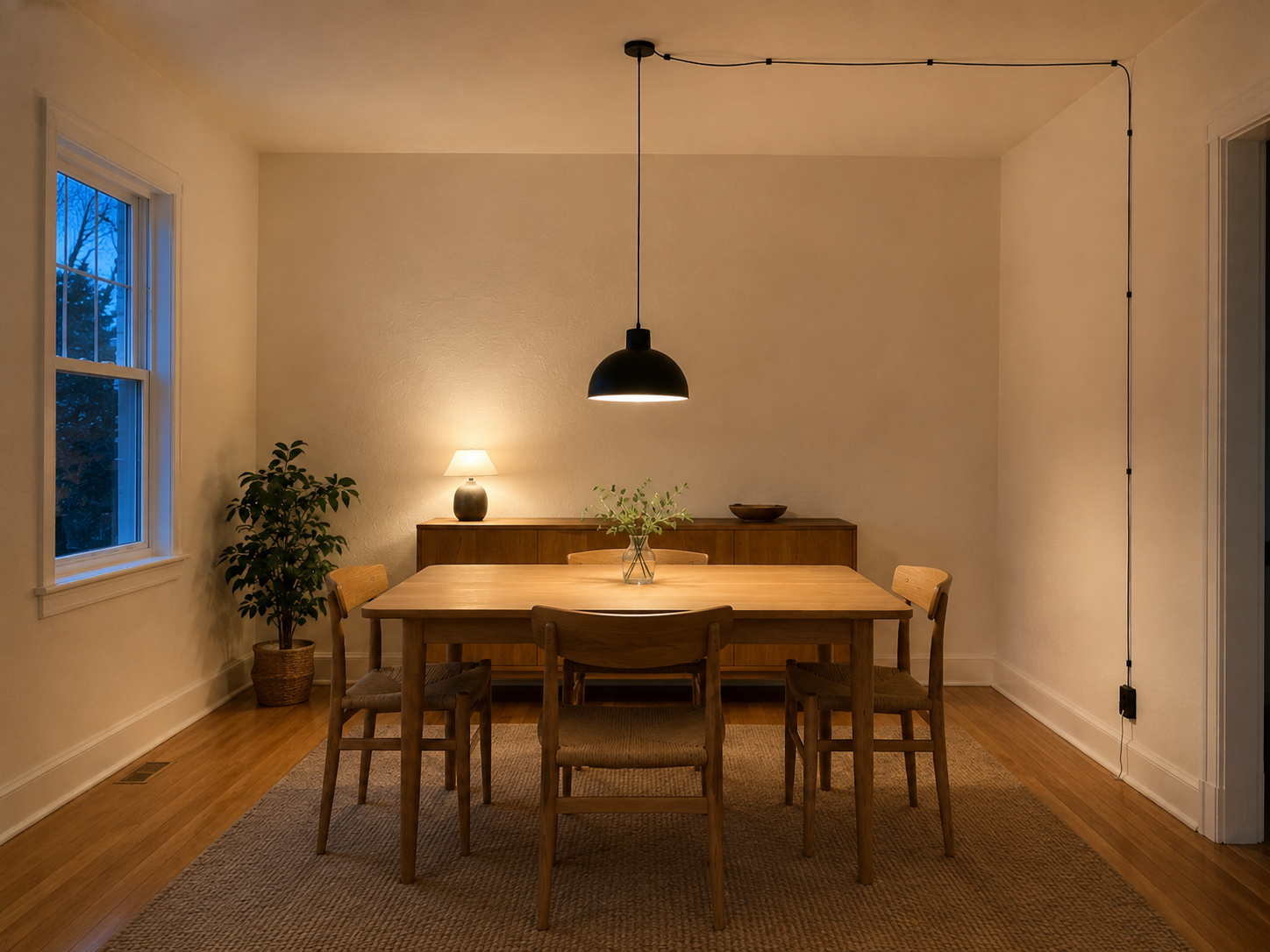
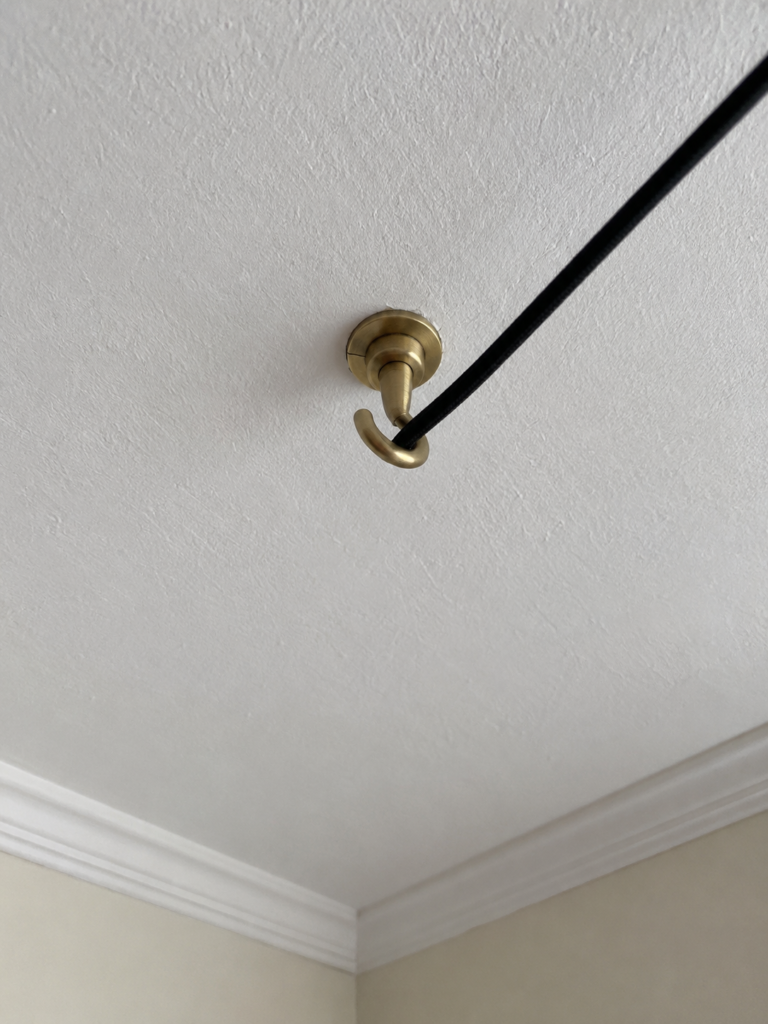
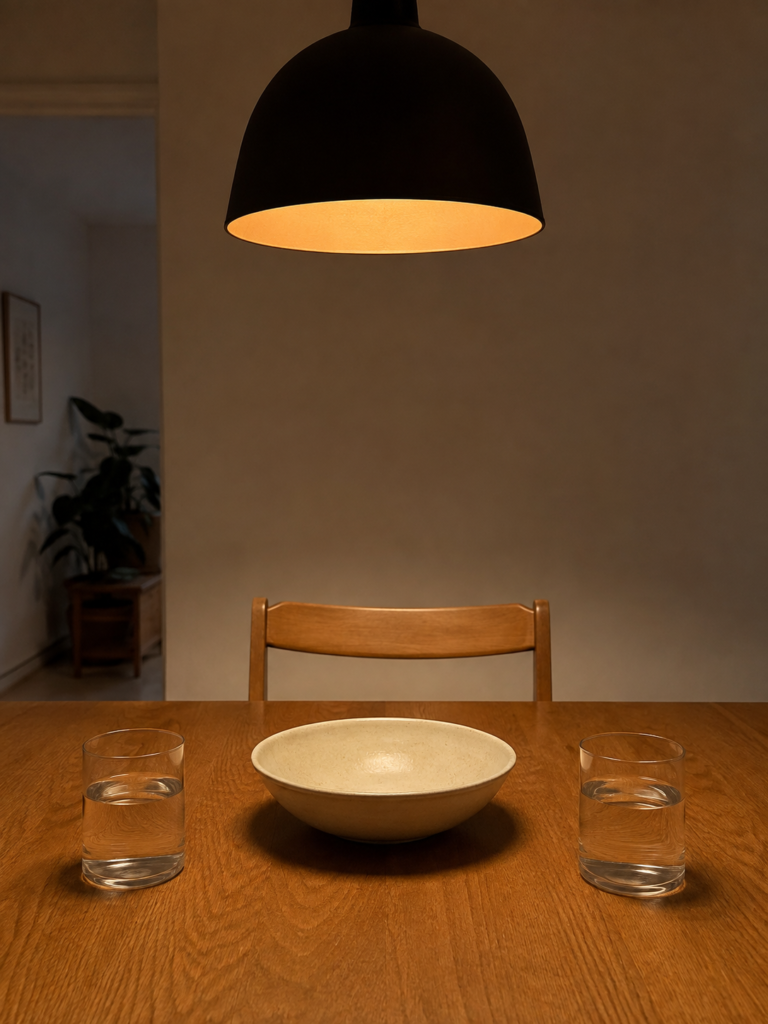
This is the closest you can get to a normal ceiling light without an electrician. A pendant on a plug in cord kit hangs from a hook screwed into the ceiling above the table, and the cord runs from there to a wall outlet.
Two details make or break it.
The first is the anchor. Find a joist with a stud finder and screw the hook into it if you can. If the hook has to go into drywall or plaster on its own, use a toggle style anchor rated well above the weight of the fixture, and check the rating printed on the packaging rather than guessing. Most plug in pendants are light, but the hook is holding something above people’s heads at a table, so there is no reason to be casual about it.
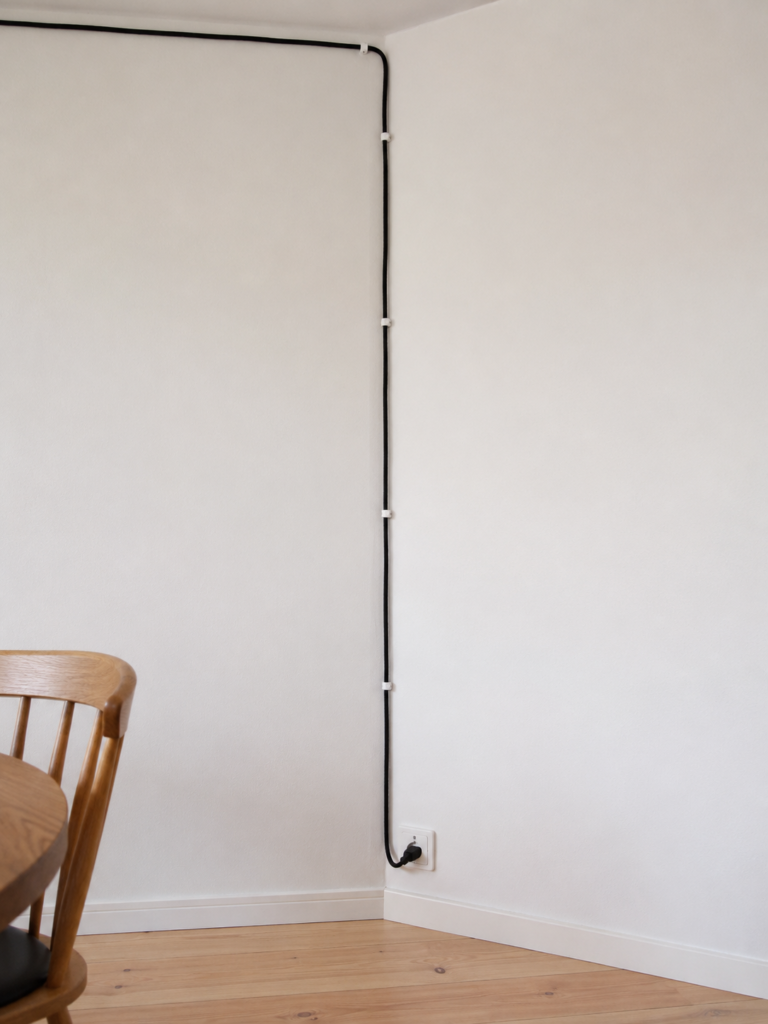
The second is the cord path. A cord that crosses the room diagonally from the pendant to the far wall will be at head height for anyone standing up, and it will catch. Use a second hook at the wall corner so the cord goes up, across the ceiling line, then straight down the corner seam. That path is nearly invisible once it is clipped, and nobody walks into it.
If your room does have a ceiling box but it sits over empty floor instead of over the table, you can swag from the existing fixture instead of adding a plug. Same hooks, same principle, no cord down the wall.
Put the light on the wall instead
If the table sits against a wall or in a corner, wall lights do the job with no ceiling work at all. Plug in sconces mount with two screws and plug into the nearest outlet. A swing arm wall light does something a sconce cannot: the arm extends, so the shade can hover over the edge of the table rather than just glowing behind it.
This is the option most people overlook in open plan rooms, where the table often sits at the end of a run of cabinets or against a half wall. It is also the friendliest choice for anyone furnishing gradually, since the same fixture moves to a bedside or a reading chair later.
The trade-off is honest: wall lights illuminate one side of a table more than the other. Pair them, or add a second small light source across the room, and the imbalance stops registering.
Use the furniture beside the table
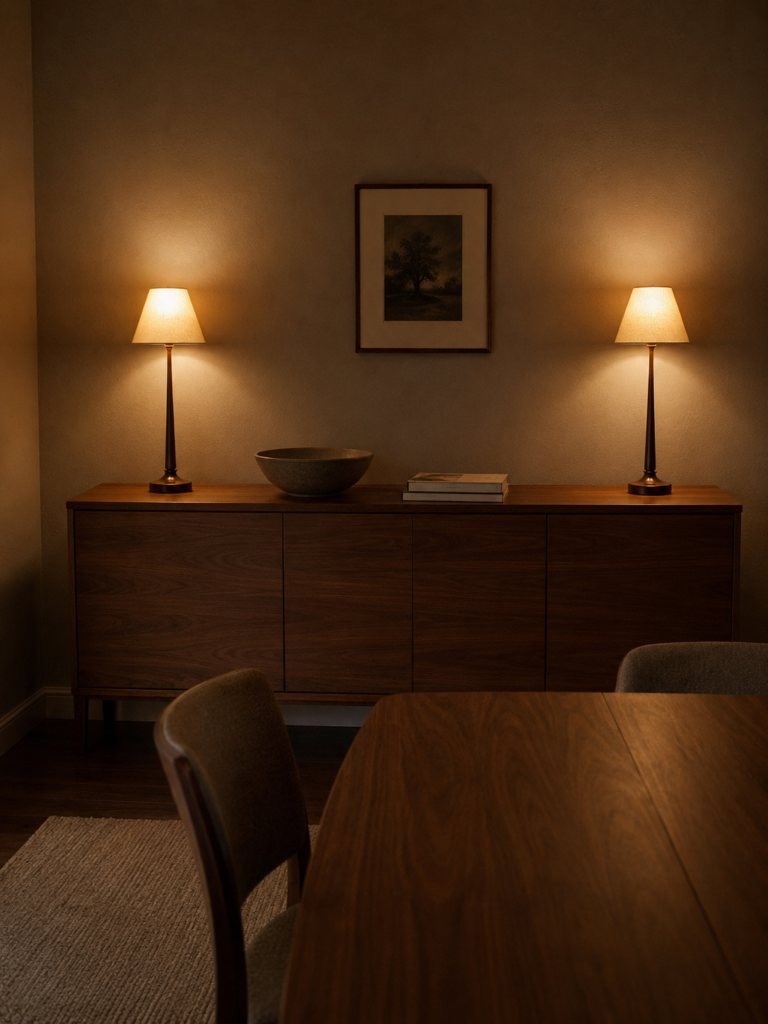
A pair of lamps on a sideboard, a console or a nearby shelf will not put light on the tabletop, but they will make the room usable and pleasant at night, and they take about four minutes to set up. Buffet lamps are made for this: tall, narrow and unlikely to crowd a serving surface.
Rechargeable cordless table lamps have become a reasonable third option here. A small one can sit on the table itself, which is the only realistic way to get light directly onto the tabletop with no cord anywhere. They are dim compared with a pendant, so treat them as atmosphere plus a little task light rather than the main event.
If your dining area is compact and every surface is already working hard, the layout tips in our small dining room decor ideas guide will help you find a spot for a lamp that does not cost you elbow room.
Run the cord where it belongs
This is the part that gets treated as a styling question and should not be.
Keep the cord out of the walking route. The National Institute on Aging’s room by room advice for preventing falls at home is blunt about it: keep electrical cords near walls and away from walking paths, and make sure any carpet is fixed firmly to the floor. A dining room is a room where people walk backward carrying hot dishes, so this matters more here than in most rooms.
Never tuck the cord under the dining rug. It is the first idea everyone has and it is the wrong one, because a covered cord cannot shed heat and foot traffic damages it out of sight.
Be careful about adding an extension cord to close a gap. The Electrical Safety Foundation International’s extension cord safety guidance is clear that an extension cord is a temporary solution rather than a long term extension of a home’s wiring, that cords should not be run through walls, doorways, ceilings or floors where heat cannot escape, and that leaning heavily on extension cords is a sign there are too few outlets in the room. It also recommends buying only cords approved by an independent testing laboratory such as UL, ETL or CSA. If the only way to make your plan work is a permanent extension cord across the room, the real fix is having an electrician add an outlet where you need one.
Adhesive cord clips work well on smooth painted surfaces. Test one in a hidden spot first and take them off slowly with a warm hairdryer rather than pulling, which is the same principle behind the reversible changes in our kitchen decor ideas for renters.
Hanging height, brightness and bulb color
Once you have picked an option, three settings decide whether it feels right.
Height.
For a hanging fixture, the widely used starting range is 30 to 36 inches from the tabletop to the bottom of the fixture with an 8 foot ceiling, adding roughly 3 inches for each additional foot of ceiling. Our guide to dining room decor ideas that start with measurements goes into the sizing in more detail. Whatever number you land on, sit in the far chair afterward and look across the table. If you are looking straight into a bulb, or you cannot see the person opposite, adjust it before you clip the cord down.
Brightness.
Bulb packaging lists brightness in lumens rather than watts. ENERGY STAR’s reference on light bulb brightness gives the translation: a bulb equivalent to an old 60 watt incandescent puts out around 800 lumens, a 75 watt equivalent around 1,100 and a 100 watt equivalent around 1,600. One 800 lumen bulb over a dining table is usually enough to eat by and not enough to light the room, which is exactly why a second, smaller light somewhere else in the room makes such a difference.
Color and dimming.
Warm light flatters food and skin. ENERGY STAR notes that products made to match the yellowish color of incandescent bulbs sit in the 2200 to 3000K range, with whiter light around 3500 to 4100K and bluer light higher again. Stay at the warm end for a table. The same source points out that not every LED works with every dimmer and that certified lights maintain lists of compatible dimmers, so if you want to dim a plug in setup, either use an inline cord dimmer the bulb maker lists as compatible or use a dimmable smart bulb and skip the hardware question altogether. Mismatched pairings are the usual cause of flicker and buzz.
Mistakes worth avoiding
- Hanging a fixture from a hook that only grips drywall. Find a joist or use a rated anchor.
- Running the cord under the rug so it does not show.
- Buying a cord kit without measuring the real path first, then discovering it is two feet short.
- Centering the fixture on the room rather than on the table. In an open plan space these are almost never the same point.
- Relying on a permanent extension cord instead of repositioning the table or adding an outlet.
- Choosing an open bulb fixture that sits at seated eye level. Bare filament bulbs look lovely in photographs and are unpleasant to eat under.
- Treating one light as the whole answer. Two modest light sources beat one bright one in almost every dining room.
- Putting candles on the table as the main light source and forgetting they are open flames near napkins and dried arrangements. Use stable holders, keep them clear of anything that can burn and blow them out when you leave the room.
Before you buy, check these
- Measure the real cord path: table to ceiling, ceiling to wall, wall to outlet.
- Identify the ceiling material and locate a joist if you can.
- Confirm what your lease or building allows.
- Weigh the fixture against the anchor rating, not the other way around.
- Decide where the cord will run and whether that route crosses a walking path.
- Pick brightness in lumens, and pick warm color temperature.
- Sit down in the far chair and check the sightline before anything gets fixed permanently.
Frequently asked questions
Can I hang a chandelier if there is no ceiling box?
Yes, using a swag kit, but weight becomes the deciding factor rather than style. A heavy chandelier needs a hook screwed into a joist, and if you cannot locate one, pick a lighter fixture instead of a stronger looking hook. Chandeliers sold as plug in or swag models are usually built lighter for exactly this reason, so check the stated weight on the product page before you fall for one.
Is it safe to plug a pendant into an extension cord?
Treat it as a short term arrangement only. Extension cords are meant to be temporary rather than a stand in for household wiring, and a light that stays plugged in every evening for years is not temporary. If the outlet is genuinely out of reach, the durable answer is having a licensed electrician add one nearby.
What if my landlord will not let me put anything on the ceiling or walls?
Then you are choosing between an arc floor lamp, lamps on furniture and rechargeable table lamps. An arc lamp is the only one of the three that gets light directly above the tabletop, so it is usually the pick, but check where the base lands. It needs to sit outside the arc of a pulled out chair, not beside it.
How many lumens do I need over a dining table?
There is no single correct number, because it depends on ceiling height, wall color and how much other light the room gets. A practical approach is to start with a bulb equivalent to an old 60 or 75 watt incandescent over the table, add a second smaller light elsewhere in the room, then adjust. Dimmable bulbs make this much easier, since you can buy brighter than you think you need and turn it down.
Do rechargeable cordless lamps give enough light to eat by?
For one small table, often yes, especially two of them. For a table seating six, no. They are best used as a supplement to a pendant or wall light, or as the atmosphere layer in a room that already has some light from a nearby kitchen or hallway.
Will a swag hook leave damage when I move out?
A single hook leaves a hole roughly the size of the anchor, which fills and touches up easily. Toggle anchors leave a bigger hole than screw in hooks, so use the smallest one that safely carries the weight, and keep the original ceiling paint color noted somewhere so you can patch it without guessing.
Where to start
Measure the path from your table to the nearest outlet, then look up and work out what your ceiling is made of. Those two answers will usually leave you with one obvious option and one backup, which is a much easier place to shop from than a page of pendant photos. Do the sitting down sightline check before you fix anything permanently, and you will not have to redo it.