Dining Room Decor Ideas That Start With Measurements

Most dining room regrets are not style problems. They are spacing problems — a table two sizes too big for the room, a rug that stops exactly where the chairs need to go, a pendant hung by eye that now sits in the sightline of whoever gets the far seat. Those are the mistakes that cost money twice, because fixing them means returning furniture rather than swapping a cushion.
This guide runs through dining room decisions in the order that prevents rework: clearances first, then the three anchor pieces, then storage, walls and the table itself. It also covers two safety details that decorating articles routinely skip, and a couple of pieces of received wisdom that do not survive scrutiny.
Settle the clearances before you settle on a style
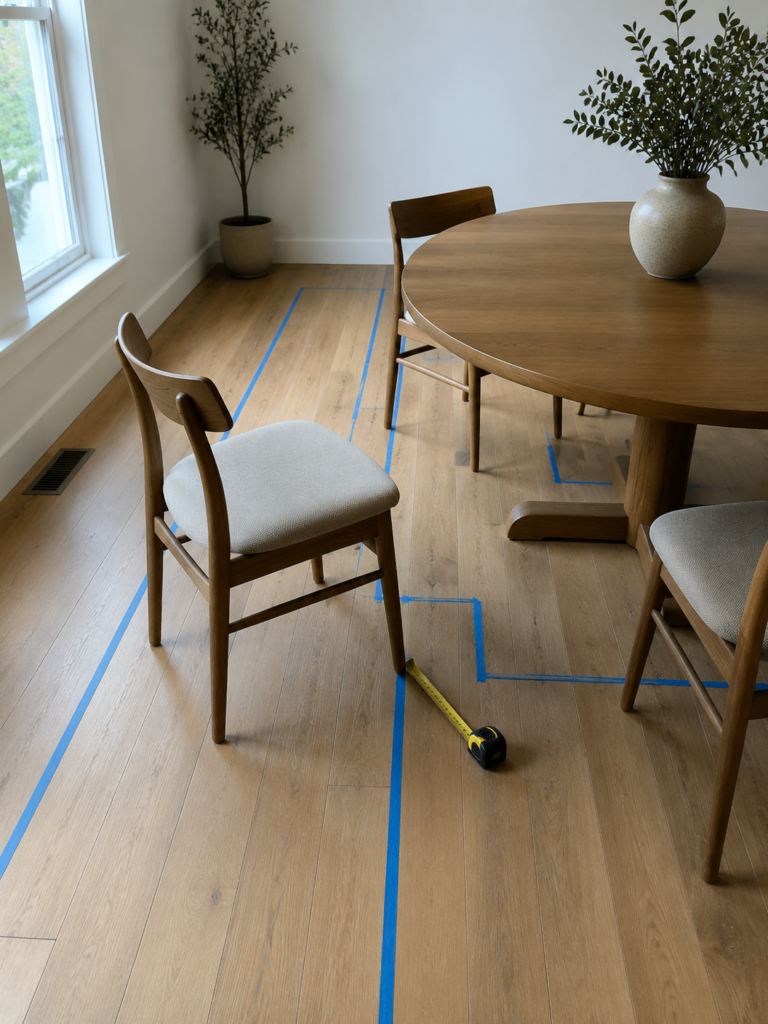
Before you look at a single table, mark the floor. Painter’s tape and a tape measure will tell you more in ten minutes than an afternoon of scrolling.
The working convention in the furniture trade is at least 36 inches (91 cm) between the table edge and the nearest wall, sideboard or door swing — enough for a chair to slide back and for a person to stand up. Where people regularly walk behind someone who is seated, that stretches to 42–48 inches (107–122 cm). These are conventions rather than codes, but there is a useful sanity check behind the first number: in public buildings, the accessibility standards set a minimum clear width of 36 inches for walking surfaces. Your dining room is not a public corridor, but that figure is roughly what one adult needs to pass comfortably, and it is a sensible floor to design to.
| Where you’re measuring | Tight but workable | Comfortable |
|---|---|---|
| Table edge to wall, sideboard or door swing | 36 in (91 cm) | 42 in (107 cm) |
| Behind a seated diner on a main walking route | 42 in (107 cm) | 48 in (122 cm) |
| Table edge allowed per person | 18 in (46 cm) | 24 in (61 cm) |
| Rug extending past the table edge, all sides | 24 in (61 cm) | 30–36 in (76–91 cm) |
Two things that catch people out: chairs with arms need noticeably more table edge than the 24-inch figure suggests, and a table that “seats eight” in a catalogue photo is often seating eight people who have no elbows and nothing to pass. Count the seats you use weekly, not the seats you use twice a year, and solve the twice-a-year problem with an extension leaf or a folding chair.
If your room genuinely cannot give you 36 inches on every side, the trade-offs change — pushing one edge of the table against a wall, or switching to a round pedestal table, buys back more than most decorative fixes. The small dining room decor ideas guide covers that scenario in detail.
Size the rug to the pulled-out chair, not to the table
A dining rug has two jobs: define the zone, especially in an open-plan room, and absorb a decade of dropped forks. Both jobs fail if the rug is too small.
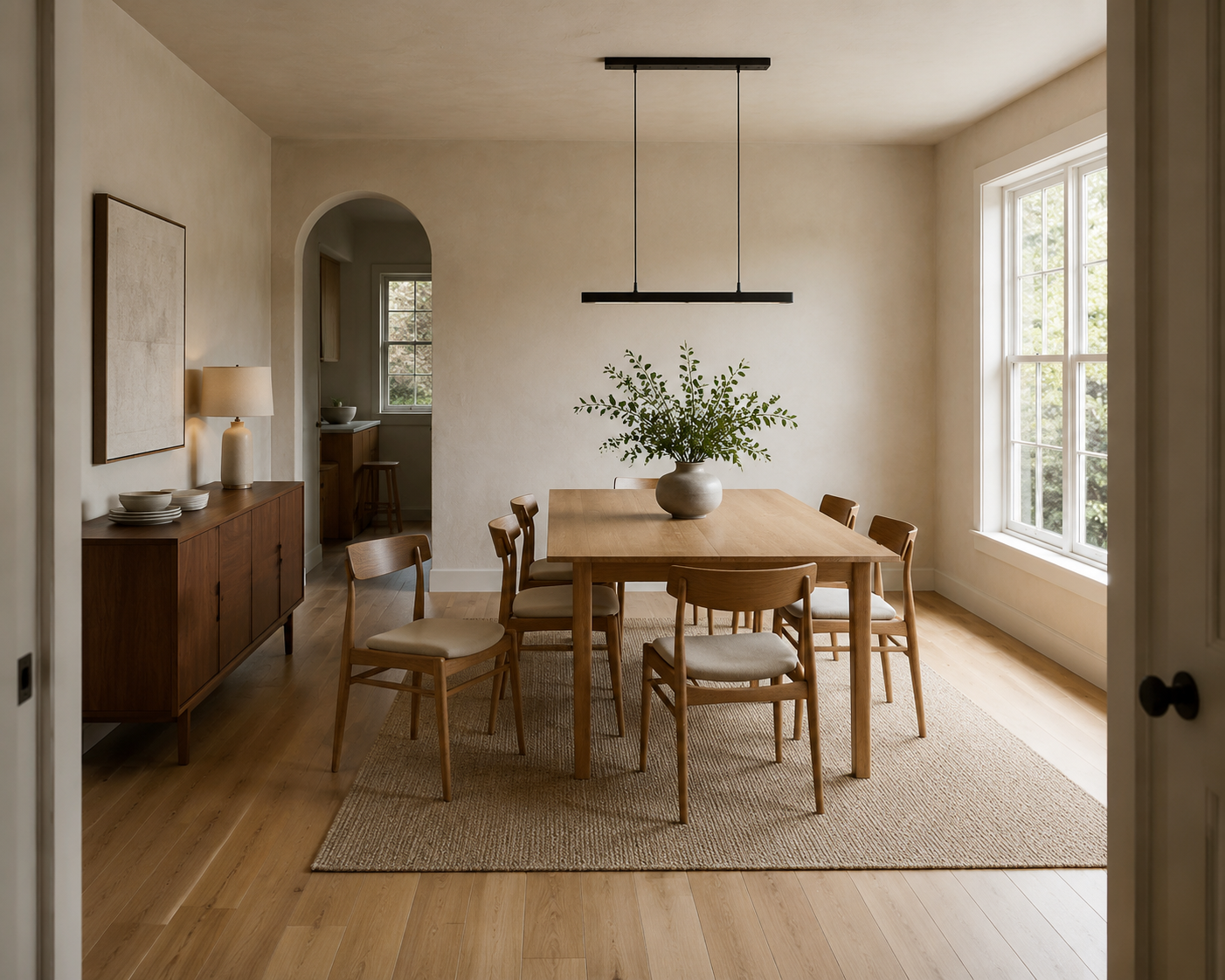
The measurement that matters is not the table’s footprint but how far your chairs travel when someone stands up — usually somewhere around 20–24 inches (51–61 cm). If the back legs land on bare floor, every single meal ends with a chair catching on the rug edge. Measure a chair’s real travel, add a margin, and buy up rather than down.
For material, a flat weave or low pile lets chairs slide and lets crumbs come out; deep pile in a dining room is a long-term regret. Mid-tone patterns hide more than pale solids. Wool wears beautifully and cleans well but costs more; a washable polypropylene rug is the pragmatic choice under small children.
There is also a legitimate case for no rug at all. Under a table used daily by toddlers, a bare floor you can wipe often beats a textile you have to shampoo.
Hang the light over the table, not over the room
Two mistakes account for most bad dining lighting.
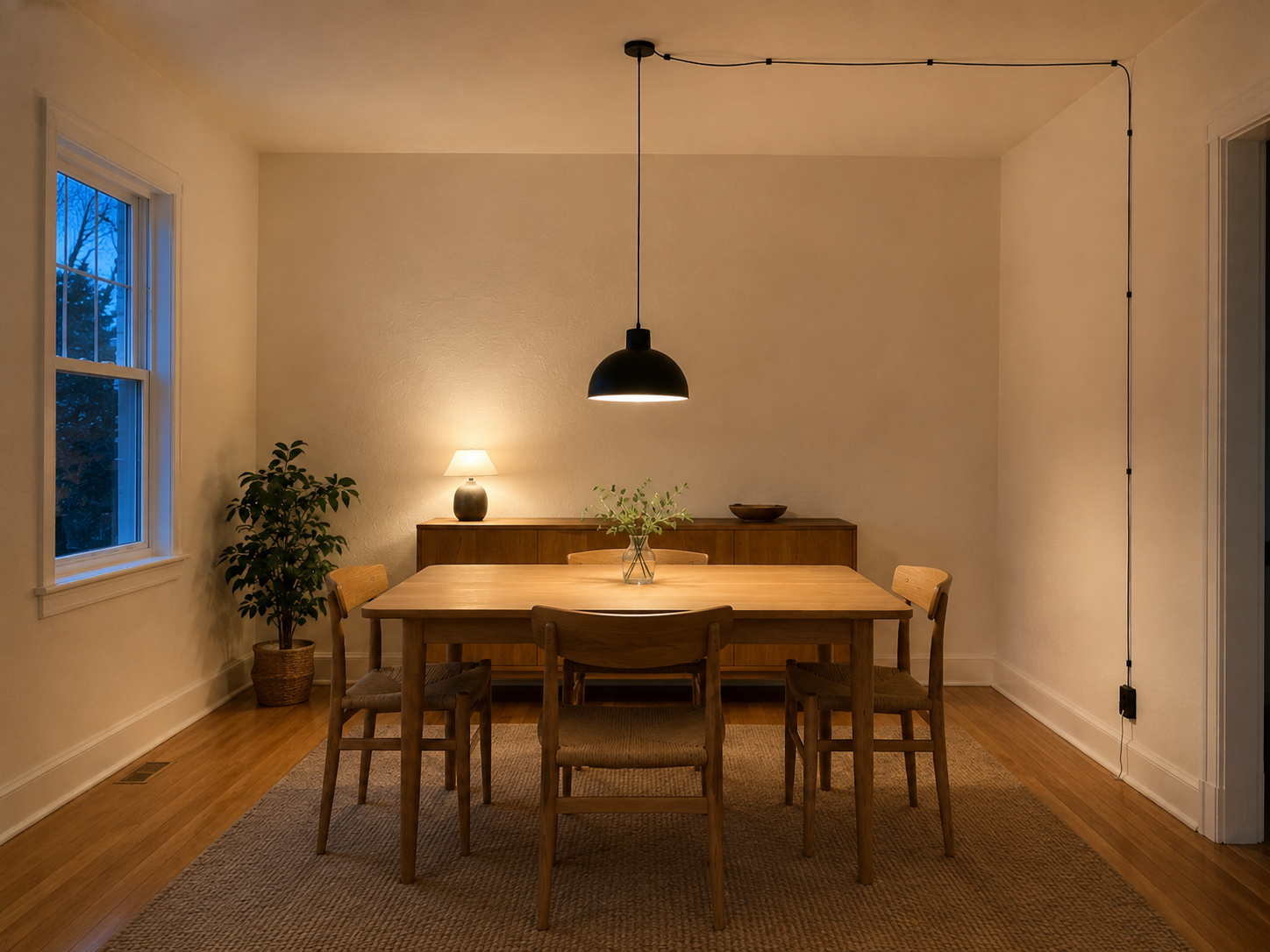
The first is centring the fixture on the room. In an open-plan space the table almost never sits at the room’s geometric center, and a pendant hung over that center will look permanently, unfixably wrong. Center it on the table. If the existing ceiling box is in the wrong place, a cord swag hook, a plug-in pendant or a wall-mounted swing-arm light will solve it for a fraction of the cost of moving wiring — which is also the practical route if you rent, in the same spirit as these kitchen decor ideas for renters.
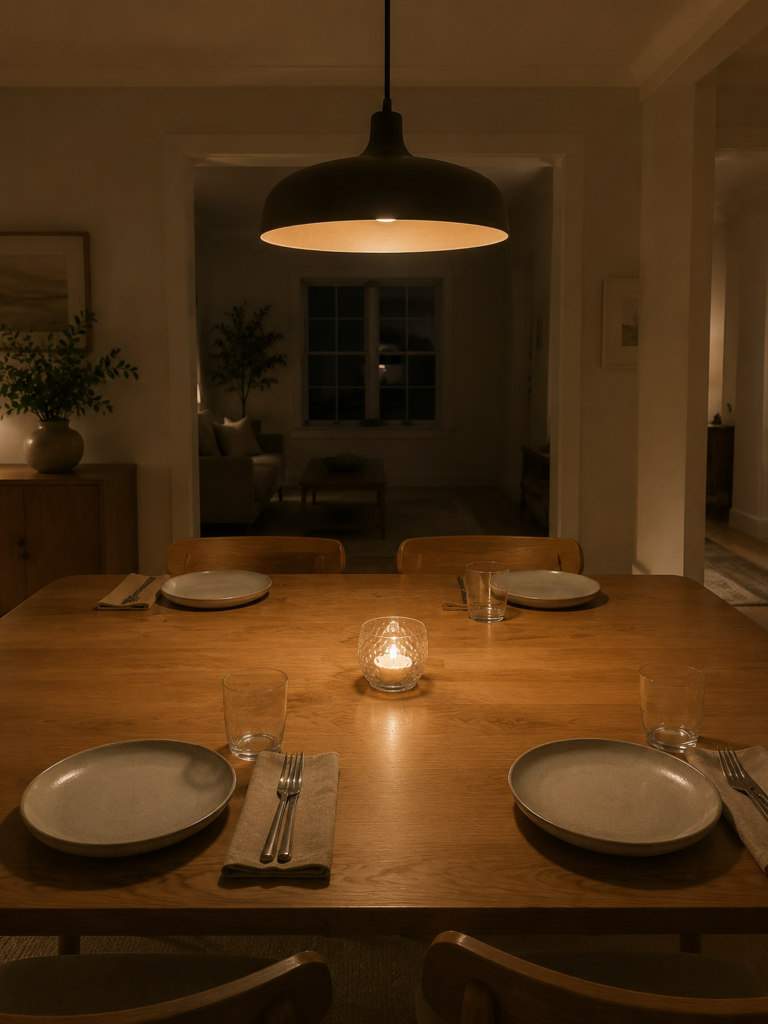
The second is hanging by eye while standing up. The widely used trade guideline is 30–36 inches (76–91 cm) from the tabletop to the bottom of the fixture with an 8-foot ceiling, adding roughly 3 inches for each additional foot of ceiling height. Treat that as a starting range, then sit down in the far chair and look across the table. If you are looking into a bulb, or you cannot see the person opposite, the number is wrong for your fixture. As a proportion, a fixture roughly half to two-thirds of the table’s width usually reads correctly — narrow enough that nobody sets a serving dish into it, wide enough that it does not look like an afterthought.
Bulb choice matters more than fixture choice for how the room feels. Cooler, whiter light flattens food and skin tones. Most ENERGY STAR certified bulbs are made to match the warm color of incandescent bulbs, roughly 2200–3000K, with whiter light sitting around 3500–4100K — for a dining table, stay at the warm end. Put the fixture on a dimmer if you can. The US Department of Energy notes that dimmers and timers lower electricity use, and that controls need to be compatible with the bulbs you choose; pairing an LED with an incompatible dimmer is the usual cause of flicker and buzz. Lighting accounts for around 15% of an average home’s electricity use, and the same source puts typical household LED savings at roughly $225 a year.
One overhead fixture is rarely enough on its own. A small lamp on a sideboard does more for a room’s atmosphere at night than raising or lowering the pendant ever will.
Design for the people who will actually sit there
Dining rooms get used by grandparents, toddlers, pregnant guests and people with mobility aids, and small dimensional choices decide whether those people are comfortable or quietly excluded.
The accessibility standards written for public buildings are a useful home benchmark even though they do not apply to private houses. They put accessible dining surfaces between 28 and 34 inches above the floor, and call for at least 27 inches of clear knee height and 30 inches of width beneath the surface, with a clear floor space of 30 by 48 inches at the seat. Measure your candidate table against those figures before you buy.
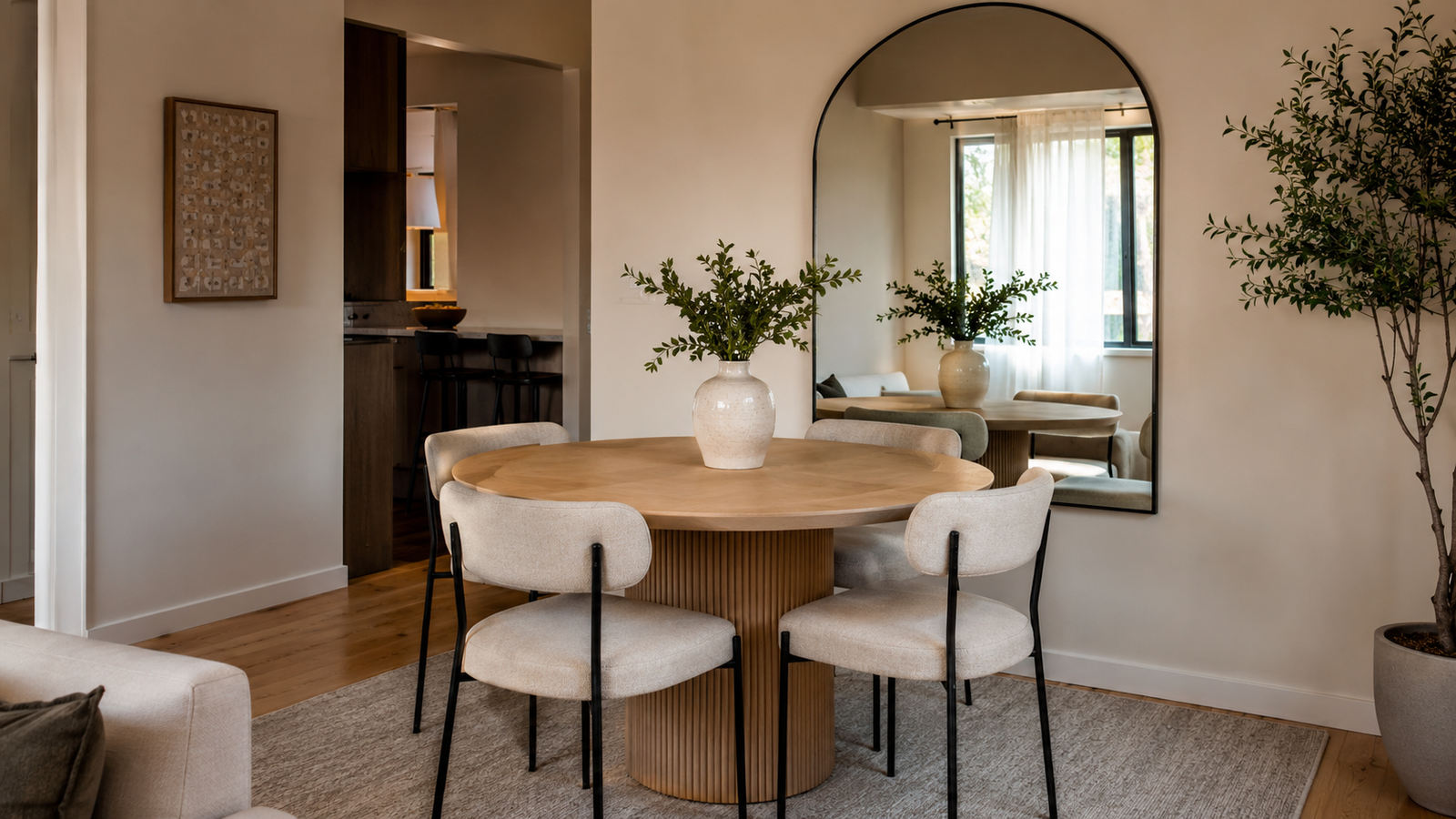
In practice this shapes real decisions. A deep apron beneath the tabletop is what catches knees and blocks armrests, so check apron depth, not just table height. A narrow central pedestal column can stop a wheelchair rolling under, while a trestle or a table with legs set at the corners often works better. Chairs light enough to move without dragging, with arms sturdy enough to push up from, matter more to an older guest than the fabric they are covered in. And rug edges near a chair are a trip point — either flat and gripped, or not there.
Choose storage before you choose accessories
Ask what the room actually has to hold. Table linens and serving pieces? School bags and post? Wine? A printer nobody wants to look at? The answer determines whether you need a closed sideboard, an open shelf, or a bench with a lift-up lid.
Whatever you choose, its depth comes straight out of your clearance figure — measure the piece, not the wall, and re-check the gap to the table edge before you commit. Closed storage is for the things you do not want to see. Open shelving is only for things you would be happy to dust, because you will be dusting them.
Treat the walls as backdrop, not gallery
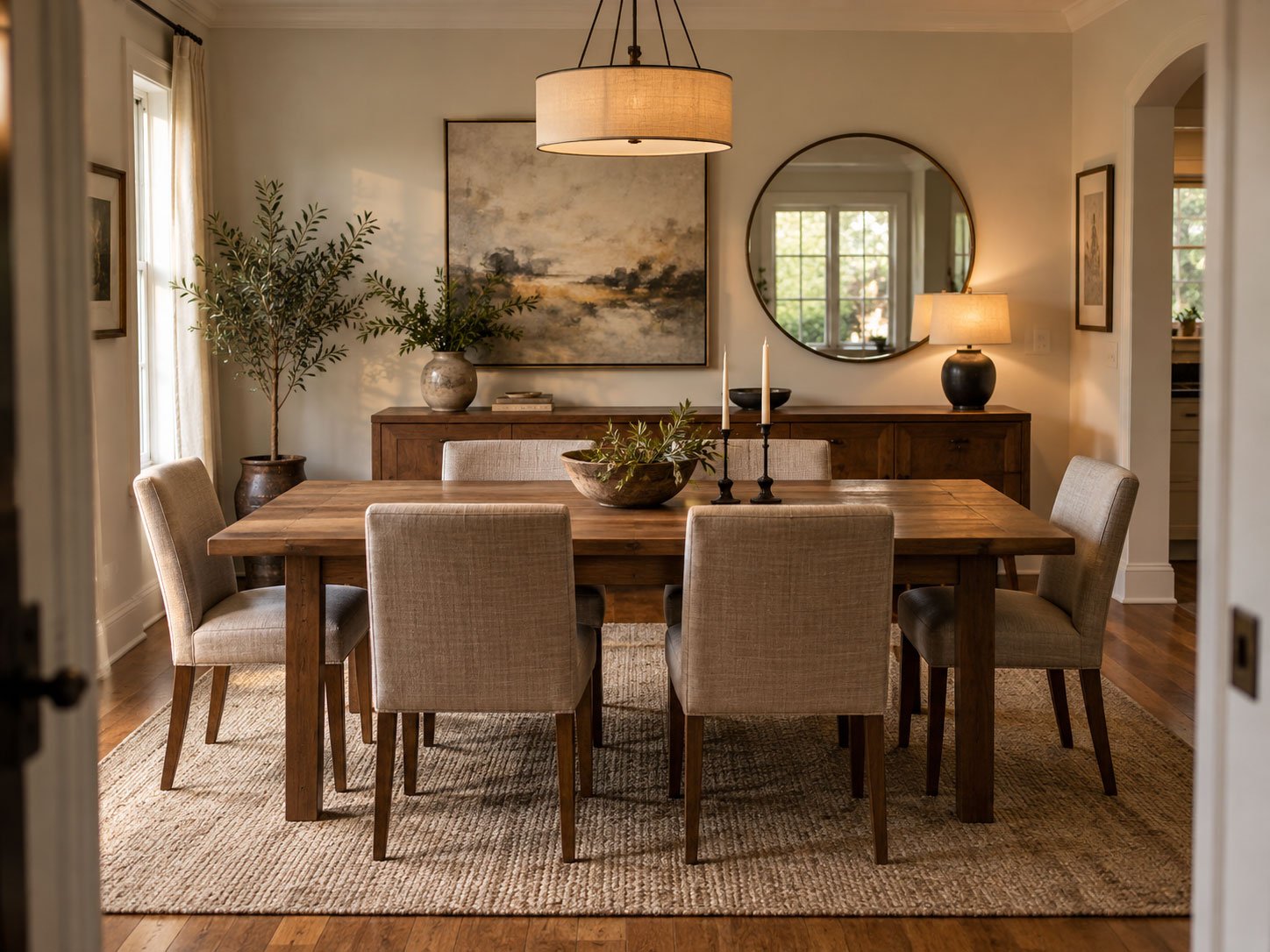
A common gallery convention centers artwork at around 57–60 inches (145–152 cm) from the floor, but in a dining room it is usually better to relate a piece to the furniture beneath it than to the wall as a whole. Leaving roughly 6–10 inches (15–25 cm) between the top of a sideboard and the bottom of a frame makes the two read as one group instead of two unrelated objects.
If you are hanging a mirror, look at what it will reflect before you drill. A mirror opposite a window earns its place; a mirror opposite a doorway into a cluttered hall does not.
One thing worth noticing: a room with a hard floor, a hard table and bare walls gets loud, and a loud room is one people leave quickly after eating. Curtains, upholstered seat pads and a rug all take the edge off. The same layering logic applies next door, which is why so many cozy living room ideas start with textiles rather than furniture.
Keep the tabletop usable
A centerpiece that blocks conversation gets moved to the floor every time you eat, which means it is not really decor. Either keep arrangements low enough to see over — under about 12 inches (30 cm) is the usual guide — or go tall and narrow so people see past the stem.
Candles are where dining room styling and fire safety collide most often, because the table is exactly where dried arrangements, paper napkins, greenery garlands and open flames end up within inches of one another. The US Fire Administration’s candle fire safety guidance notes that an average of 20 home candle fires are reported each day in the US, and advises keeping candles at least 12 inches from anything that can burn, using stable holders that will not tip, and blowing candles out when you leave the room. It also points out that battery-operated flameless candles now look, smell and feel close enough to the real thing to be worth considering for a table that gets left unattended mid-meal.
For linens, buy something you are willing to wash. A tablecloth too precious to use is decoration for a room you are not really living in.
Displayed dishware is not automatically serving dishware
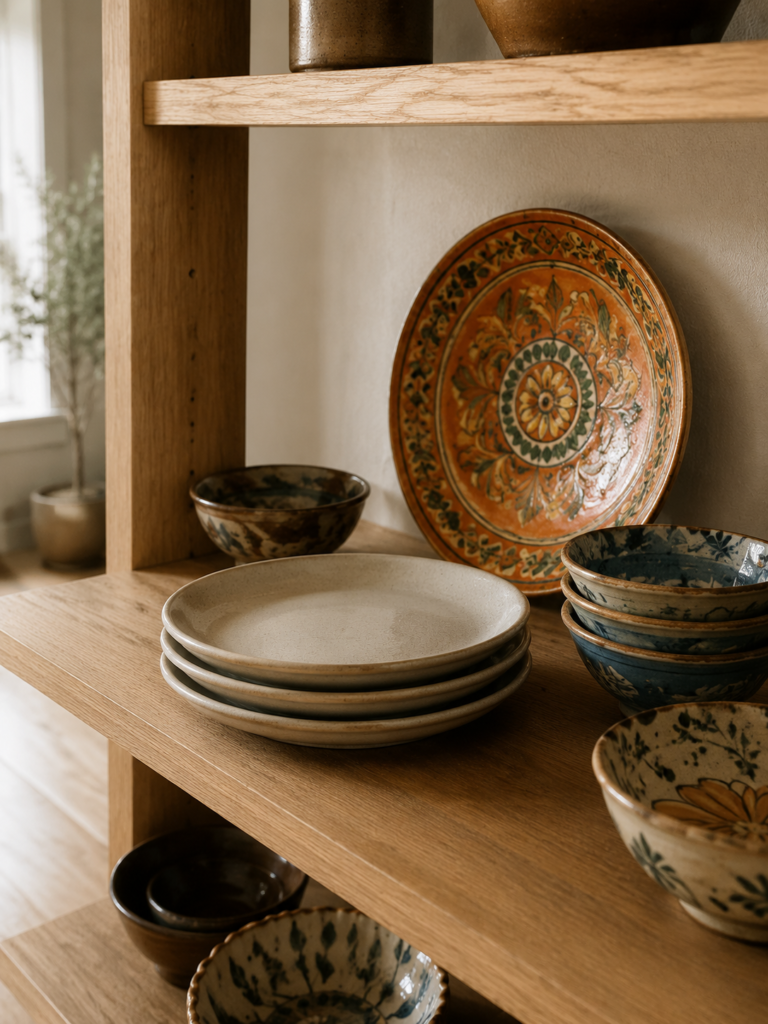
Styling a hutch or open shelf with thrifted, inherited or hand-thrown ceramics is one of the easiest ways to make a dining room feel personal. It is also where a real safety distinction gets blurred, because a plate that looks lovely on a shelf is not necessarily a plate you should eat from.
Lead can be present in the glazes or decorations on some ceramics, and if a piece was not fired properly, that lead can leach into food. The FDA’s guidance on which ceramics to treat with caution flags several “problem types”: pieces that are handmade with a crude or irregular appearance, antique pieces, anything damaged or heavily worn, items bought from flea markets or street vendors or from a maker you cannot identify, and pieces brightly decorated in orange, red or yellow, since lead has often been used to intensify those pigments. Some items made purely for display carry a stamped warning such as “Not for Food Use — May Poison Food.” Consumer lead test swabs are sold in hardware stores, and — importantly — no amount of washing or boiling removes lead from pottery. Commercially factory-made ceramics intended for everyday use are much less likely to be a problem.
The practical upshot for a dining room: display generously, serve selectively. Keep the brightly glazed flea market find upright at the back of the shelf, and put dinner on something whose provenance you know.
Two pieces of dining room advice worth retiring
“Plants will purify the air.” They almost certainly will not, at any density you would actually live with. A review published in the Journal of Exposure Science & Environmental Epidemiology analyzed 12 chamber studies and 196 experimental results and found a median single-plant clean air delivery rate of 0.023 m³/h — meaning you would need somewhere between 10 and 1,000 plants per square feet of floor space to match the removal that ordinary air exchange in a building already achieves. Keep plants in the dining room because they look good and soften a hard-edged room; that is a perfectly good reason, and it is the honest one. If you enjoy the effect, the same principle drives these ideas for using plants as decor elsewhere in the house. Just check that any species you bring home is safe around your pets.
“Everything should match.” A full matched suite — table, six chairs, sideboard, mirror, all in one finish from one collection — tends to read like a showroom floor rather than a room someone assembled. Repeating one or two elements does the same work with more life in it: the same metal on the light fixture and the chair legs, or the same wood tone on the table and the shelf, with everything else free to differ.
The order, in short
- Measure the room and tape out clearances.
- Choose the table that fits the taped outline, not the one that fits the wall.
- Choose seating, checking arm width and knee clearance against the table’s apron.
- Size the rug to the pulled-out chair.
- Place and hang the light over the table, then sit down and check the sightline.
- Add storage sized to the clearance you have left.
- Hang walls in relation to the furniture beneath them.
- Style the tabletop last, and keep it low enough to talk over.
The one thing worth doing this weekend, before buying anything: tape the outline of the table you are considering onto the floor, pull a chair back to where it would really sit, and walk behind it carrying a full plate. If that feels awkward now, no amount of decorating will fix it later.
Frequently Asked Questions
My dining table is in an open-plan living room. How do I stop it looking like furniture that just landed there?
Three things define a dining zone without walls: a rug sized to the pulled-out chairs, a light fixture centered on the table rather than on the room, and a piece of furniture — a sideboard, a bench, the back of a sofa — that gives the zone an edge. Keep the two areas related but not matched; repeating one material across both usually does more than matching finishes exactly.
Our table doubles as a desk and homework spot. Can it still look like a dining room?
Yes, as long as the storage is honest about it. The reason dual-purpose tables look cluttered is that the daily equipment has nowhere to go, so it never leaves the surface. A closed sideboard or a bench with a lid that holds laptops, chargers and school things means the table clears in under a minute. Also consider a dimmable fixture or a separate task lamp, since the light level that suits dinner is rarely the one that suits homework.
Is a rug in a dining room worth the maintenance?
It depends who eats there. A rug does real work — it defines the zone, softens the acoustics of a hard room, and stops chairs scraping. But under young children, a wipeable hard floor is genuinely easier, and a room can look finished without one if you bring in softness through curtains and seat pads instead. If you do want a rug, a flat weave in a mid-tone pattern is the version most likely to survive.
Can I use thrifted or inherited plates as everyday dinnerware?
Sometimes, but decide piece by piece rather than as a batch. The FDA singles out antique items, hand-thrown pieces of unknown origin, anything chipped or heavily worn, and brightly decorated orange, red or yellow surfaces as the ones to be cautious about, and notes that washing does not remove lead. Consumer test swabs are inexpensive if you want certainty on a piece you love. If a plate does not pass that test, it can still live happily on a shelf.