What to put above a kitchen sink with no window

The wall above a kitchen sink with no window tends to stay empty for years. It is not that people run out of ideas. It is that the ideas do not fit. The gap is narrower than a normal wall, a faucet sits in front of it, and anything you hang there gets splashed two or three times a day.
Here is the short version. Measure the space first, find out how far the water actually reaches, then choose. In that order. Most advice on this starts with a list of pretty things, which is how you end up with a wood sign that cups at the edges by spring or a shelf you clip with your elbow every time you rinse a pan. Once you know the width, the height and the wet line, the list of things that work is short and easy to shop for.
Start with three measurements
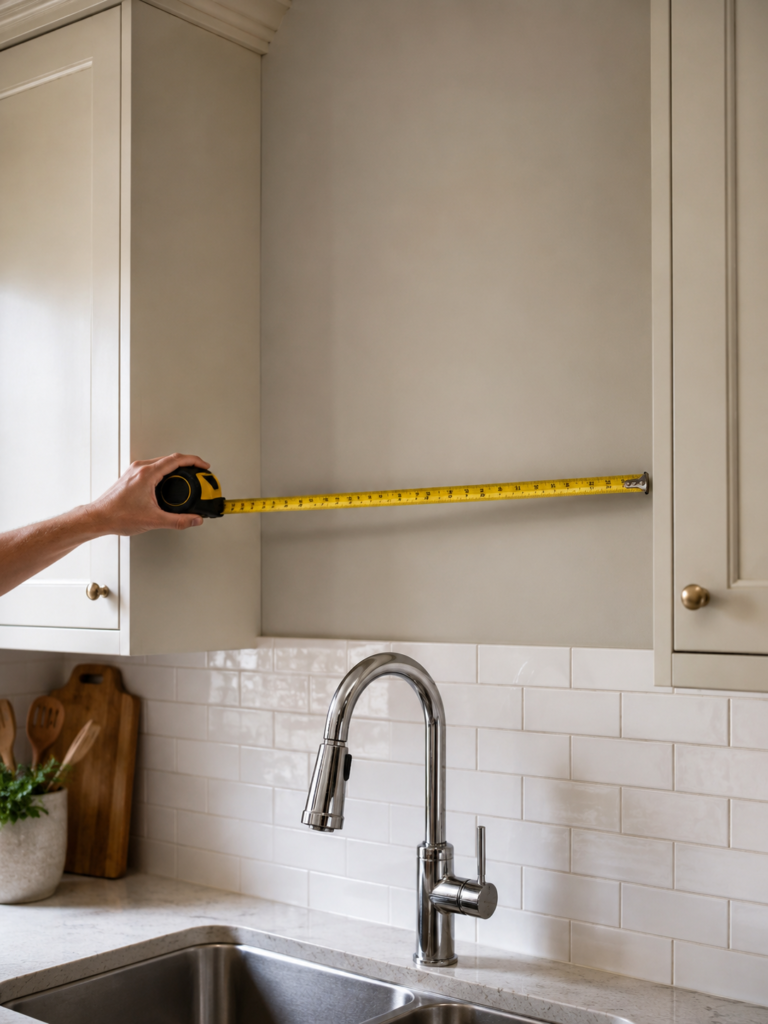
Take these before you look at a single product listing.
Usable width. Measure between the cabinet boxes or trim at the narrowest point, not the widest. If a cabinet has a decorative side panel that steps out, that panel is your edge.
Usable height. Measure from the top of the backsplash, or from the countertop if there is no backsplash, up to the underside of the upper cabinets or to the ceiling. Kitchens vary more than people expect here. The distance between countertop and upper cabinets is often around eighteen inches, but yours may be shorter or considerably taller, which is exactly why the number matters more than the average.
Faucet clearance. This is the one people skip. Pull the faucet up to its full height, swing the spout across its whole arc, and pull out the sprayer if you have one. Note where the top of the faucet lands against the wall. Anything you hang has to clear that point, not the resting position.
While you are there, think about depth. Hold a cereal box flat against the wall and stand at the sink as if you are washing a roasting pan. If your forearm hits the box, a shelf that deep will annoy you daily.
Find the wet line before you hang anything
Splash reaches further than most people think, and it does not travel evenly. A deep sink with a low faucet throws very little. A shallow bowl with a tall gooseneck faucet throws a lot, especially when the water hits the back of a wide pan.
There is an easy way to find out. Wipe the wall dry, tape a strip of plain paper to it running from the top of the backsplash upward, then wash dishes normally for a day. Look at where the last spots land. That is your wet line. Anything hung below it needs to be a material you can wipe without thinking. Anything above it has an easier life.
Steam behaves differently from splash. It rises and settles as a thin film across the whole gap, and over months it picks up cooking grease along with it, which is why decor above a sink gets sticky rather than wet. Running the exhaust hood while you cook or wash up cuts down how much of that lands on the wall. The EPA’s guide to mold, moisture and your home recommends using an exhaust fan or opening a window when cooking or washing dishes, and notes that damp surfaces dried within twenty four to forty eight hours will usually not grow mold.
What actually survives above a sink
| Material | How it handles splashes and steam | Sensible use above a sink |
|---|---|---|
| Glazed ceramic and porcelain | Unaffected, wipes clean | Hanging plates, a tiled panel, small dishes on a ledge |
| Glass and mirror | Fine, shows water spots so it needs wiping | A mirror, or a print behind glass |
| Metal | Fine, may spot on brushed finishes | Rails, hooks, frames, a utensil rack |
| Sealed wood | Holds up above the wet line, less so below it | A ledge or shelf placed high |
| Unsealed wood, MDF and particleboard | Swells at the edges and does not recover | Better used elsewhere in the kitchen |
| Paper prints and unframed canvas | Warps, stains, attracts grease film | Only as a framed reproduction, hung high |
The framing point is worth being specific about. Library of Congress guidance on matting and framing works on paper is to hang framed pieces away from moisture and away from any location with a high risk of water, and to make sure the paper never touches the glass or acrylic in front of it. A kitchen sink wall is exactly the kind of spot that guidance is describing, so hang a reproduction you can replace rather than an original, a print with sentimental value or anything signed. The same logic Femorias applies to bathroom wall art that can handle humidity works here, with the added complication of airborne cooking grease.
Choose by the gap you have
A narrow gap between two cabinets
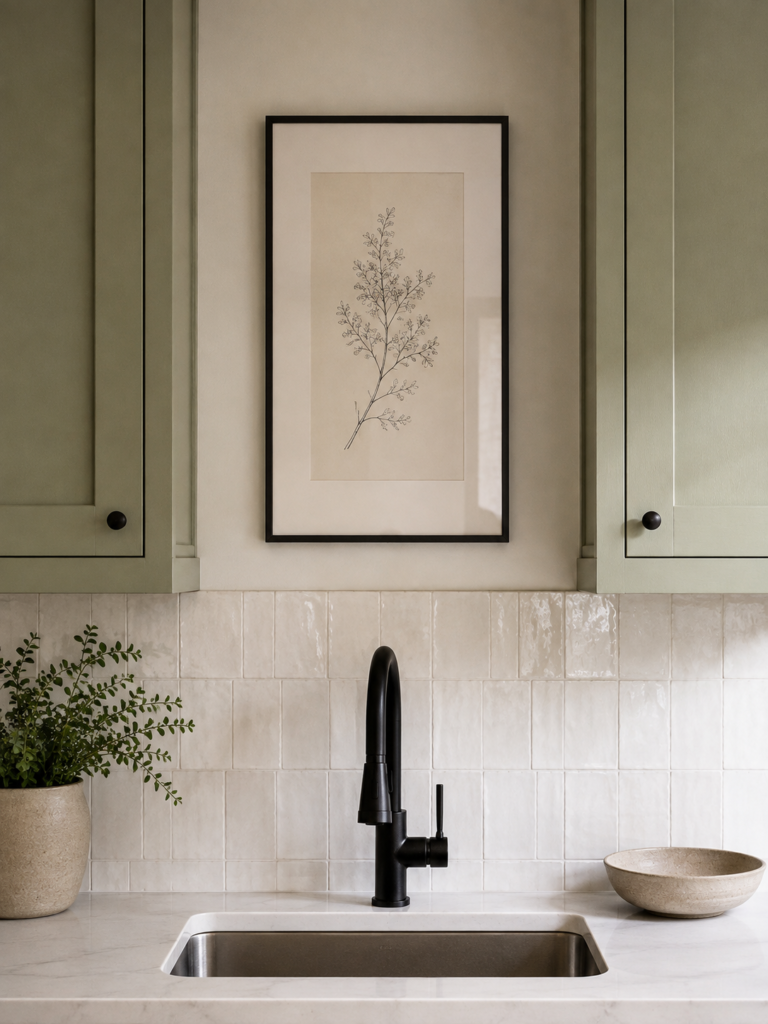
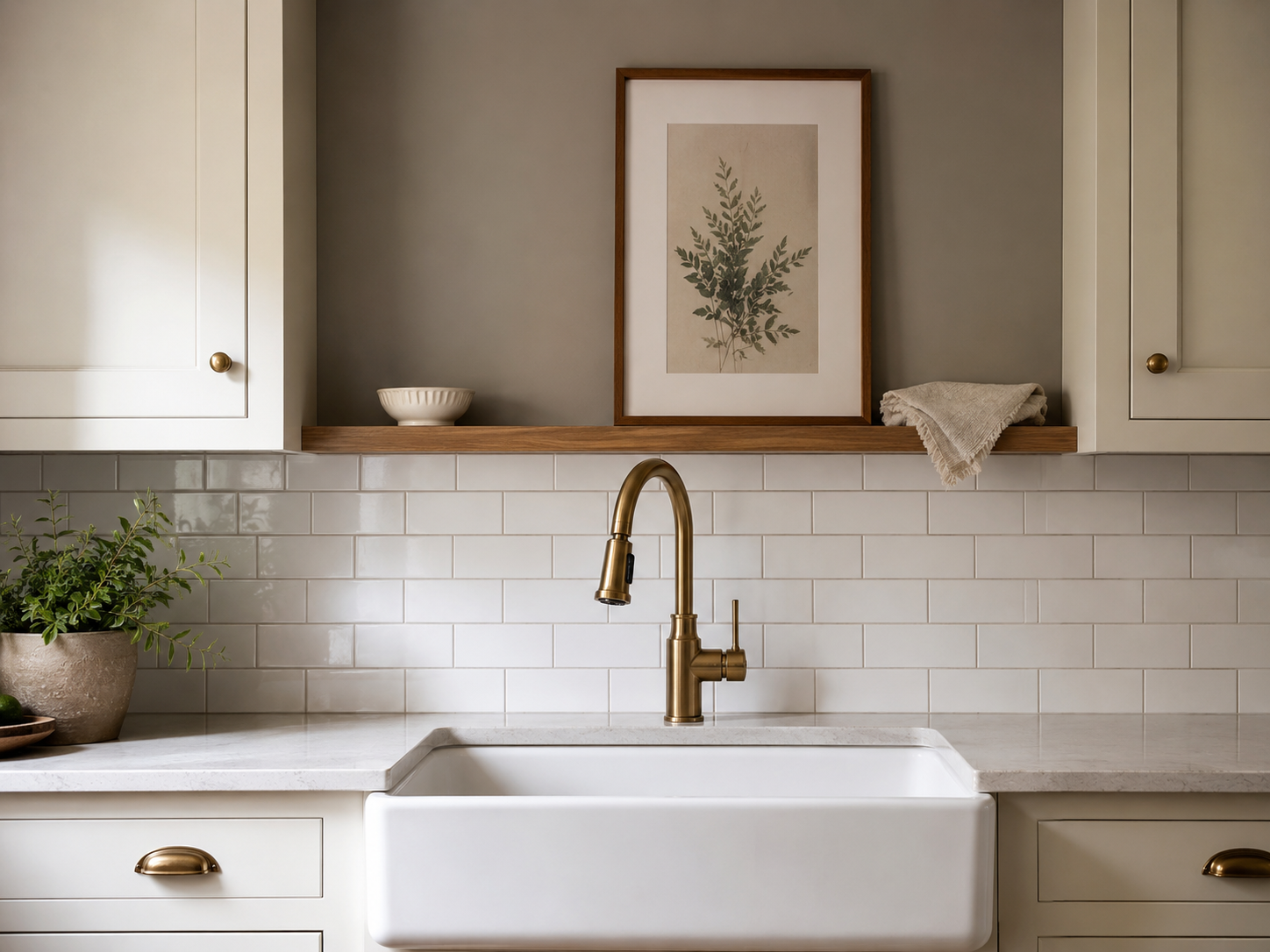
This is the most common version, and it is more forgiving than it looks. One piece usually beats several. A single vertical frame, a round mirror or a compact shelf reads as a decision, while three small objects read as filler.
Leave a couple of inches of bare wall on each side. Something wedged in from cabinet to cabinet makes the gap look smaller, not fuller. Aim to fill roughly two thirds of the width and let the wall do the rest.
Center the piece on the sink, not on the gap. Those two points are often an inch or two apart because sinks are not always centered under the cabinet run, and your eye follows the sink. This one adjustment fixes more sink walls than any product choice.
A full open wall with no cabinets over the sink
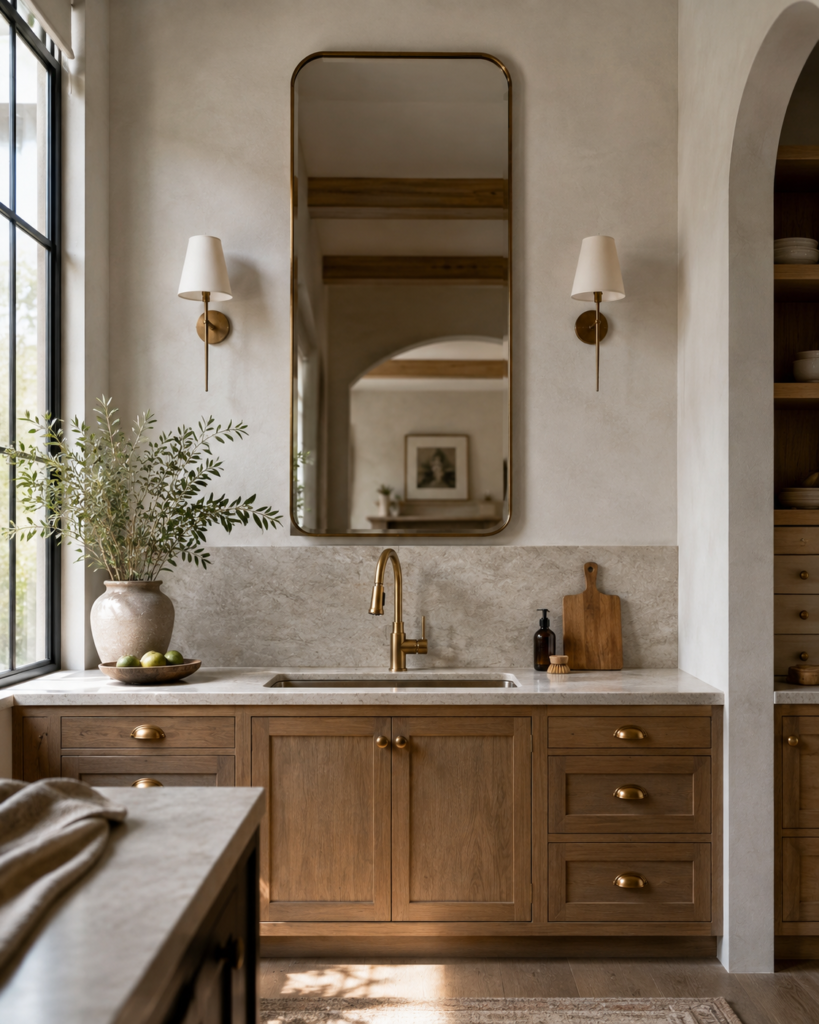
More height means more options, and also more ways to get the proportions wrong. A tall mirror, a pair of wall lights, a two shelf stack or one large piece all work. What does not work is a small item marooned in the middle of a big wall.
Keep the bottom edge above the faucet at full extension, then treat the space between the faucet and the ceiling as your canvas. If you are hanging two shelves, put the deeper one lower and the shallower one higher, so you can still get a stockpot under the tap.
A short strip above a tall backsplash
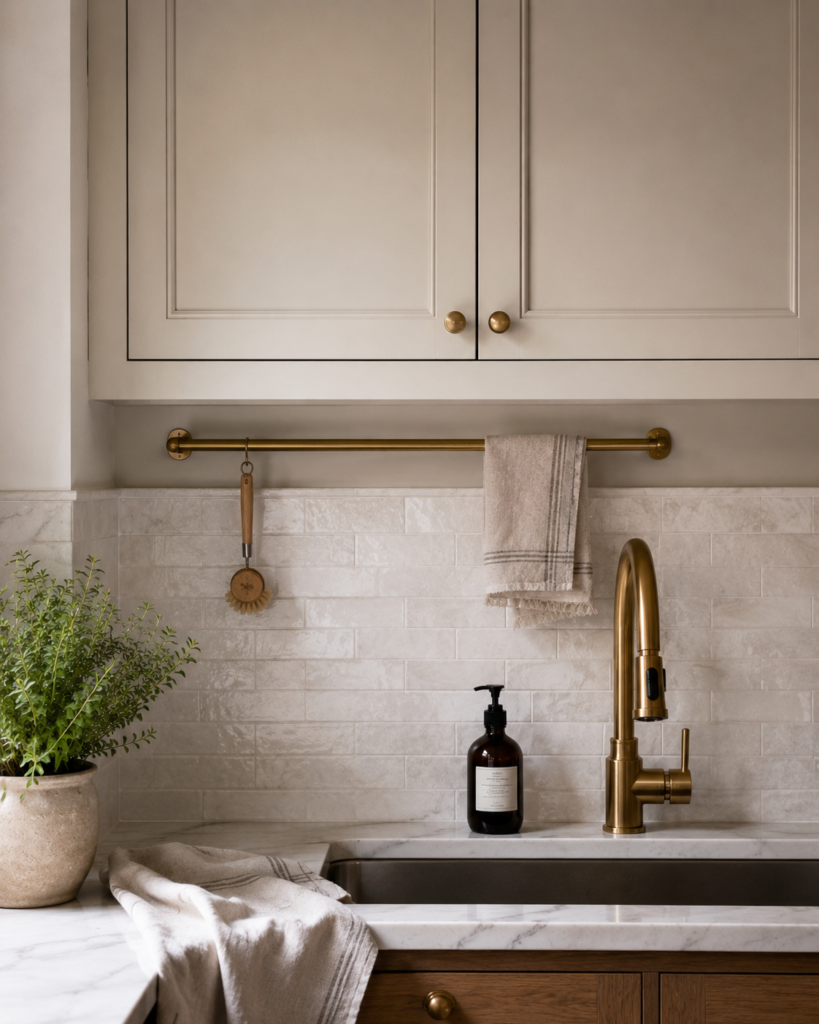
Sometimes there are only a few inches of paint between tile and cabinets. Hanging anything here fights the space. Better options are a slim rail with hooks for a dish brush and a towel, a narrow picture ledge, or running the tile up to meet the cabinets so the strip disappears.
It is also fine to leave it. If the wall is short and the sink area is already busy, the honest answer is to put your effort into the faucet finish, a good soap dispenser and a folded linen towel, and let the wall stay quiet.
Light is often the better answer than decor
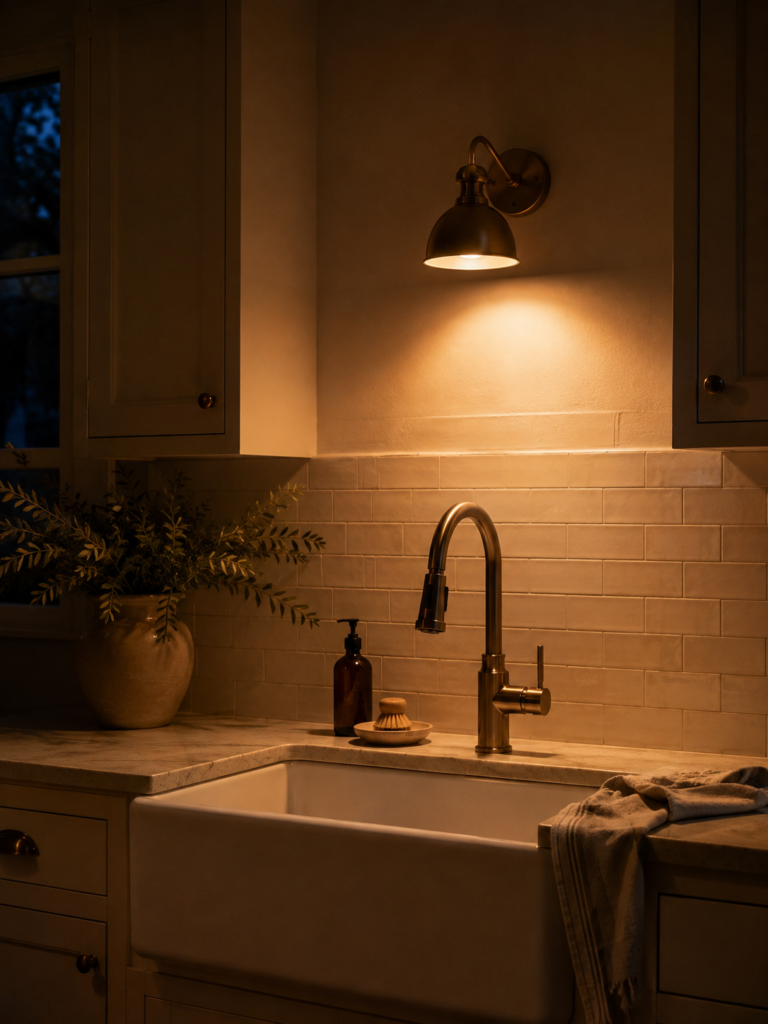
A sink wall with no window is usually a dark wall, and dark corners read as unfinished no matter what you hang in them. Adding light frequently does more than adding an object, and there are ways to do it without touching wiring.
A plug-in wall light with the cord run down and across to a countertop outlet works if you have somewhere sensible to route it. Rechargeable puck lights stuck under the front edge of the upper cabinets throw light down onto the sink and can be recharged in a few minutes. A small rechargeable lamp set to one side of the sink gives you a warm glow in the evening without any cord at all.
Keep all of it away from the water. Electrical Safety Foundation International’s kitchen safety guidance is to locate appliances away from the sink and to use ground fault circuit interrupter protection for countertop outlets, which are the ones you would be plugging a lamp into. Cord placement matters as much as fixture placement: run it behind objects and down to an outlet that is not directly beside the tap, using the same approach Femorias covers for lighting a dining table without a ceiling light. Anything hardwired, including a new switched fixture or a new outlet above the sink, is work for a licensed electrician.
Plants above a sink, honestly
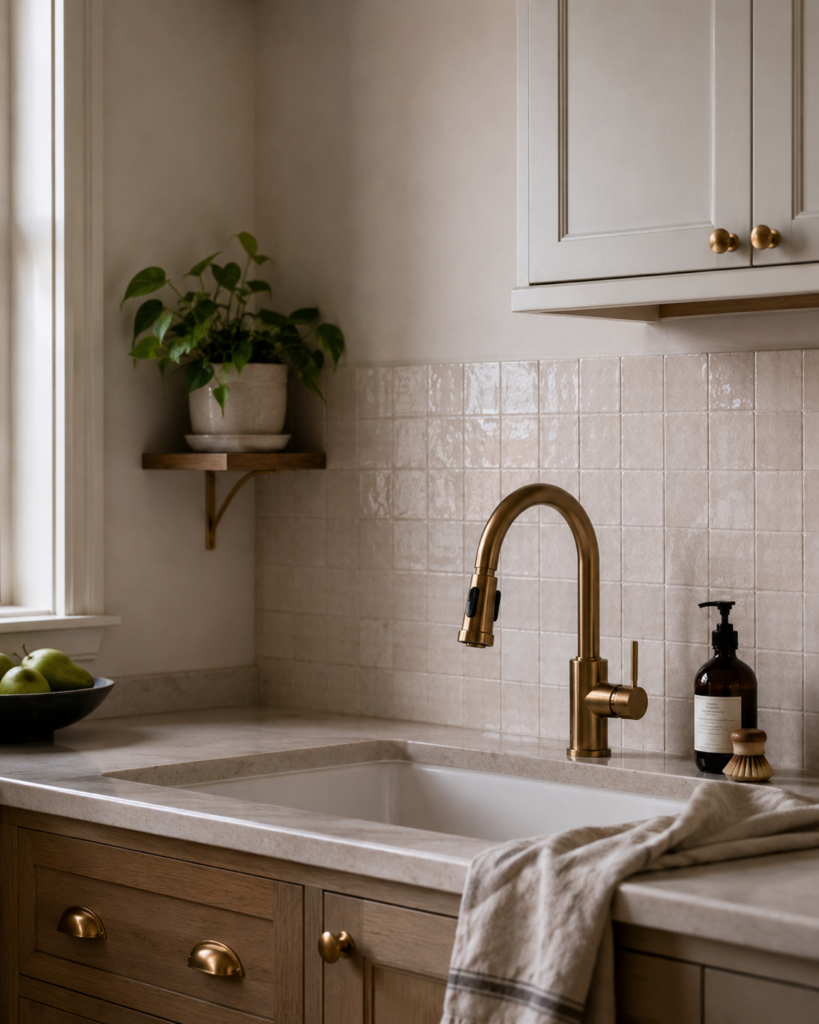
The humidity above a sink suits most houseplants. The light usually does not. A wall with no window is often the darkest spot in the kitchen, so a plant that needs bright light will stretch, drop leaves and look worse within a couple of months.
If you want greenery there, choose something that copes with low light, keep it on a shelf or a hook to one side rather than directly over the bowl, and use a pot with a saucer or a cachepot so drips do not sit on the counter. Pothos is the plant most often suggested for this spot, and it is easy to grow, but the ASPCA lists golden pothos as toxic to cats and dogs, causing mouth irritation, drooling and vomiting if chewed. If you have a cat who climbs counters, pick something else or contact your vet’s advice line before you buy.
A good faux plant is a reasonable choice in a genuinely dark spot. Just expect to wash it. Anything sitting in cooking steam picks up a film within a few months.
Hanging it without wrecking the wall or the tile
First work out what you are hanging on. Painted drywall, a tile backsplash and old plaster all behave differently, and the wall above a sink is often two of those stacked.
On tile, avoid drilling if you have any choice, because a cracked backsplash tile is a much bigger job than a hole in drywall. Adhesive picture strips work on clean, dry, smooth tile for lightweight pieces. Check the weight rating, then choose something well under it, wipe the tile with rubbing alcohol first and let it dry fully. Textured or matte tile and grout lines are where these fail.
On drywall, anything with weight needs a real anchor. A shelf that will hold ceramics needs to hit studs or use toggle anchors sized for the load, not the small plastic plugs that come in the box.
Renting changes the calculation rather than ending it. Removable fixings, tension mounted shelves and leaning a frame on a ledge all avoid holes, and the wider set of options is covered in the Femorias guide to kitchen decor ideas for renters.
Then check the height twice: bottom edge above your wet line, clear of the faucet at full extension, and clear of the cabinet doors as they swing open.
Mistakes worth avoiding
Hanging something irreplaceable. Original art, a family photo or anything signed belongs on a drier wall.
Filling the gap wall to wall. It compresses the space and makes the kitchen feel tighter.
Buying the piece before measuring the faucet. This is the single most common reason a purchase gets returned.
Putting a mirror up without checking the reflection. Stand at the sink and look straight ahead at the blank wall. Whatever is behind you is what the mirror will show, including the ceiling light, the top of the fridge and the counter opposite. If that view is not one you want doubled, a mirror is not the answer here.
Using a deep shelf. Anything projecting more than a few inches gets knocked while you rinse.
Choosing wood or MDF for the lowest position. Below the wet line, those materials go first.
A short checklist before you buy
- Usable width at the narrowest point
- Usable height from backsplash top to cabinet underside
- Faucet height at full extension, sprayer pulled out
- Wet line marked after a normal day of dishes
- Wall surface identified: drywall, tile or plaster
- Weight of the piece against the rating of the fixing
- Reflection checked, if you are considering a mirror
- Piece centered on the sink rather than the gap
Frequently asked questions
Is a mirror a good idea above a kitchen sink?
It works well when the reflection is worth having, which usually means a doorway, a lit room or a run of open space behind you. Mirrors bounce whatever light exists, which helps on a wall with no window. They also show every water spot, so expect to wipe one down about as often as you wipe the faucet.
How high should I hang something above the sink?
Above your wet line and above the faucet at full extension, whichever is higher. If the two leave you almost no room, the space is telling you to use a rail or a ledge rather than a hanging piece.
Can I put a shelf above the kitchen sink?
Yes, as long as it is shallow and properly fixed. Keep it under about five inches deep so it stays out of your way while you wash up, put it into studs or toggle anchors if it will hold ceramics, and store things there you use rather than things that only look good, since anything in that spot needs washing periodically anyway.
Should I install a faux window or a window style mirror?
A window mirror or a set of interior shutters can work when the wall is wide and the ceiling is high enough for the proportions to read correctly. On a narrow gap between cabinets it usually looks like a small mirror with extra frame. Measure first, then decide, and treat it as a design choice rather than a way to make the missing window less obvious.
Why does the wall above my sink feel damp or sticky?
That is steam settling and carrying cooking residue with it. Running the exhaust hood while cooking and washing up reduces it, as does wiping the wall down when you clean the backsplash. If the wall stays visibly damp long after dishes are done or you see any discoloration, that points to a moisture problem behind the surface rather than a decorating one, and it needs looking at before anything goes back on the wall.
Where to start
Take the three measurements and run the paper test this week. It takes a day and it eliminates most of what would have disappointed you. Then buy one piece rather than a set, hang it above the wet line and centered on the sink, and see how the wall reads for a fortnight before adding anything else.
If your kitchen has other spots that never quite got finished, the Femorias kitchen decor section covers more of them, including what to do when you cannot change a thing about the cabinets.